Sign Language: Single Women


DSC01716

It wasn’t that I was unaware that women here undergo a great deal of discrimination and denial of basic human rights. Its just that the label “single women” to me just meant unmarried.  I had noticed signs all around the city using  the “single women” term, but it was only when I became aware of  how shameful the word “widow” is in Nepal (and how difficult their lives are), that I began to understand how using the phrase “single women” had become a positive attempt at creating an all encompassing term for unmarried, widowed, separated and divorced women.

Through awareness raising and lobbying, womens’ groups are battling to achieve changes in discriminatory laws against single women.  Piece-by-piece that are making changes to the law, but there’s still a long way to go. Discrimination against widows here is deep-rooted, and I was also surprised to learn that it cuts across all castes, religions and categories of society.  A woman from an educated, middle-class family can still be as vulnerable as one from a poor, rural one.

However, things are slowly changing:  Now the law says that the property of deceased husband does not need to be returned after remarriage.  A widow no longer needs to be 35 years to inherit deceased husband’s property. Male consent is no longer required while acquiring a passport and citizenship.

Through the efforts of groups like Women for Human Rights, widows are increasingly aware of their rights and WHR works to increase their skills, and social and economic status.  Job creation programs teach women how to start their own businesses and learn to be financially independent.  I’m hopeful that things will change dramatically for the next generation of Nepali women, but sometimes — looking at the size and extent of the problem —that feels like a long way off.

DSC01719

Visting Godavari Knowledge Park


IMG_9434 - Copy

The Knowledge Park at Godavari

When I first learnt about a knowledge park in Godavari, about an 1.5 hours drive east of Kathmandu, I didn’t know what to expect. I think I thought it was some kind of interactive educational place, although in Nepal I wasn’t quite sure what that meant….

Turns out its a 30 hectare “educational farm” developed by the International Center for Integrated Mountain Development (ICIMOD) as a demonstration and testing site for sustainable farming in the Himalayas. With modern development and climate change threatening the livelihoods of so many rural communities throughout the Hindu-Kush area, ICIMOD tests different environmental farming methods and environmentally-sustainable agricultural practices.  That means Afghanistan, Bangladesh, Bhutan, China, India, Myanmar, and Pakistan,,, not just Nepal. The center serves as a resource for visiting groups from all over the region.

There’s lots to see, and in the short 1.5hrs that we were there, we only saw highlights, but I really enjoyed the tour. The park was well kept and groomed, with labels and information boards explaining what we were observing. We strolled through a variety of different areas including orchards, crop fields, greenhouses and a display of alternative energy. There are nursery gardens, pigeon roosts, chicken farming, angora rabbit raising, and composting areas. We also viewed mushroom farming, forest floor management programs, and the raising of unusual crops including medicinal herbs. Their training center runs classroom and practical training courses on the many different kind of practices they maintain, training trainers so they can back to their respective communities and build on the idea.

Here’s a few pictures of the different practices going on there.  I found it really interesting:

IMG_9416

Solar heaters like this can boil water in about 30 minutes, providing families with free fuel to cook their meals.

IMG_9405

Briquettes can be manufactured from paper, mulch and other organic matter, which are mixed with water, compressed, dried and used to make a pretty efficient source of fuel.

IMG_9409

Briquettes like the ones manufactured above can burn for 30-60 minutes which is enough time to cook a meal.  Not only are they another free source of energy, but their use means less wood burnt for everyday use, and helps prevent deforestation.

IMG_9413

Demonstrating a pedal-powered water pump for irrigation

IMG_9395

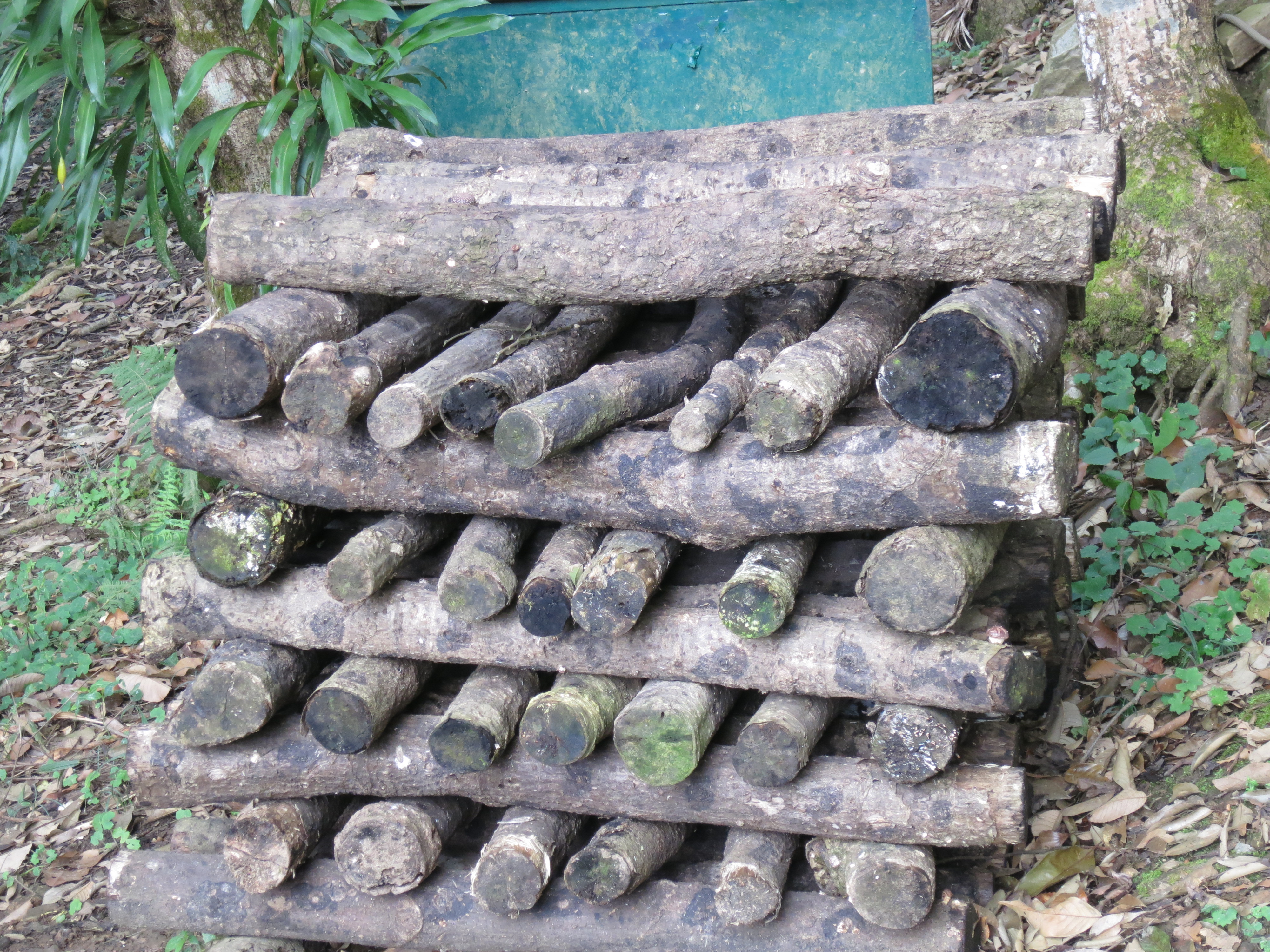
Forests in the park are maintained to keep them healthy, and the cut logs are injected with mushroom spores.  The logs produce mushrooms for several years.

IMG_9421

IMG_9399

And finally, a couple of pictures from the orchard. There’s probably something more I could say about what they were doing there, but I enjoyed being in a blossom-filled orchard so much that I wasn’t really reading the signs! A beautiful break from the dust and grey of the city….

IMG_9401

Pokhara: Last Stop!


As interesting as it was to visit Lumbini, it was a good feeling to drive out of the dust and heat, and slowly make our way up from south to north through Nepalese hill country. For about six hours we wound up and down hillsides on narrow roads, drove through small roadside small villages, and finally arrived in Pokhara in the late afternoon.

This was my fifth or sixth visit to the city and I wanted to try a new location away from the hustle and bustle of Lakeside. So I picked Maya Devi Resort on the north shore of Phewa lake. Its a quiet, undeveloped location with just the occasional paragliders who drop out of the sky on to the small beach and, unexpectedly, a very good Thai restaurant.

The resort is small and laid back, and specializes in parahawking, a unique type of paragliding.  The owner rescues birds of prey and trains them to lead paragliders to the best thermals, and the paragliders gets a very cool flight experience with a bird.

GE DIGITAL CAMERA

The little hut where we stayed

But we were just there for the relaxation and scenery. And made a few animal friends anyway:

GE DIGITAL CAMERA

DSC02375

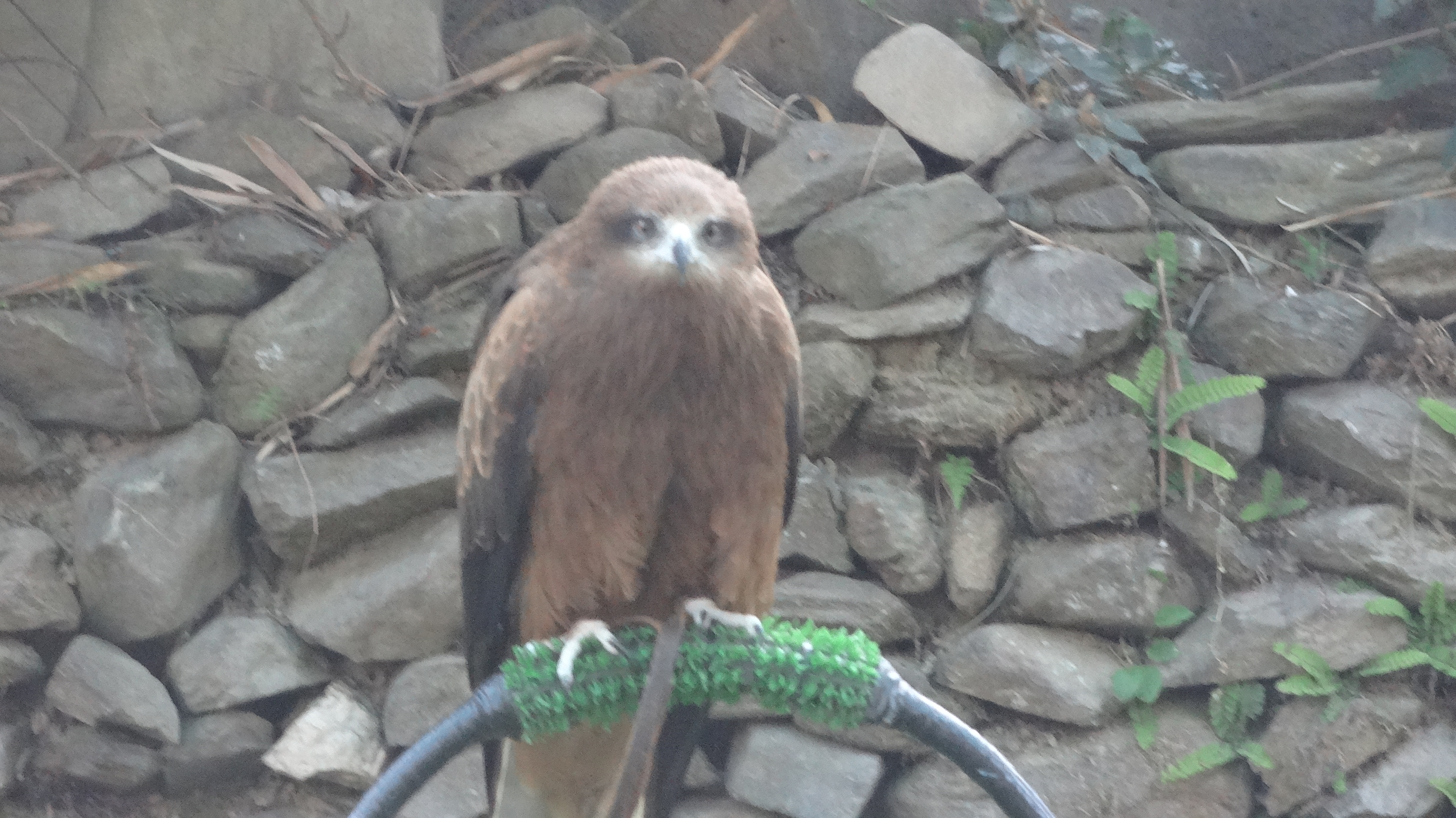
One of the Egyptian parahawking vultures – Bob, I think?!

DSC02376

….and one of his kyte friends.

It was a quiet, relaxing 3 days. The downside was that Susie barely got a glimpse of the Himalayas — she should have had panoramic views – but we did get to spend time rowing on the lake, gossiping in cafes, and trolling around the shops at a much more leisurely pace than normal.

What a great trip!  From jungle to dusty Indian border towns to quiet lakeside silence…..I’ve had worse weeks. ;o)

GE DIGITAL CAMERA

Loved the emptiness of the lake beach at night

GE DIGITAL CAMERA

Visting Lumbini: The Birthplace of Buddha


DSC02331

I’m not sure what I expected to find in Lumbini, which is internationally recognized by almost everyone as the birthplace of Buddha. All I had seen was a few photographs of a white monastery-like building in the middle of nowhere and, as we drove through the arid stretches of the Terai, nowhere seemed to be just where we were heading.  I supposed I’d expected one or two sacred sites and maybe a few golden Buddhas, as after all it is one of the most sacred sites in Buddhism, but I was shocked and impressed at the scale of the place.

The UN Lumbini Development Project was set up in 1970 and a master plan was put together to develop Lumbini, which had fallen into disrepair centuries ago.  Today its an UNESCO World Heritage site,  consisting of a rectangular walled block of land measuring 4 kilometres by 2 kilometres, which includes a sacred garden and Buddha’s birthplace at one end, and a Peace Pagoda at the other.  Between these two extremes runs a long connecting mall with reflecting ponds, vaguely similar to the famous mall in Washington.  Either side of the mall (to the east and west) are plans for up to 40 different Buddhist monasteries from different sects and countries all over the world; some are built and some are still being developed.  And the scale of development is far larger and more impressive than anything else I have seen in Nepal to date.

DSC02310

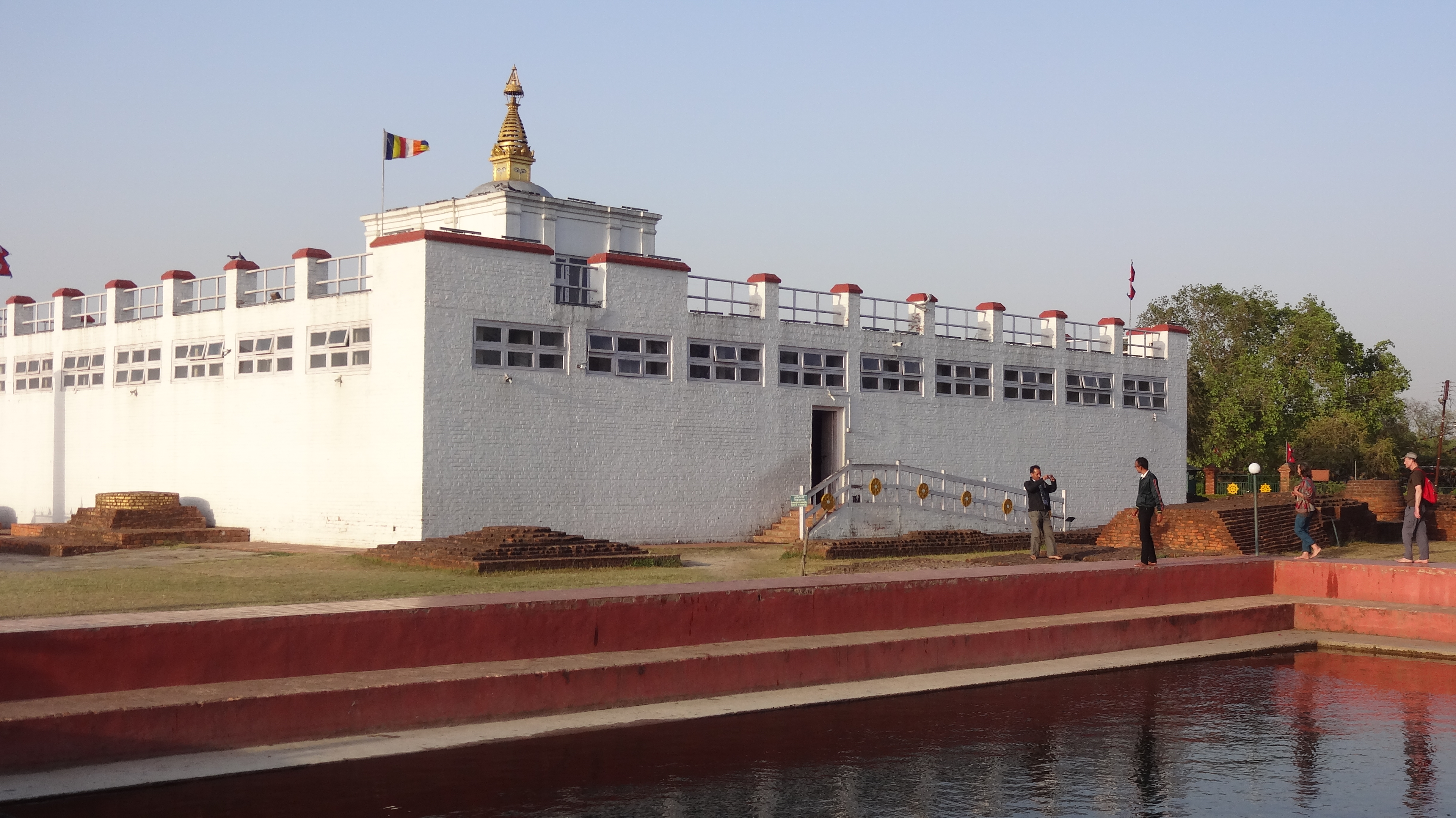
The Maya Devi temple in the sacred garden at the north end of the temple

DSC02323

Buddhist monks under the sacred tree.  These guys were selling blessings.

DSC02324

Stunning tree covered in prayer flags that we are told is the tree that Buddha’s mother leaned against to give birth to him.

DSC02325

The ruins of his birthplace are covered in a white monument, but still surrounded by original foundations from other buildings.

GE DIGITAL CAMERA

Part of the connecting mall looking North from the Peace Pagoda

DSC02332

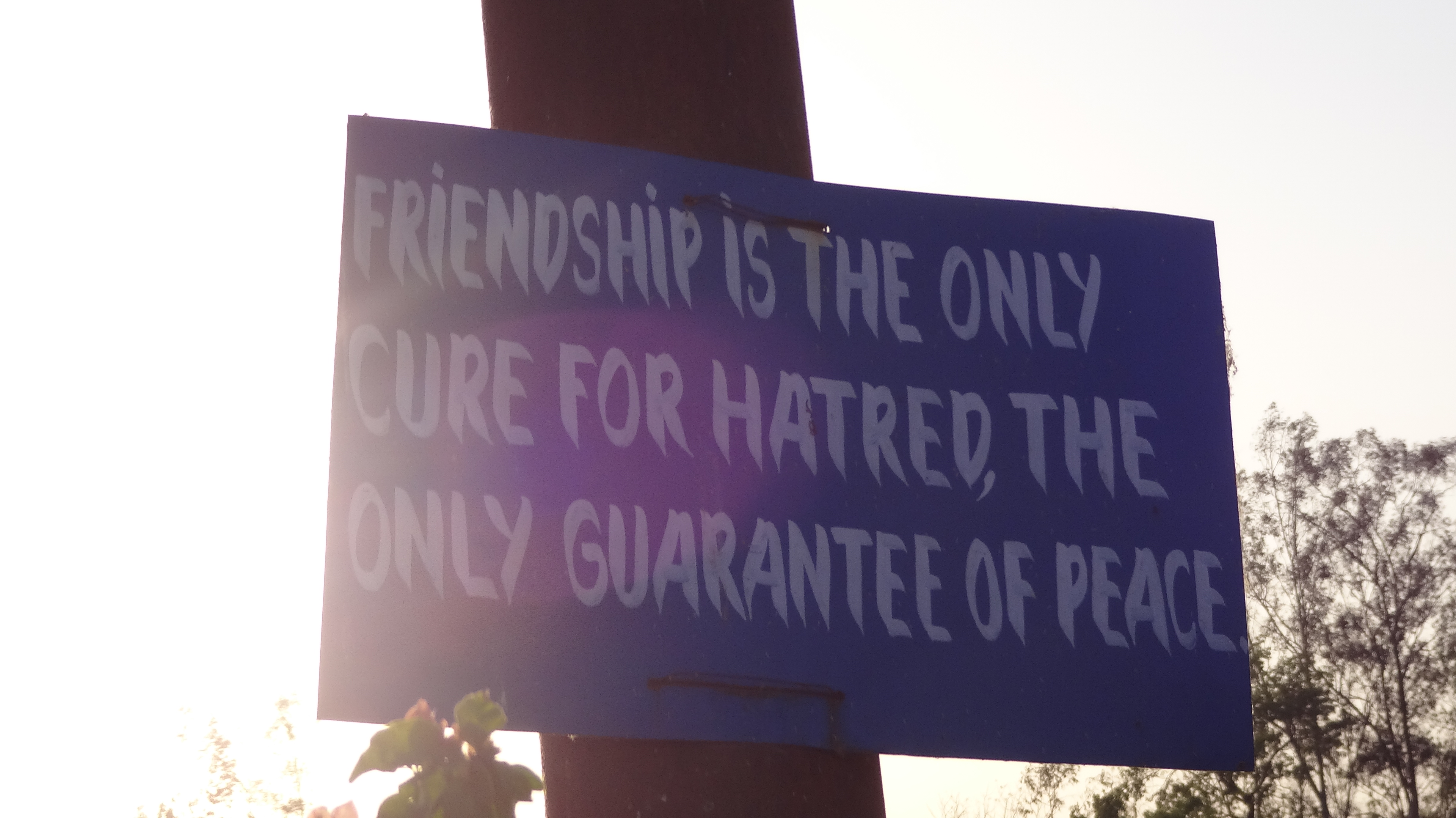
Spaced out along the mall were signs in English and Nepali which shared messages from Buddhist teachings.

DSC02334

At the eternal flame looking South to the Peace Pagoda

I’m not Buddhist, so this wasn’t a religious experience for me, but it was a peaceful and beautiful place. And remarkably clean and well cared for. It was actually quite shocking to walk on clean, swept, wide pathways (and great proof that if Nepalis want to keep something up, they can!)

However, what struck me most was the emptiness of the place.  Wide boulevards that would fit thousands of people, and barely anyone there.  Of course, this had something to do with the time of year.  Touring outside in 90 degree is too overwhelming, even for the devout.  But I also know that Nepal has not done a great deal to promote religious tourism here. Most (non-Buddhist) tourists come for the trekking and mostly don’t even know about Lumbini.  So it sits in relative obscurity, as this giant monument to Buddhist in the middle of nowhere.

Finally, a quick look at some of the monasteries.  I could do a separate post entirely on the different monasteries that we saw.  I would guess there were about 25-30 built and we saw about 10-15: Korean, Vietnamese, Thai, Nepali, Chinese, French and German (yes!) , Japanese….  Here are few examples of the different styles. We spent half a day, we could have spent two days looking at everything. Fascinating place.

DSC02360

DSC02348

DSC02351

DSC02352

Susie making new friends!

The Terai


GE DIGITAL CAMERA

You know you’re in the Terai as pedicabs and rickshaws suddenly appear.

When the time came around, it was hard to leave the peace and greenery of Chitwan.  In April,  the weather was getting a bit too hot and humid for my liking, although not too bad.  But rumour had it that this was nothing compared to the rest of the Terai, which we were about to experience as we were heading westward towards Lumbini in the Central Terai.

The Terai refers to the flat, southern strip of Nepal, which borders Northern India. Most people are surprised to learn it even exists as everyone expects Nepal to be cold and mountainous, not hot and flat. Of course, Nepal is both, and everything in between, it just depends on when and where you are standing.  Its actually astounding how much variety in landscape and temperature there is here.

Back on the road, it was hard to get pictures from the moving vehicle.  On the flat tarmac it was possible to drive faster, and the small towns and agriculture centers whizzed by at speed.  And, yes, it was very hot and dusty, and some of the major towns were ugly (non-descript at best) and there was no reason to stop and see more.

DSC02297

GE DIGITAL CAMERA
What I did like was the agricultural areas.  The Terai is known as Nepal’s bread basket.  And to prove it was saw endless acres of wheat, which happened to be harvesting as we were there.  99% of the harvesting was by hand, with long medieval scythes.  (It looked backbreaking and I can’t imagine doing it in the heat.)   However, we did see a couple of bright green combine harvesters at work in the massive sea of beige.

GE DIGITAL CAMERA

Terai wheat fields

Terai wheat fields

DSC02371

Terai village

Terai village

If Kathmandu is grey, the Terai is beige. Beige mud houses, dusty unpaved beige streets and unending fields of beige crops. And hot, did I mention it was hot?!…. So where in all this hot beigeness would we find the birthplace of one of the major major religious leaders in the world and whatever was it doing here…..? We were about to find out….


Gharial Breeding Center


gharials at gharial breeding center in Chitwan

We’re watching you!

In case you didn’t know, gharials are prehistoric cousins of the alligator, fish-eating reptiles with strange narrow snouts that end in a ball. They might like fish, but some of the larger ones we saw…I’m sure one of my limbs would have made a tasty snack in a fish shortage! But fortunately for us at the Breeding Center, we were safely separated by stainless steel mesh.

chitwan national park, gharial breeding center
DSC02122

Here’s the list of sponsors for the breeding center.  If you look carefully you can see Lacoste – very creative!

The breeding center was built about ten years ago with WWF money and donations from other sponsors in response to the increasing problem of gharial extinction. Its populations have reduced dramatically in the last 70 years and it is now listed as “critically endangered.” The breeding center incubates the eggs and raises babies, and keeps populations of gharials from all age ranges. You could walk from pen to pen and see them at 2, 5 10 and even 45 years old, but I understand most are released into the wild once they reach the age of 4. I couldn’t find any statistics online on the impact that the center is having on the wild populations, but hopefully its a positive one.

crocodile breeding center

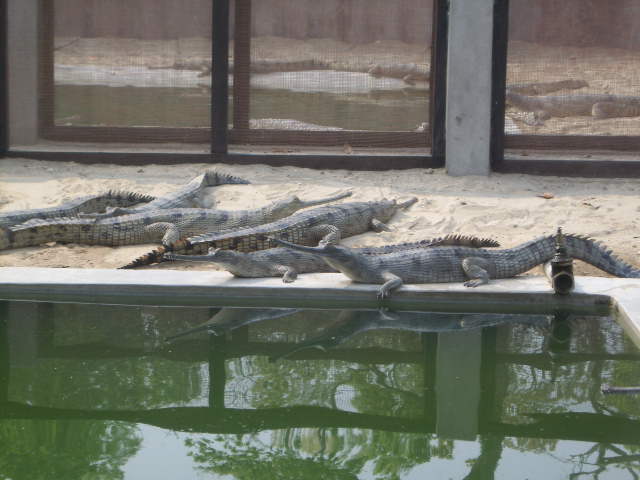
Gharials that are few years old.  I loved the way they piled up on one another like logs!

alligator, gharial, crocodile

…and then there were these big terrifying ones

DSC02116

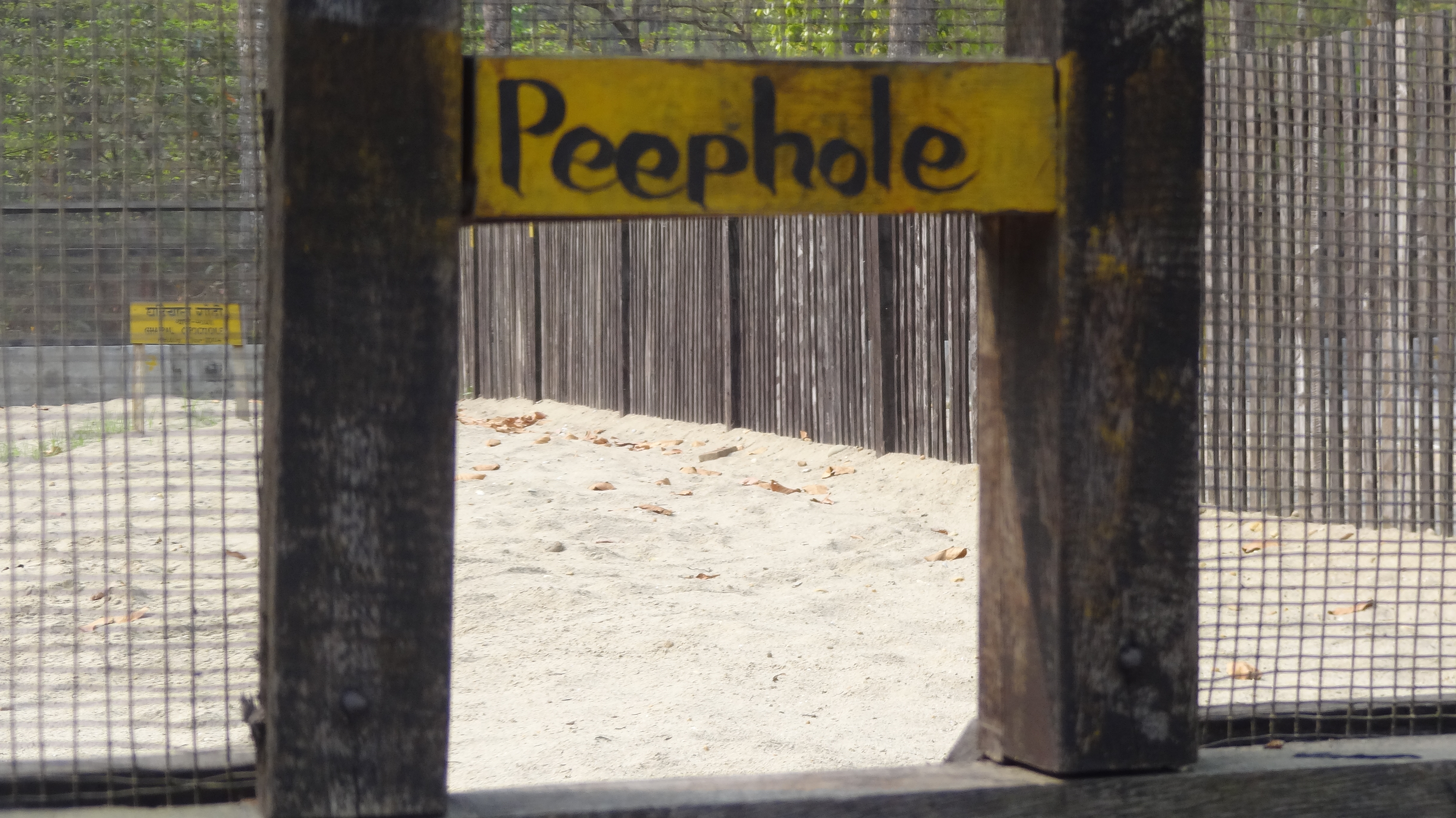
We both loved this labeled peephole.  Its supposed to allow you to see the big gharials, but they were smart enough to hang out right under the sign so you could only see their massive backs as you strained to see in.


DSC02119

This notice showed you how many gharials were in captivity at different ages.  Its hard to read from a photo, but was interesting to see close up.

gharials

I’m guessing these are 4 year olds around release age.

GE DIGITAL CAMERA

This wasn’t a lucky snap or superior camera skills by me.  He sat like that the whole time I visited – frozen with his mouth open.  In fact they all did.  If they hadn’t blinked occasionally I would have thought they were made of rubber.

Chitwan Jeep Ride


DSC01991 Our big adventure for this part of the trip was to go out into the jungle on a jeep. I’d been warned that the safari part of this was limited. There are animals there, but its not like Africa with an abundance of wildlife. So we took the adventure as a jungle trip, rather than a safari, as the experience of just being out there in nature is a special one. So first thing in the misty morning, as the first part of our adventure, we headed down to the Rapti river, which forms the boundary of Chitwan National Park. Its shallow and fast, and the only way to get across and stay dry (sort of) is by hollowed-out canoes. These are less than stable…I really thought I was going in!

DSC01997

Canoes made from hollowed out logs, ready to take us across

chitwan national park

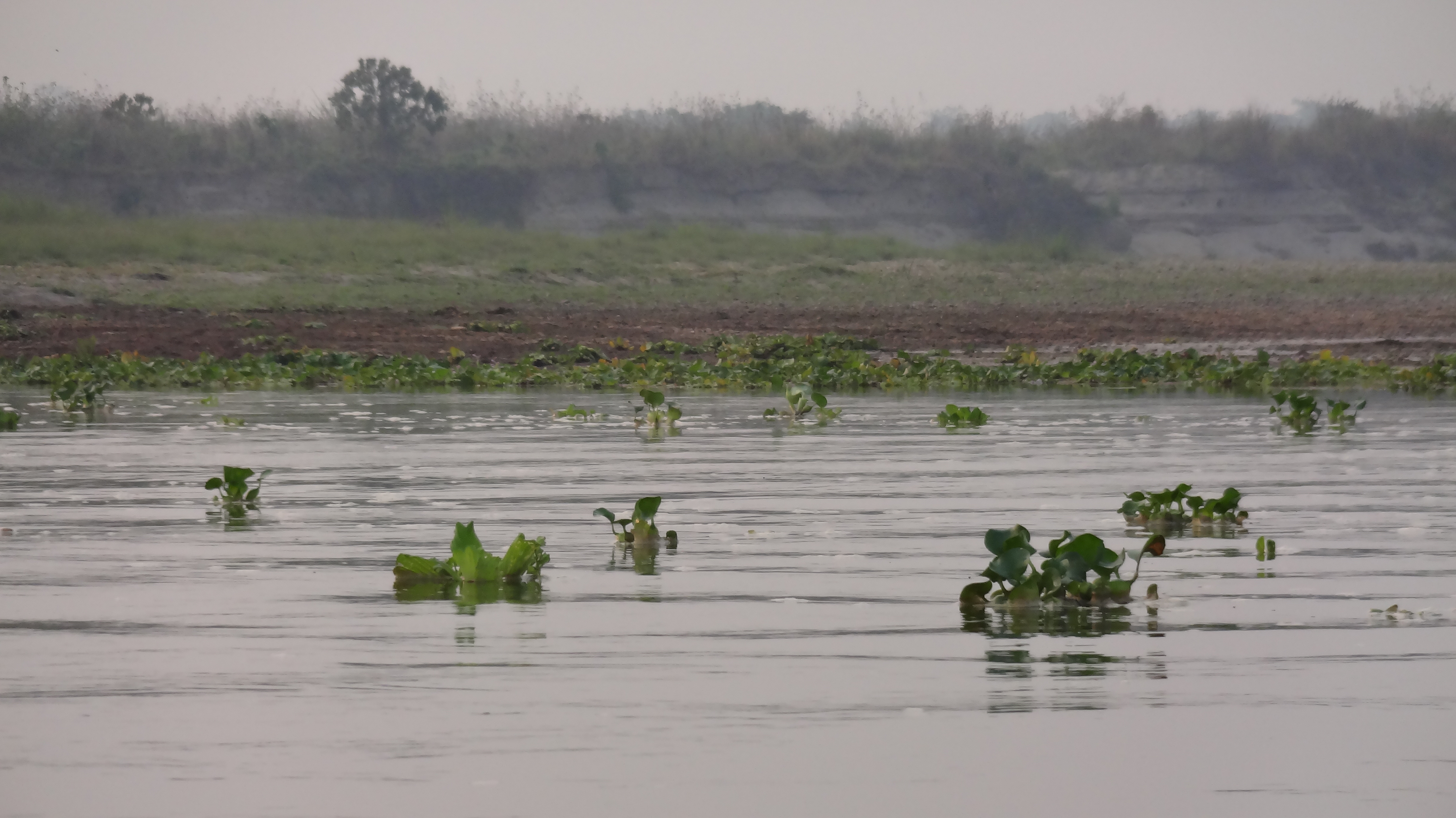
Rapti river

chitwan national park

Heading out in the jeep

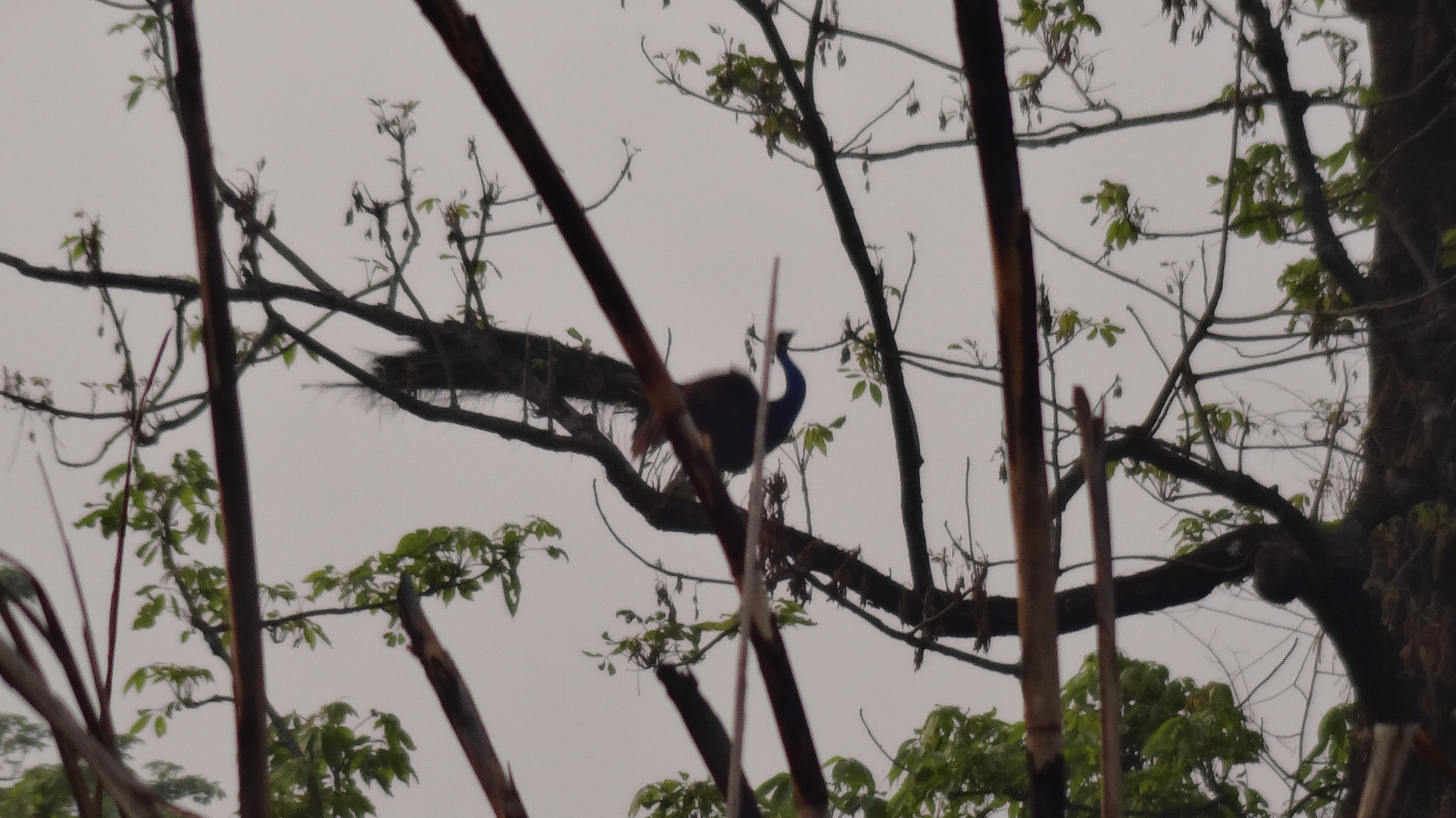
From the opposite bank,  we walked to our jeep, and then drove dirt trails into the jungle. In the early morning, the birds were really active and you could see kingfishers and all sorts of colorful and beautiful birds. It was hard to capture them on film without a fantastic camera lens, but wonderful to be there and listen to them sing anyway. When we saw the first peacock, we reached for our cameras and he flew into a tree. Here is my best shot:

DSC02017

Peacock!

Later peacocks kept showing up everywhere. It was mating season, and the males were strutting around. By the end of the day, we were saying “oh that’s just a peacock” and recognizing their cries. Hard to believe that we got used to such a spectacular bird, so they seemed common like pigeons! As it got warmer, the mist lifted and the terrain changed.  I loved how different areas of the jungle had their own feel.  My favourite was the open grasslands and the cotton silk trees: the beautiful reed-like grasses and the angular, vaguely oriental feel of the trees were stunning.  Add to this the imagination of what may be hiding in the grasses, and our eyes were set ahead, frantically scanning the view.

DSC02025

the beautiful silk cotton trees

DSC02043

elephant grass

We stopped at one of several viewing platforms to take a breakfast break. The rickety platform did give us more elevation to see around, but unfortunately no animals interrupted our meal.

DSC02050

Our rickety viewing platform. Note missing step!

termite nest

Termite nest. Apparently these make tasty treats for sloth bears. You could see claw mark-scratched holes around some of them…made by sloth bears looking for a snack.

So what did we see that day? No tigers, unfortunately. They are now considered the prime wildlife sighting because they are so rare. There’s only about 200 Bengal tigers left in the park. But, fortunately, there’s now a concerted effort to stop poaching and track the surviving tigers. Hopefully, their numbers will slowly start to increase. We saw lots of beautiful birds, countless peacocks, monkeys, deer, boars, alligators, cranes and wild ducks, a rhino and — most significantly of all — a black sloth bear. A large, male actually. They are considered the most dangerous and unpredictable of all wildlife in Chitwan. He was actually frightened by us and ran along the horizon, trying to find a way to cross our path. He finally darted across our trail, but too fast for me to catch a shot. Maybe next time.

Love, Love, Love the Baby Elephants!


First stop on our roadtrip was Chitwan, where we had visited last year over Christmas. We stayed a second time at the charming Sapana Lodge and met again with the “pregnant elephant” who now was mum to a three month old calf. He was adorable!  We went over to pet him and he was hungry for attention. He sucked my silk shirt up his nose and wrapped his trunk around my legs. He was so wonderfully goofy and eager….just a really, really big baby.  It did bring the expression “charging around like a baby elephant” into new perspective.  It was so funny to watch something so powerful be so clumsy.

baby elephant

It was so much fun to reach out and touch him. He wanted to interact as much as me

DSC01954

Susie playing with the elephant and some local kids

The keeper fed his mum some sugarcane, and he tried but just couldn’t coordinate stuffing the sticks into his mouth. They were just too big and he was too uncoordinated, but his mum loved them! Talk about a sugar high!

GE DIGITAL CAMERA

This is mum, after feasting on about 12 sticks of sugar cane. Look at that face! Bliss!

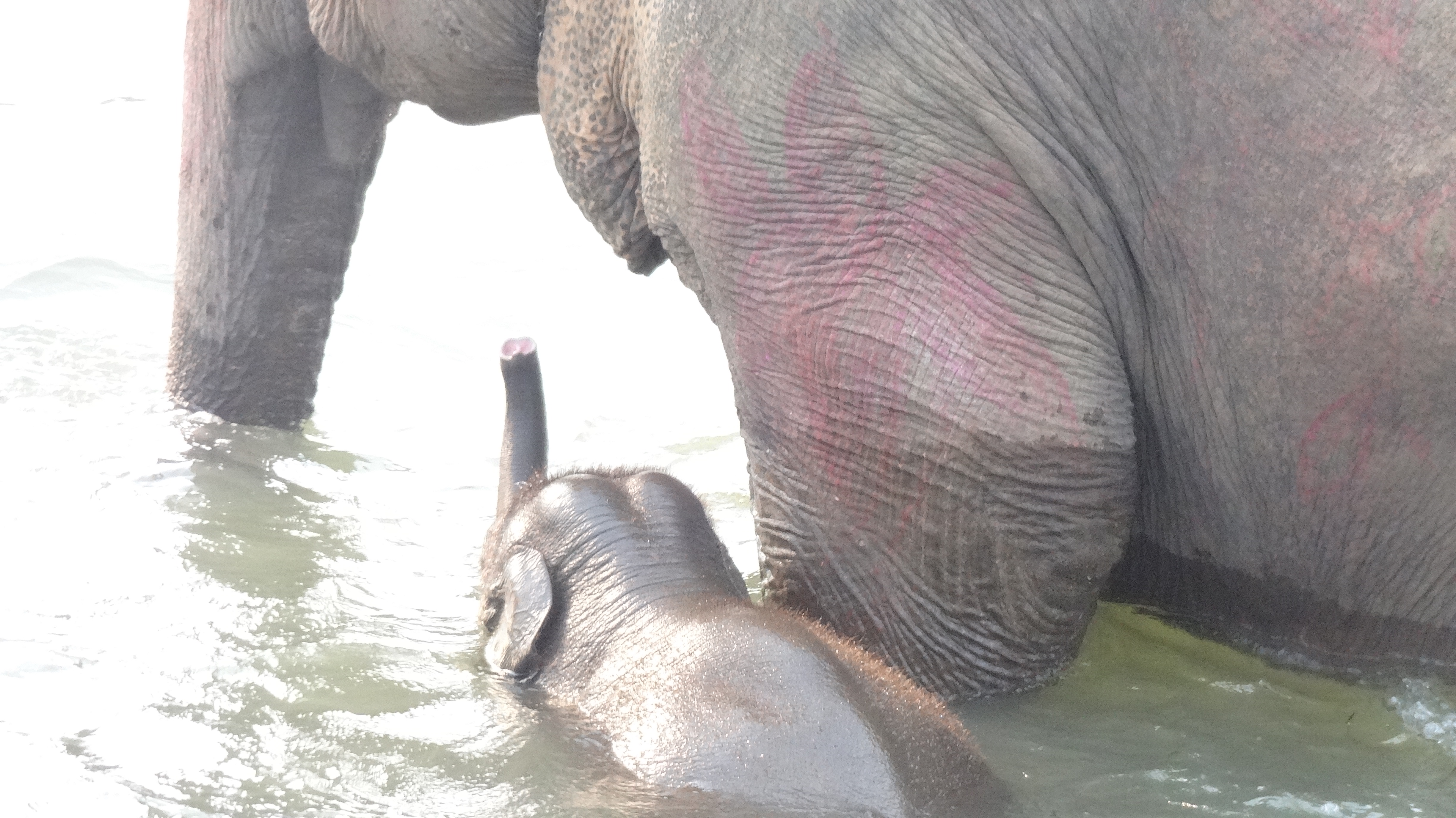
Around midday the keeper would take them both down to the river for a bath. And the little elephant swum around his mother, hiding under her belly and diving underwater to snorkel. Nearby the local Tharu kids were playing football and tossed the ball for the baby elephant to catch, but he was far more interested in the water and for us it was so much fun to watch elephant bath time!

DSC02208

Taking a bath with mom

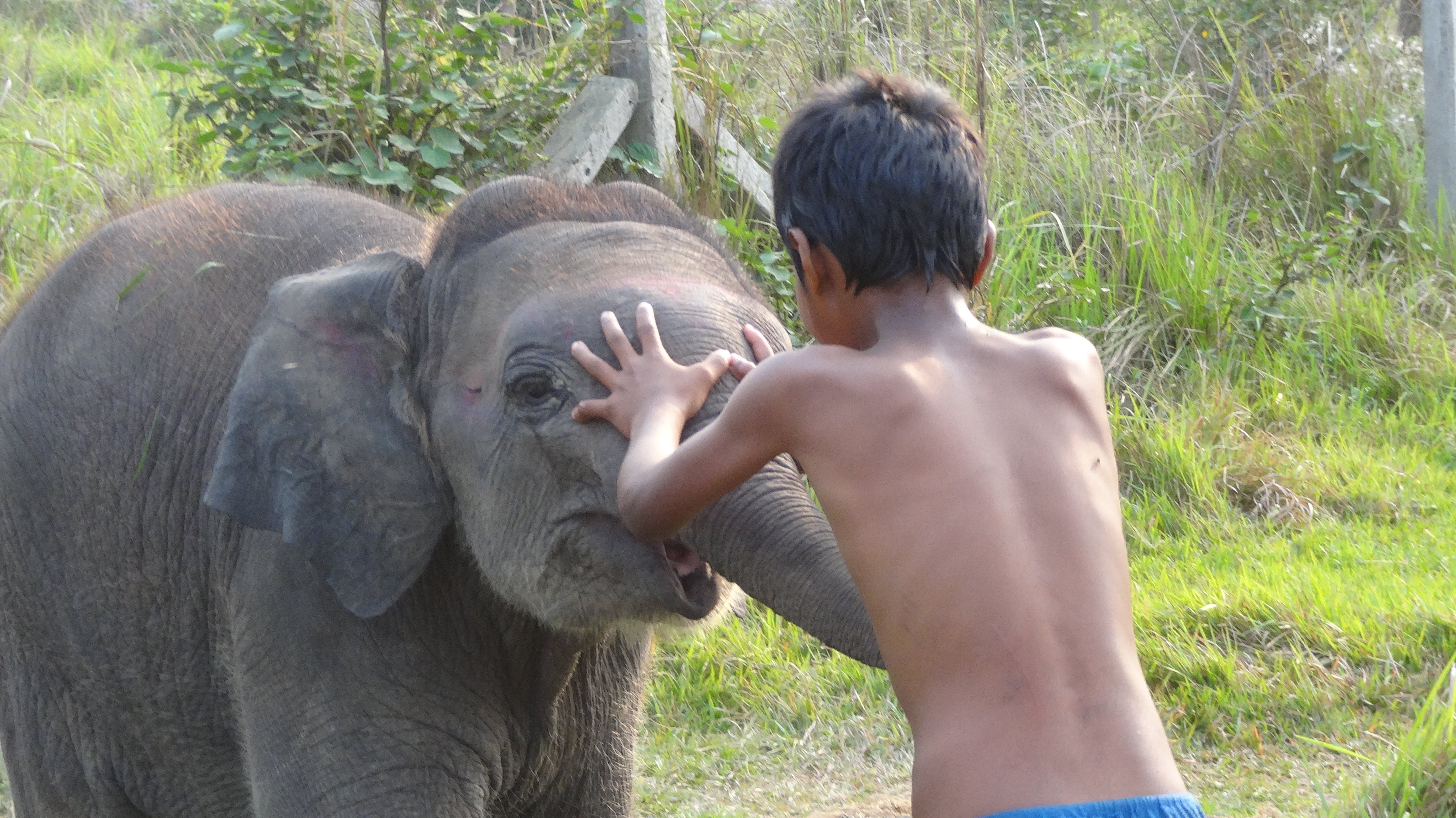
In the afternoon, the elephants were taken out to a fenced enclosure by the river where they grazed and hung out. The local kids took their soccer game out of the water when it got a little cooler and ran over to us asking for their picture to be taken. We went over to see the baby again, and he came running over to a gap in the fence, straight to my outstretched hand. He wanted to play and out he came! I guess baby elephants play with one another head-to-head and tousle with their trunks. He tried that with me and very nearly knocked me over! He sneezed on Susie’s clean white shorts, which were now covered in sooty elephant snot. (We think he’d been nosing around in one of the fire pits.) Then he got really frisky and tried to play-charge me. I turned around to try and use my back weight to stop me from falling over. I was laughing but also a little afraid that he trample me as he charged at my butt and pushed me around like a steam engine.   Susie was laughing but also a little cautious, so getting this on camera was not an option.  But we did manage to get some pictures of the kids playing with him:

DSC02138

This little guy used a different technique to me. When the baby elephant wanted to play and started pushing….he pushed back!

DSC02177

It was a wonderful opportunity. If I’m lucky enough to come back again in a few months he will be bigger and probably too dangerous to play with- if indeed he still wants to play at all.

DSC02247

At the end of the day- after bathing, grazing and games – its time to walk back home with mum

Girls Roadtrip! Or Thelma and Louise (with a driver)….


… (hint) It has a much better ending!

It was so exciting that my really good friend, Susie, would be coming all the way to Kathmandu. I was a little apprehensive too as this is a difficult city to visit in a lot of ways — its dirty, dusty and congested — but I thought she would do ok and she did. ;o)

DSC01779

Susie arriving at KTM.  This is one of the few pictures we managed to get together.  Guess neither of us had heard of selfies…oh well!

I had planned a full week on the road to escape the grey dust of Kathmandu.  (We did exchange some of it for the beige dust of the Terai…but that story comes later.)   We were excited.!!  A whole week of no kids or husbands, and time to catch up on each others lives.

Nepal isn’t the easiest country to get around. The road system is limited and a lot of the roads are windy and potentially dangerous. So if you wanted to keep to tarmacked roads that have western quality hotels, Chitwan and Pokhara are the best bet.,,and that’s where we were headed.   We had our own driver, a serviced jeep, good brakes and plenty of trunk space.  So, we were sure to pack essentials like gin, tonic, Pimms and PG tips.  We were going to do this in style…!

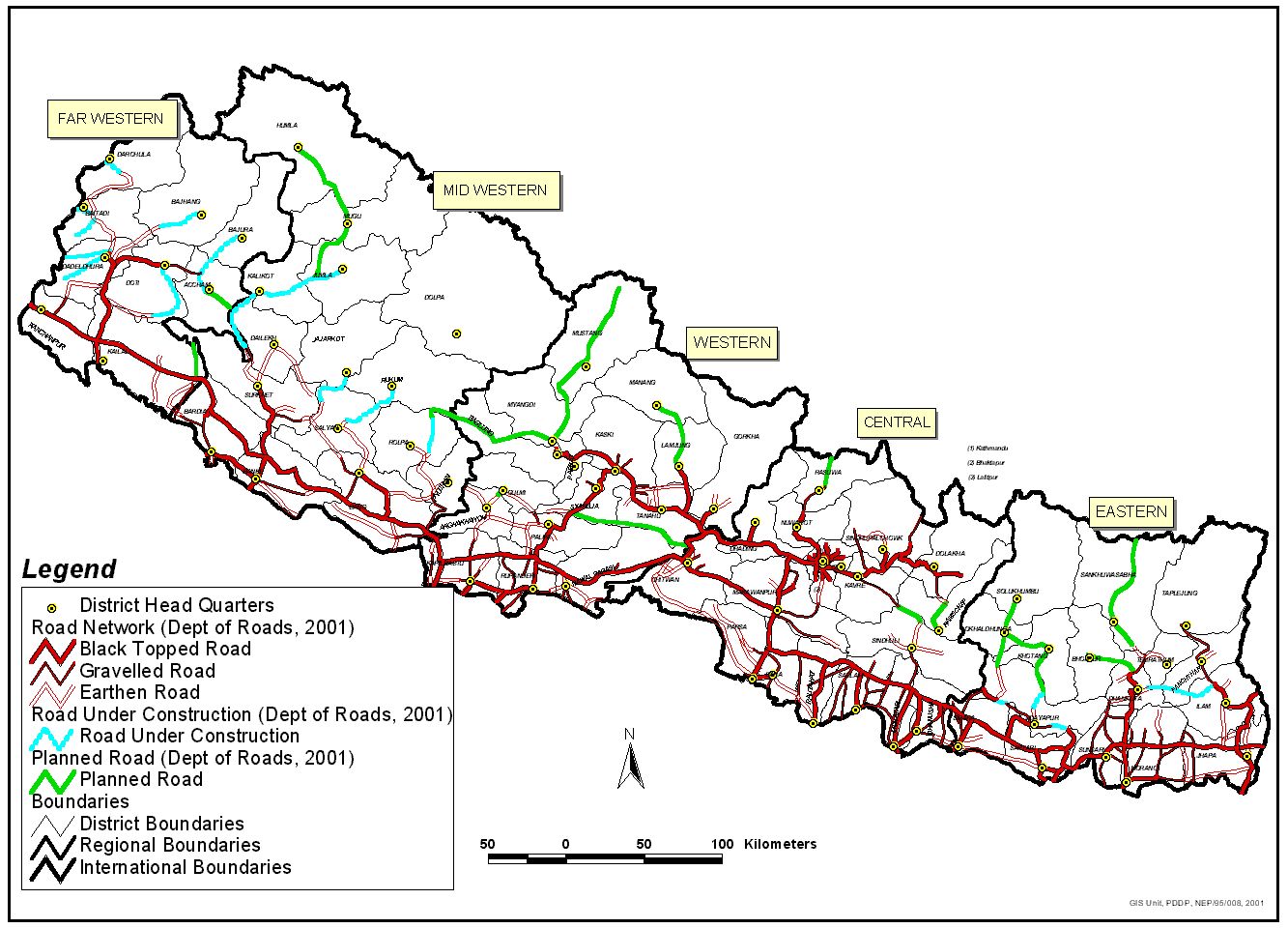
nepal roadways

Notice the black top roads (in red) are all in the south of the country. Thats because the north of the country is covered by rather large mountains called the Himalayas. No highways there!


DSC01785

Ready to go…bags at the door…

DSC01787

.. and into the jeep.  Let’s get out of here….!

We traveled for 4-6hrs from location to location, glimpsing rural Nepalese life from the windows.  It wasn’t always easy driving…too many trucks…but our driver did a good job of keeping us safe and we were never in the jeep so long that we went crazy.   It was fun to watch the scenery change…and the weather too.  The south is so much hotter!

GE DIGITAL CAMERA

Grabbing the view from the front….

GE DIGITAL CAMERA

….and from behind!  That truck was stuck in a 2 foot gutter.  One of several “accidents” we saw.  Fortunately nothing fatal.

So the next few posts are going to be about our adventures in Chitwan, Pokhara and Lumbini. He’s a little preview:

Photo0013

Other people even hauled our stuff up and down the stairs, so bags magically appeared in the rooms.

GE DIGITAL CAMERA

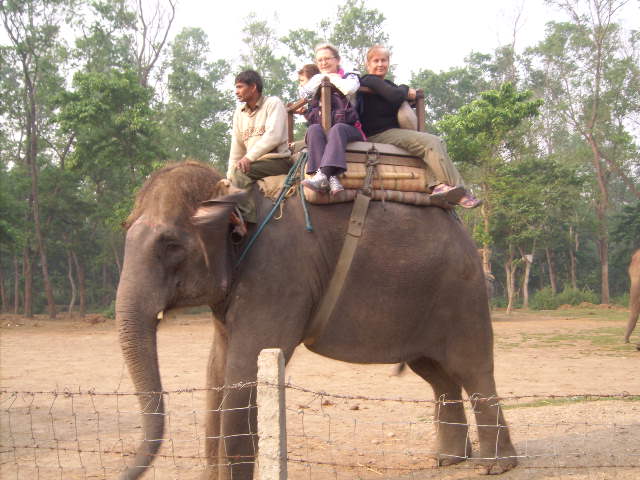
Enjoying an elephant ride together

GE DIGITAL CAMERA

Making new friends in Chitwan

People brought us plates of food. Yes those are french fries. What the hell!

GE DIGITAL CAMERA

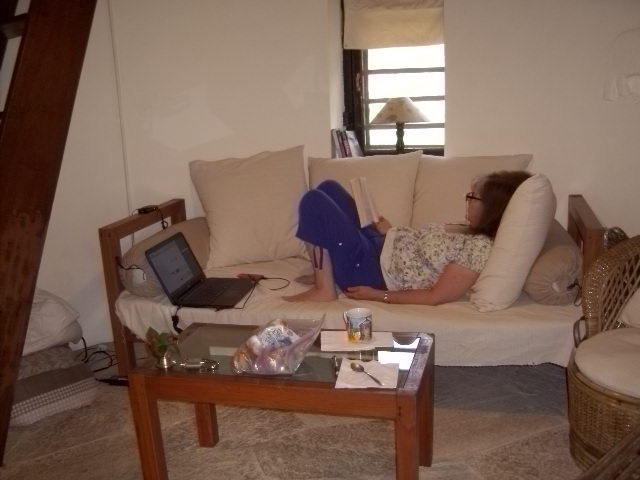
Finally being chilled out enough to lounge around and read

GE DIGITAL CAMERA GE DIGITAL CAMERA

Pet Peeves


Pet peeves are a ridiculous thing. We know that,  but we continue to nurture and feed them anyway. I don’t have universal pet peeves for everywhere like bad grammar or rude language (well, maybe chewing with your mouth closed)… but mostly mine are country specific!


Nepal: I start with my absolute major peeve at this point in time: spitting.  Do I ever hate it that people spit here!  OMG! Sometimes I’ll be walking down the street, quietly minding my own business and before I can turn my head fast enough, there comes the sound of someone hacking deeply–all the way down from their toes– as they deliver a disgusting, ugly splat of phlegm just inches from my feet.  And as I turn my head to the other side in disgust, yet another person –with horrendously perfect timing–hangs another, equally loud and disgusting.  There is no escape!

Philippines: Manila is full of zebra crossings, or pedestrian crossings if you prefer.  Unfortunately in Manila, I couldn’t help feeling they serve only to spruce up the city a little, make it look more modern.  Decoration, if you will.  They certainly serve no function.   (Kathmandu at least has the good sense not to even bother wasting the paint.)   In Manila, they are like death traps for expats who have the deluded notion that when you step out onto one cars will stop.  I found myself drawn to them out of habit and then felt utterly frustrated when drivers would seem to speed up as I used them to cross the street.

UK: “Sorry!  I’m so sorry to bother you, but this microwave you sold me doesn’t work.  I’m really, really sorry to make a fuss, but would you possibly consider replacing it with a new one?!”  Why do the British feel the need to apologize profusely for everything, even when something is clearly not their fault,  even when they have been more than put out by someone else.  When I go back to the UK and complain about something – people look at me aghast that I haven’t gone through this ritual.  I’m not rude.  But I am direct.  “This microwave doesn’t work.  I’d like it replaced please.”  What’s wrong with that?

US: Last week, on a Nepalese airport transit bus from the terminal to the plane, I sat with a group of about 20 young trekkers from all over the world.  The bus was crowded and uncomfortable,  and as we all sat there tolerating the jolts and jostling, a young American guy told his friends in very loud detail about his adventures the previous day.  Finally someone said, “Speak up a bit, John, the people at the front are complaining they can’t hear you!”  It did actually shut him up for a while, and it made me realize how much he had added to the discomfort of the situation.  Dear loud Americans, cliched or not, please stop.  We don’t want to hear it.

So sorry dear Nepalese, Filipino, British and American friends and readers of my blog.  I do usually try and focus on the positive…really I do.  But just occasionally, I think I deserve a rant as much as the next person.  And I’m sure its not you that spits/drives badly/over apologizes/or arrogantly takes over every conversation.  Its the other guy! ;o)


This post participated in the Daily Prompt:She Drives Me Crazy!

Here are some other pet peeves:

  1. I hate Inspirational Facebook Update Pictures | AS I PLEASE
  2. VIP Saudi Wedding at Ritz Carlton – JBR | Rima Hassan
  3. Daily Prompt: She Drives Me Crazy- Pyshology Behind “Being Late” and it’s Consequences | Journeyman
  4. Daily Prompt: She drives me crazy! | Purplesus’ Blog
  5. Daily Prompt: She Drives Me Crazy | seikaiha’s blah-blah-blah
  6. The Production of “Hair” At Billy Bronco’s | The Jittery Goat
  7. Daily Prompt: They Drive Me Crazy | Under the Monkey Tree
  8. Daily Prompt: She Drives Me Crazy | The WordPress C(h)ronicle
  9. I drive me crazy… | new2writing
  10. DP Daily Prompt: She Drives Me Crazy | Sabethville
  11. 狂気!(Crazy!) | Eyes Through The Glass – A Blog About Asperger’s
  12. Daily Prompt: what drives me crazy | Love your dog
  13. Control??? / Daily Prompt | I’m a Writer, Yes I Am
  14. A Courteous Nod to A Fresh Me | Views Splash!
  15. Daily Prompt: She Drives Me Crazy | littlegirlstory
  16. Wait you mean you came to class unprepared again??? | One Educator’s Life
  17. etiquette | yi-ching lin photography
  18. the second law of | y
  19. The First Date – Part 3 | In Harmony
  20. Stories That Drive Me Crazy | My Little Avalon
  21. Daily Prompt: She Drives Me Crazy | Pastathree’s Blog
  22. Stop lingering, STOP lingering, please stop lingering!! | The Flavored Word
  23. A dialogue | Perspectives on life, universe and everything
  24. Actus reus | Perspectives on life, universe and everything
  25. Daily Prompt: She Drives Me Crazy | Bob’s Blog-O-Rama
  26. Narcissism or Self-Exploration? | Lisa’s Kansa Muse
  27. March is driving me crazy: Laguardia, Wrestlemania and Selena on my mind as winter draws to its final end « psychologistmimi
  28. She Drives Me Crazy | The Story of a Guy
  29. “Will the last one in my World please turn everything off” | Prompt Me Please
  30. daily prompt: one of these days, alice! | r | one studio architecture
  31. Déjà Vu All over Again! | My Author-itis
  32. Groove « Averil Dean
  33. Daily Prompt: She Drives Me Crazy | tnkerr-Writing Prompts and Practice
  34. Leonard Woolf ‘speaks’ | ALIEN AURA’S BLOG: IT’LL BLOW YOUR MIND!
  35. Crazy Monday | Jody Lynne
  36. “She Drives Me Crazy” | Relax
  37. Watch Out for that Tree! | meanderedwanderings
  38. Daily Prompt: She Drives Me Crazy | imagination
  39. Like nails on a chalkboard. | Hope* the happy hugger
  40. Respect for the music | Life is great
  41. Pet Peeves Continued… | Live, Love, Laugh, Dance, Pray
  42. A few thoughts for improvement | An old fart back in school
  43. Daily Prompt: She Drives Me Crazy | My Atheist Blog
  44. ah shaddap you face | eastelmhurst.a.go.go
  45. Daily Prompt: She Drives Me Crazy |Five Annoying Things | Shawn
  46. Don’t be Manipulated | wisskko’s blog
  47. DP: DON’T TOUCH THAT! | Scorched Ice
  48. Some things just drive you a little crazy… | chattinatti