WPC: Fat Betty


This week’s Photo Challenge Half and Half asks us to share an image that represents two clear halves, literally or figuratively.  Meet Fat Betty.  She stands on the Coast to Coast walk in Northern England, on the bleak road that leads across the North York moors from Blakey Rigg to Rosedale Abbey.  The head of the cross is an ancient wheelhead half-painted white.

Out on the moors it just you, the brooding sky and the purple heather that stretches out for miles ahead.  I thought Fat Betty made an interesting contrast to the already bisected vista, at least until the fog comes down and everything disappears.

Lion Hike 172

After the Quake – Part 2


About two weeks after the second quake, I was back in the Kathmandu Dhurba Square neighbourhood searching for a vacuum cleaner of all things… I wasn’t having much success as most of the stores were still closed, as many of the store owners had returned to their villages to help with the recovery. We were about to head back to work when, on a whim, we decided to stop and take a look for ourselves at the devastation that happened at this famous World Heritage site.

It was eerie. A lane had been roped for pedestrians to walk though the main site, keeping us away from the damaged buildings. Walking past piles of sorted rubble, tents, and cracked buildings, all we could really do was stare in horror. The palace roof was severely damaged, whole temples had completely disappeared and tourist vendors were gone and had been replaced by a tent village. It really looked nothing like its former self. For contrast, take a look at the short video I made just a couple of months before the earthquake. Here also are a few pictures:

Kathmandu Dhurba Square

Kathmandu Dhurba Square before the quake. Teeming with people and pigeons (and cows)…

Kathmandu Dhurba Square after the earthquake

After the quake and after the rescue squads, in came the clean up crew and stacked the wooden beams and want ever was salvageable from the wreckage (not much). The rest of us just stood and gawped.

20150515_143124

Extensive damage to the Royal Palace at Kathmandu Dhurba Square: Hanoman Dhoka

20150515_143247

Where tourist vendors previously set up endless stands of Nepalese tourist paraphernalia, now sprung a tent city.

I think international money will come in and rebuild the three Dhurba squares (Kathmandu, Patan and Bhaktapur). However, outside of the World Heritage Sites, so much has been destroyed that will never be replaced. I hope what is rebuilt has a little seismic resilience built into the construction next time around.

After the Quake – Part 1


Its not often that you see a city take shape before your eyes.  Manila was that way, with giant skyscrapers flying up seemingly overnight.  By contrast,  Kathmandu builders took years to put up a couple of much smaller multi-story buildings in our neighbourhood. Since the earthquake, the Nepali government stopped the construction of high-rise buildings in Kathmandu.  A significant number received a yellow or red card from earthquake damage and the skills and technology needed to implode them are absent along with any conviction to uphold seismic code regulations.  What Kathmandu excels in is the construction of two and three story apartment buildings on what was used to be rice paddies.  They fly up in the blink of an eye. There’s no seismic code implementation there either, but luckily many did survive the tremors.

Many older buildings didn’t, especially in the Narayan Chaur/ Nag Pokahari area which was walking distance from our home. Before the quake, the neighborhood was a typical mixture of old and new, but it felt poised to grow, gentrify even. Recent community efforts to upgrade communal spaces with simple outdoor activities and “beautification” efforts continued long after the recent SAARC efforts to spruce up the city.  Narayan Chaur,  an oval-shaped piece of open land in Naxal, was largely a waste ground and dumping site when we first arrived in Kathmandu. With what in retrospect was surprising foresight, the community police in Naxal developed the barren land into a park and possible rescue point in times of natural calamity. The land was fenced off and a footpath laid out around the perimeter.  For a while it turned into a favourite exercise spot for early morning joggers.  Clearly, the value to the community was enormous in a city with no parks.  Its was a roaring success.

After the quake, Narayan Chaur, quickly became a tent city.  I spent about six hours there immediately after the earthquake, sheltering in one of the few, relatively safe open spaces, as the after tremors kept coming and coming. I finally left to walk home, but others are still living there now, almost three months later.

Nearby so many old buildings were destroyed. Some were ready to fall anyway, others just ramshackle from years of neglect.  I could already see that it was just a matter of time before the old buildings were demolished to be replaced by new, but the hope persisted that perhaps they would survive long enough for someone to come save them. But the earthquake took care of them in its own way, and now there’s little evidence they even existed.
S0223064

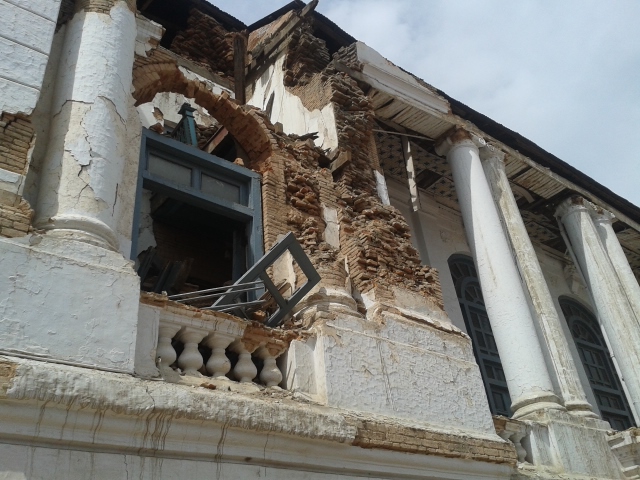
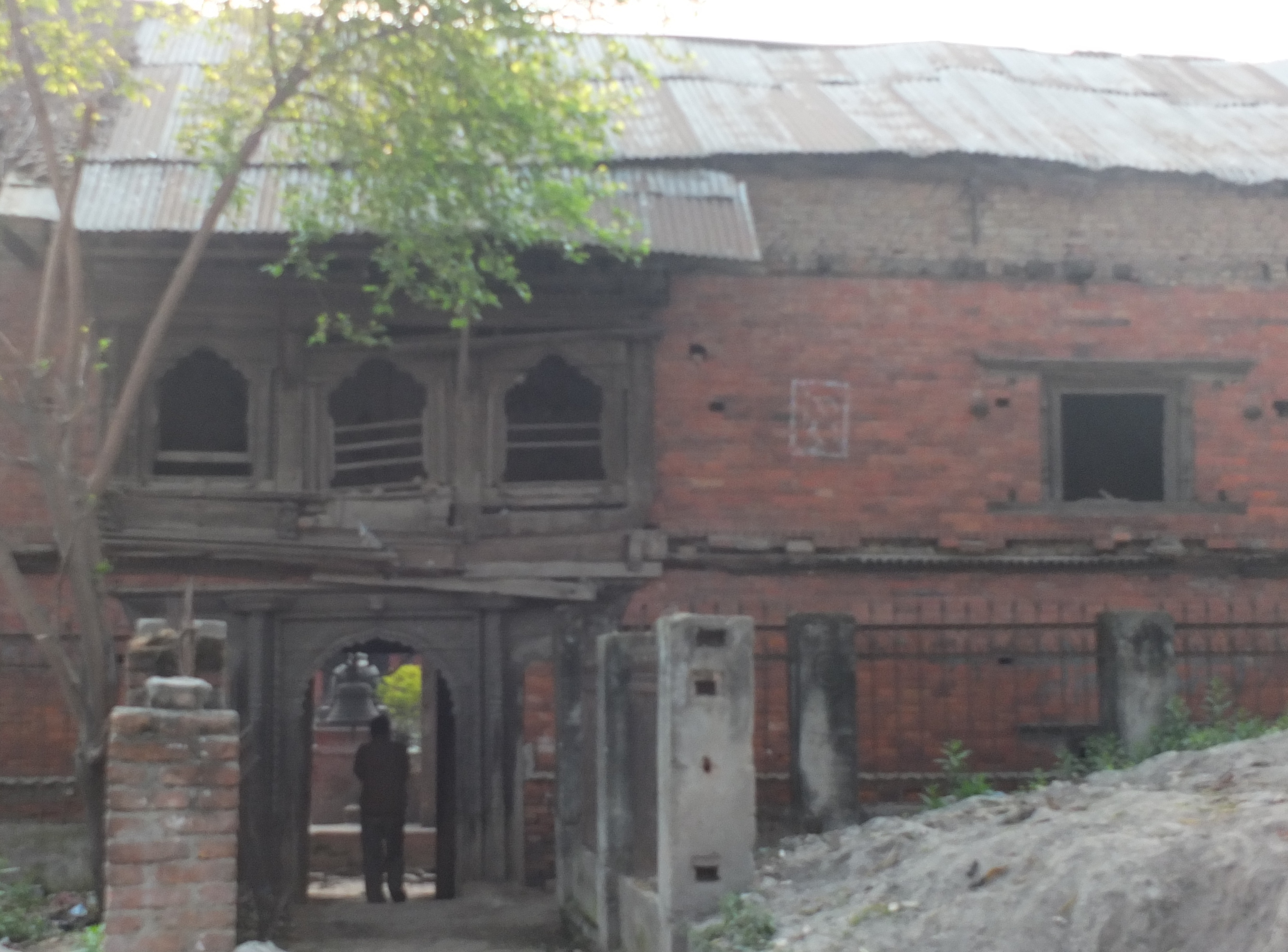
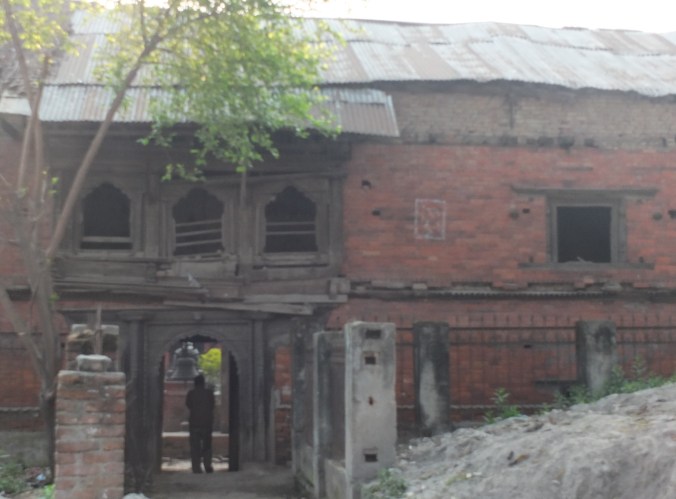
Before the quake, the ramshackle temple at Nag Pokhari  housed a school also.  Its almost dilapidated buildings showed wonderful traditional architecture and carving.

Nepal earthquake damage

Immediately after the earthquake damage whole chunks of the temple fell down. After the second quake, most of the roof collapsed

S0385170

There was no option left but to demolish it. A temporary school building is being constructed among the rubble from international humanitarian funds, which is much needed. But so much history is gone.

Crisis. What Crisis?


DSCF6048

The contrast between the Nepal I left and the Greece I find myself in couldn’t be more stark, although the journey has been from one crisis to another. As I left Kathmandu, the city was settling back to its old chaotic self with record traffic and loadshedding a-plenty. The schools had returned, a demolition effort had removed the more visible damage, and remaining remnants from the earthquake’s devastation just blended together with the old, broken, and partially-constructed ramshackleness of the pre-earthquake city.  At least on the surface, things looked back to normal.

Here –at least superficially — there is no crisis in sight.  The air smells of Greek pine-y fragrance, the crickets are making their usual racket, the July sun beats down and the cross winds blow through our house sending dried bougainvillea flowers scuttling down our path.  I watch the sea sparkle and little boats chug by in the distance.  Its peaceful, beautiful, and a wonderful place to be.

WPC: Nepalese Doors


This week’s Weekly Photo Challenge: Doors is an opportunity to feature Nepali doors – plain and ornate. I may have just left, but I think I’ve many a Nepali post still to come!

WPC: Muse (and the language of Signs)


S0333351

This week’s Weekly Photo Challenge, Muse, didn’t really resonate with me at first. Perhaps it just the “pack out state of mind” I was in?  Then I remembered how signs are such inspirations for my posts, that I have a section on this blog devoted to them.  That qualifies as a muse, right?

Located on a busy, noisy intersection with trucks that constantly block it, capturing this one was a challenge….  (the irony isn’t lost on me) …and you don’t need to speak Nepali to understand its meaning.  Whenever I had the camera in the car, I would take another stab. Twenty attempts later, I succeeded.  The motivation to capture it was all about collecting great signs in a photo– I had already cover noised pollution on the blog — so I appreciate the opportunity to use it here in quite a different way.

Here is a motley collection of signs I collected that missed their moment or mark, or covered issues already discussed, but I think deserve attention anyway:

S0545263

Oh God, Please Stop the Earthquake

DSCF7220

Its meant to convey “unique”. Why did this not quite work?

DSC00362

Not really a sign…but curious about the artists message!

DSCF7209

The other KFC!

30 Seconds: Packout


Well..’tis done.  Everything is back in the box and heading into the pale blue grey, dusty yonder…

The packers were very professional and fast.  I was pleasantly surprised to be truthful.  It was very encouraging.

Its hard to be leaving, and its not quite sunk in yet.  Here’s a little video glimpse:

Five Days/Five Photos: Day 5 Bhimsen Tower


S0343097Day 5

This is a photo of Bhimsen tower, also known as Dharahara, which I snapped a couple of weeks before the 7.8 Earthquake on April 25. In the immediate hours following that terrifying day, the tower was the first casualty of the quake that we were learned about.  The numbers of reported casualties from the tower’s collapse vary enormously from 50-200 dead, but one this is for sure… although the quake’s occurrence on a Saturday was a blessing in so many ways, this wasn’t true for the tower.  I imagine that lunch time on a Saturday was peek visiting hour on everyone’s day off.  I never went up it and never seriously considered planning to go.  I’m not claustrophobic, but I don’t like crowds in small places and the idea of climbing nine stories in a cramped space was very unappealing. I’m sure the views were terrific though.

Now when we travel through the center of town — which has been 2-4 times daily for me recently – my neck cranes to see the landmark that is no longer there.  It reminds me, of course, of the twin towers and how the New York skyline is changed forever with their absence.

In the middle of the heavy flow of traffic, on a traffic island that’s really just a scrap of land, an artist has recently erected a four foot replica of the tower, as an attraction and reminder to passersby.  I wonder how long it will take them to rebuild the real thing?

Five Days/Five Photos Day 4: Spot the Difference!


DSC_0036
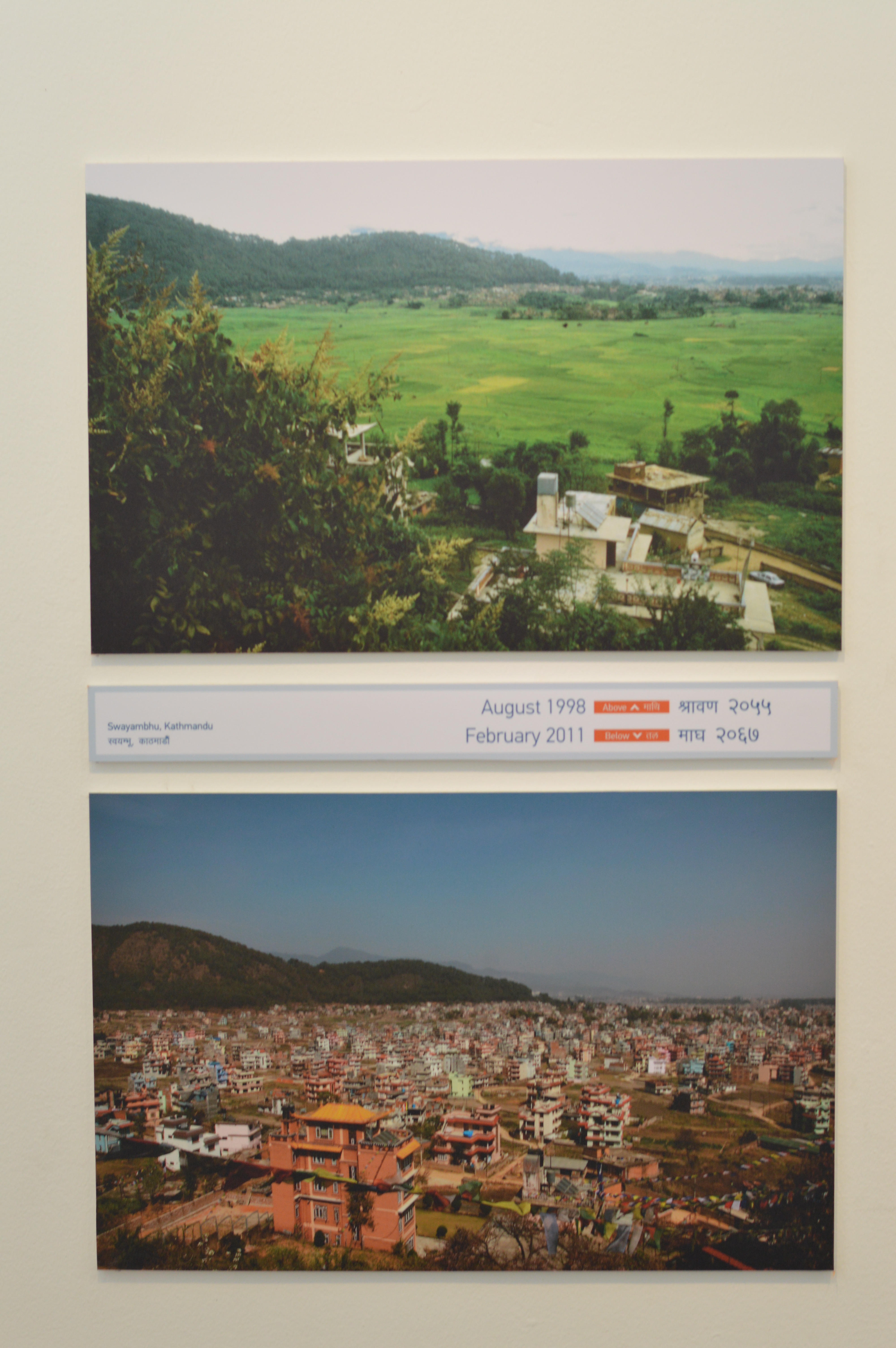
This is a photo of a photo, taken at the Climate Plus Change exhibition in Kathmandu last year. Among the collection of poignant, climate-related photography, this exhibit showed a number of before and after pictures taken inside the Kathmandu Valley, documenting the developmental changes over a relatively short period of time.

Can you actually believe that this is the same scene across just 13 years? The only real clues are the shape of the background hills and a small building at the right-hand foreground of the picture. Truly unbelievable. I have been here two years and I know that the sprawl continues to grow, probably at the same rate, its just harder to see when it occurs incrementally around you every day.  Its been four years since the lower picture was taken and the Swayambhu area now has literally no patches of green, other than the hill that overlooks it.  All this sprawl is in unchecked, unplanned, and unsupported by any growth in roads or services.  Its a sad reality.

Five Days/Five Photos: Day 3 Kathmandu Microbus


DSCF7306

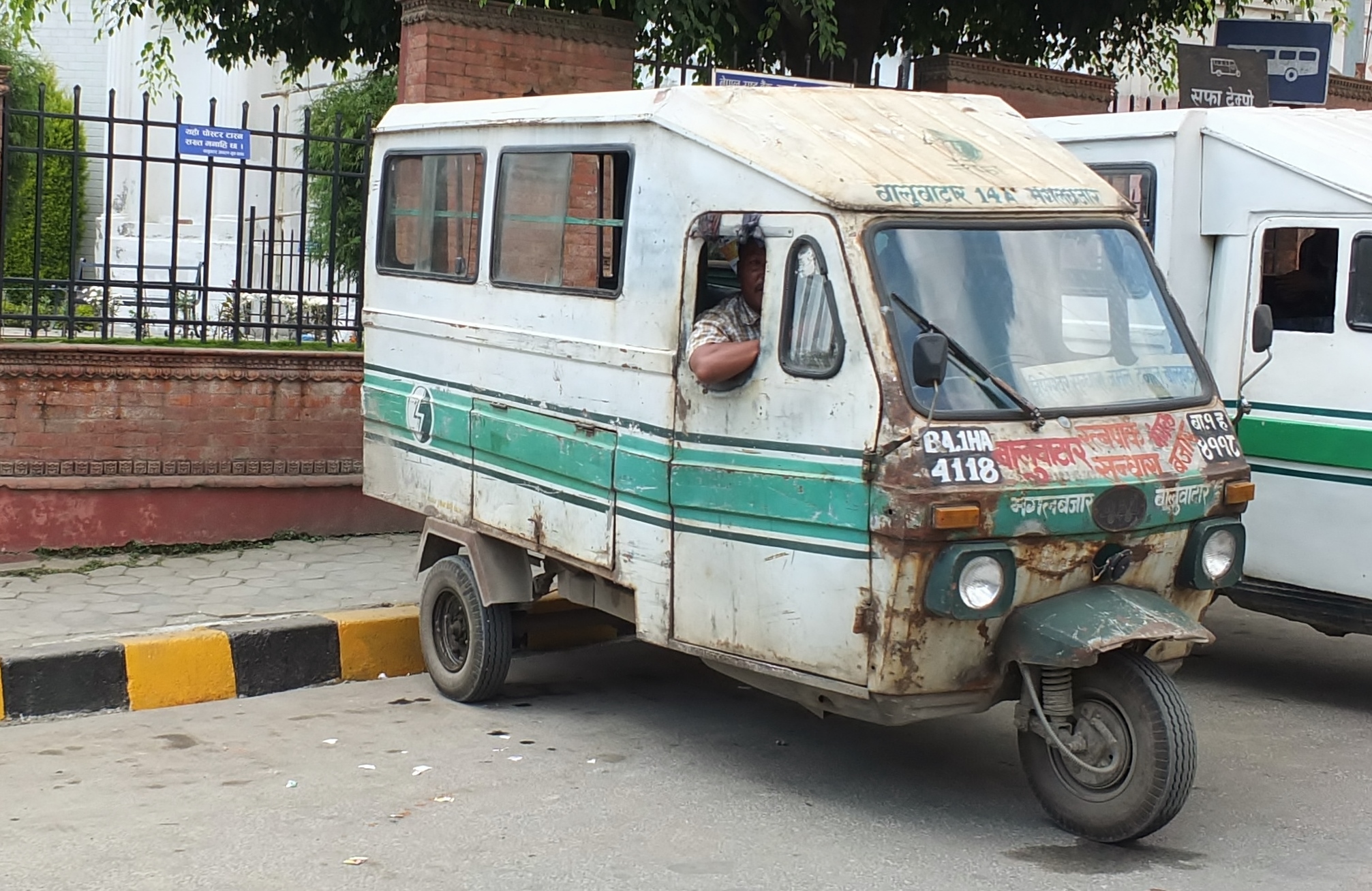
I lived in Kathmandu for several weeks before I spotted public transportation. The white taxis and micro buses were invisible to me. Maybe they just faded into the background behind the colour and confusion of everything else. Maybe my eyes were still trained to see the bright colours of Filipino jeepneys. I’m not sure. But slowly they came into focus; there they were: plain, white, rickety and very small. The idea of a Jeepney ride always seemed more fun than it actually was, as Jeepneys face inwards and there’s no view.  But their colour baits you, which is actually the whole idea behind their outrageous designs. By contrast, the idea of riding in a Kathmandu microbus seems no fun at all. I can’t imagine actually cramming myself into one. Where would I put my legs? My head would scrape the ceiling.

It wasn’t until much later that I spotted the microbuses were all electric vehicles or EVs. It was a shocking revelation in a city that pays little attention to pollution or lead levels. It was later still that I learnt that EV microbuses were a USAID-supported innovation from a while back….of course. Despite the rust and hanging exhaust pipes they are still on the road. They may be the Jeepney’s poor cousin, but whatever would Kathmandu pollution levels be like if they belched carbon too?