Coming Home


DSC_0272

We get around more than most people, I know.  Last summer was pretty intense with travel.  This summer even more so.   My travels started in June and will continue until the end of September thus:  Manila – Washington DC – New York – Washington DC – Greece – Kathmandu – London – Kathmandu….with enough side trips at the various locations to keep us permanently living out of suitcases for a long while yet.  When we got to Greece a couple of weeks ago, I posted “Home, finally!” on Facebook and someone asked me to explain what that meant.  It  made me wonder about the definition of the word, and what feels most like home to me.  I certainly would have defined home as Manila at different points in the last two years, but our Greek home is Home in so many ways.  For others, working overseas for a while and planning to return to the place where you grew up is pretty straightforward classification:  permanent home and temporary home.   We however have been moving around for so many years that I have lots of definitions.  There’s:

Original Home:  London.  Where I grew up and where I visit almost every year.  That’s where my family is and so many familiar things.  Many unimportant, trivial, yet comfortingly familiar things like chocolate bars, tv shows, bus stops or familiar streets.  Going to London is like a grounding in who I am and where I came from.  But as the years go by there are very little concrete remains of the old memories, and very little real “home” except for the care that my family gives me.  Out on London streets there are very few doors left that I can knock on any more, but I still consider myself a Londoner.

Adopted Home:  New Jersey. There’s the NJ town where I lived for lots of years (one of my favourite places) and American friends and family and the cultural connection I have built over the last 25 years of being married to an American.  Its less about the place and more about the culture.  I don’t miss NJ.  I do miss the town where I lived.  Now I am an American but I’ ll don’t think I’ll ever consider myself a New Jerseyite.

Assigned Home:  Wherever we are posted.  It was Manila, its about to be Kathmandu.  I’m sure I will learn to love (and dislike) many thing about Nepal and, like the Philippines, it will become part of my world “home” places as all the crazy new stuff becomes normal and navigable.  But in an assigned home for a predetermined period of time works very well to deter you from the kind of attachment formed in other places.  Its really just the people that stick with you.

Permanent Home:  Greece.  Home of our house, our things, and friends we see every year. The place where we raised our son for his preschool years, a place of consistency…sort of.  Every year is different and this year more so than most.  But there’s something about returning to a place where your clothes are already in the closet and your favourite sheets are on the bed that makes it a Home with a capital H.  I’m sure we are classified by many locals as one of the temporary summer families that are around for a short while and then are gone through the majority of the island’s year.  But, unlike other Summer families, we ain’t got no other home to go to!  (You’d have to be a Londoner at chucking out time to get that one.)

The Elusive Greek Tomato


Greek-tomatoes

Greek Tomatoes from Crete. Perfect, regular and probably tasteless

Greek-tomatoes

More perfection of appearance (only)

Mythological Fruit or Lost National Treasure?

When I first came to Greece in the early eighties it was a vastly different place.  Since then so many things have changed — for the better and worse — before we even get to its economic troubles today. It always easy to look back and see a kinder, simpler time and let sentiment cloud judgement.

Back then I was a twenty year old English girl who grew up on fresh fruits and vegetables from the local greengrocer (not a supermarket) including seasonal Canary Island tomatoes and home grown tomatoes from my dad’s greenhouse in August.  Canary tomatoes are small, uniform, and not particularly special, but they sliced up beautifully in perfect little segments on a salad.  When I first saw a Greek vegetable stand the lemons were piled high with leaves still attached and knobbly, misshapen bright red tomatoes were everywhere.  When you cut them open, they were red through and through, juicy, sweet, and full of seeds which seemed to randomly cluster throughout the flesh of these tomato monsters.  Quite frankly, they looked a bit weird.  Cut up on a Greek salad they were easy to eat because they tasted so good, but they shook my limited definition of what a tomato should be.

Flash forward twenty five years and I am beginning to doubt that those tomatoes ever existed in Greece.  Now they seem impossible to find, and have been replaced by large, uniform fruit that look impressive and much more perfect, but cut them open and — I’m sorry — they are just not Greek enough.  I’m told time and time again that “so and so” has fantastic tomatoes this season, and off I go to buy some.  Only to be disappointed in what I find. So much so, that I’m starting to question whether I have idealized them to the point that no mere tomato can ever live up to my expectations?

I’ll illustrate this with a story.  My husband loves the Greek dish, Macaroni me Kima.  Its a Greek version of Spaghetti Bolognese with the distinctive addition of cinnamon.  The basic recipe is not complicated and there’s not that much variation on how to make it.  I would make it for him and ask how he liked it and he would always say “its very good, but its not like Maria’s”.  He could never tell me what Maria did to make it so good and she wasn’t around to ask.  I tried numerous versions of the recipe, but as I say that’s not that much room for variation.  From time to time I would ask a Greek friend (or better still her grandmother) to show me how to make it.  Every time the preparation seemed pretty standard to me and Robert’s reply was the same:  “very good but not like Maria’s.”  It literally took me 15 years to realise that it was not Maria’s skill as a cook that my dish missed, but the long hike to her house and the hard work outside in the Greek sun that preceded the reward of her Macaroni me kima lunch.   It was the context and sentiment that my recipe lacked.  So, my question to myself was whether this was happening here with my elusive Greek tomato?

Greek-tomatoes12345

These are tomatoes?! You have to friggin’ be kidding me! I would be embarrassed to give these away.

Greek-tomatos12

Perfect, shiny and a beautiful red. Buy me it screams…but look at the cut away. That white ring is a good sign its tasteless and probably mealy too. No thank you! I’m not obsessed with this….really!

I went to buy tomatoes last week from a local grocer who has fresh produce three times a week.  She is a lovely woman and I don’t question her sincerity one bit. She told me the prices of two types of tomatoes she had and one was twice the price of the other as it was the better product.  The more expensive variety was mostly green and had the shiny, plastic appearance of wax, the hallmark of something raised in a greenhouse. I asked her if they were imported as that might account for the difference in price.  But no, the box showed they were Greek.  Really?!  Here we are in August, in Greece, and this is the best you have on offer?  Something is really wrong here.  Has everyone bought into this myth that perfect-looking tomatoes must be better?  Am I the only sane one left?!

I don’t think its me.  I don’t think that the Greek tomato of the 80s and 90s is a myth in my mind.  I think its demise is the work of the bastards at Monsanto and other giant seed companies who are messing with our food, messing with our culinary heritage and messing with our seed stocks.    Its heartbreaking to know that profit is driving them to purchase traditional seed stocks with the intention of discontinuing them permanently, so they disappear from our tables forever.  The replacement is proprietary, hardy seed stocks which produce perfect-looking produce that resist disease and transport better at the price of quality and taste.  People buy into the glossy perfection of perfect produce and forget about taste.  How else could I ever explain the grocer’s honest belief that she was selling me a better product?

Greek-tomatoes123

Now this looks like a good tomato! I can’t taste the picture but my money is on this one. Do you know how many google images I had to scroll through to find this..? Which is kind of my point…

But I still live in hope that one day I’ll bump into an old farming family in the corner of a laiiki somewhere who will sell me tomatoes from his grandfather’s seeds that really taste like a Greek tomato.  If this ever happens, I don’t know that I’ll even eat them.  I may just scrape out the seeds and save them and start my own subversive tomato farm somewhere.  Someone has to save this national treasure if it hasn’t already gone forever!

Kaiki Trip to Kounoupi


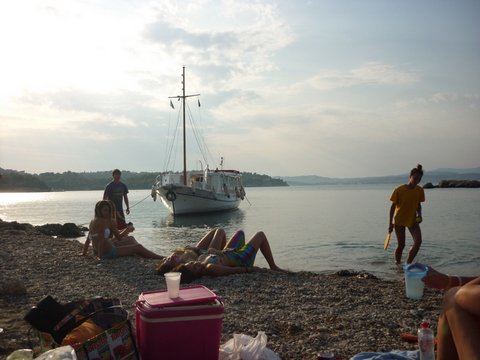
Every summer for the past 15 years or so, we have been lucky enough to return to Spetses.  And every year we have been able to take a least one late afternoon boat trip out with friends to enjoy a beach a short ride away.  Sometimes the trip has been around the island, stopping at 3-4 different places to swim along the way.  Other times we gone to beaches on the mainland or just around to the other side of the island.  Mostly its the weather that dictates where we go.  But, weather permitting, the first choice with most is to go to Kounoupi, a little island about 20-30 minutes away by boat.  Kounoupi means mosquitoin Greek, but the island’s name doesn’t refer to the amount of bugs, just its small size, which is tiny really, small enough to swim around if you are so inclined.  But most friends aren’t.  We just laze around on the small beach, taking frequent dips in the water and sharing food from the dozens of bags that get unloaded like a 747 on to the beach.  Usually it around 5pm when we arrive and the sun is still warm but not scalding and its a much more comfortable time to be at the beach.

The communal pig out

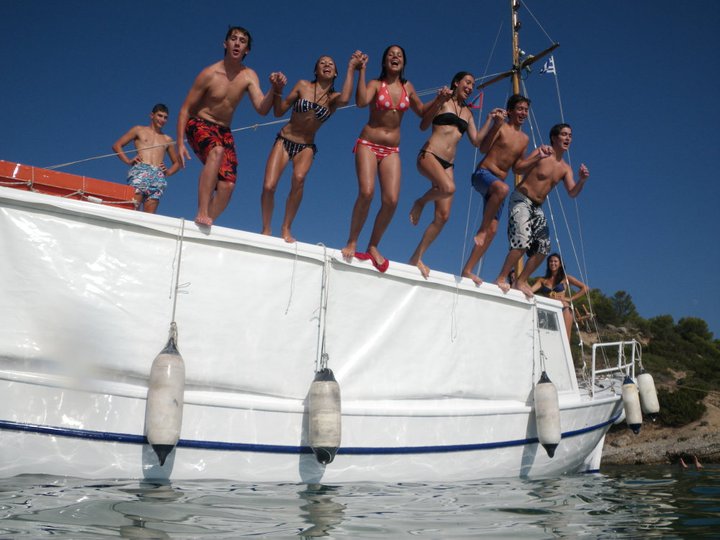
Ten years ago, most of the kids were little, bobbing around in the shallow water with water wings while we watched from the shore.  When they got older, jumping off the Kaiki roof became the main activity.  Hours of entertainment!  I never was brave enough to do it too, nor did my stomach ever quite stop doing a flip every time a child jumped.  We still couldn’t take our eyes off them for fear of a bad fall or somebody landing on another’s head, but no accidents thank goodness.

These days the kids are almost all seniors or college age and the years are numbered that everyone can converge altogether.  They mostly lounge around on the beach like the adults or take 10 zillion photos of one another. Kaiki roof jumping is still cool, just not as all-consuming as before.

This year we celebrated Latham’s birthday on the beach with 10 year old sparklers that I pulled out of the back of the cupboard somewhere.  Amazingly they still lit.  We ate a crumble birthday cake — this year it was peach or rhubarb — and sang happy birthday just as the almost full moon was making an appearance behind.

“Happy Birthday dear Latham…..”

The best part though, for me, is the last part of the day.  The sun starts to go down and the water and sky turn a nowhere-else-on-earth purple for a magical 20 minutes.

As it starts to get dark and the chain of bag loaders have done their job, you realise that there is no choice but to get back in the water and swim to the boat.  The water seems cold and the idea of getting wet and staying wet for the journey back seem so uninviting.  But in you go — because you must — and the sea is warmer than you thought, the moon is shining on the water and suddenly swimming all night seems like a really good idea.

For the trip back, the kids traditionally all climb to the roof where they all get the best view (why is that? and when do we get a turn?) and we take a moonlit ride home.

Teenage roof hang out

This year Lucy, Linda and I hung off the bow and dangled our feet in its warm wake.  Aaaah….. ‘Til next year, ladies…

Linda and I being Greek goddesses of the night

Revisiting Profitias Ilias


The church of Profitias Ilias (Prophet Elias/Elijah) is always the highest point in a given area in Greece, referencing Elias’s mountaintop Biblical stories. On Spetses, the church is at 245 meters, which is predictably the highest point on the island.  Not such a great height I know, but it’s high enough to give significant views out to both sides of the island.

We hadn’t visited in a really long while. Its a small detour from the Anagiri hiking path and most of the time our hiking party is just eager to get down to the beach. But I remembered going there when Latham and his friends were small (about four years old) and we hadn’t been back since. When we used to live in Spetses year round, it was best to go outside the summer months, especially with little kids. Here’s a few “then and now pictures” as contrast, both taken from the sterna (cistern) in front of the church. Happy days!

Latham and girl friends in front of Profitias Ilias, Spring 1999 I think.

Same spot July 2012. Unfortunately not the same group (except for Latham of course). But still a very rare “mothers and sons” pic.

The front of the church has a large working cistern. Here’s some more pictures from beside the well:

Clear Spring day 1999

Hot and hazy, July 2012

Hike to Anagiri


We have hiked over to the beach on the other side of Spetses for several years now. It takes 1.5-2 hours at a leisurely pace and I think most family and friends know the route now by themselves. About 15 years ago someone painted discreet red dots on the rocks to indicate the route. The dots have mostly faded or become covered in moss, but its not too difficult to remember without them.

Early morning start at Agios Vassilis

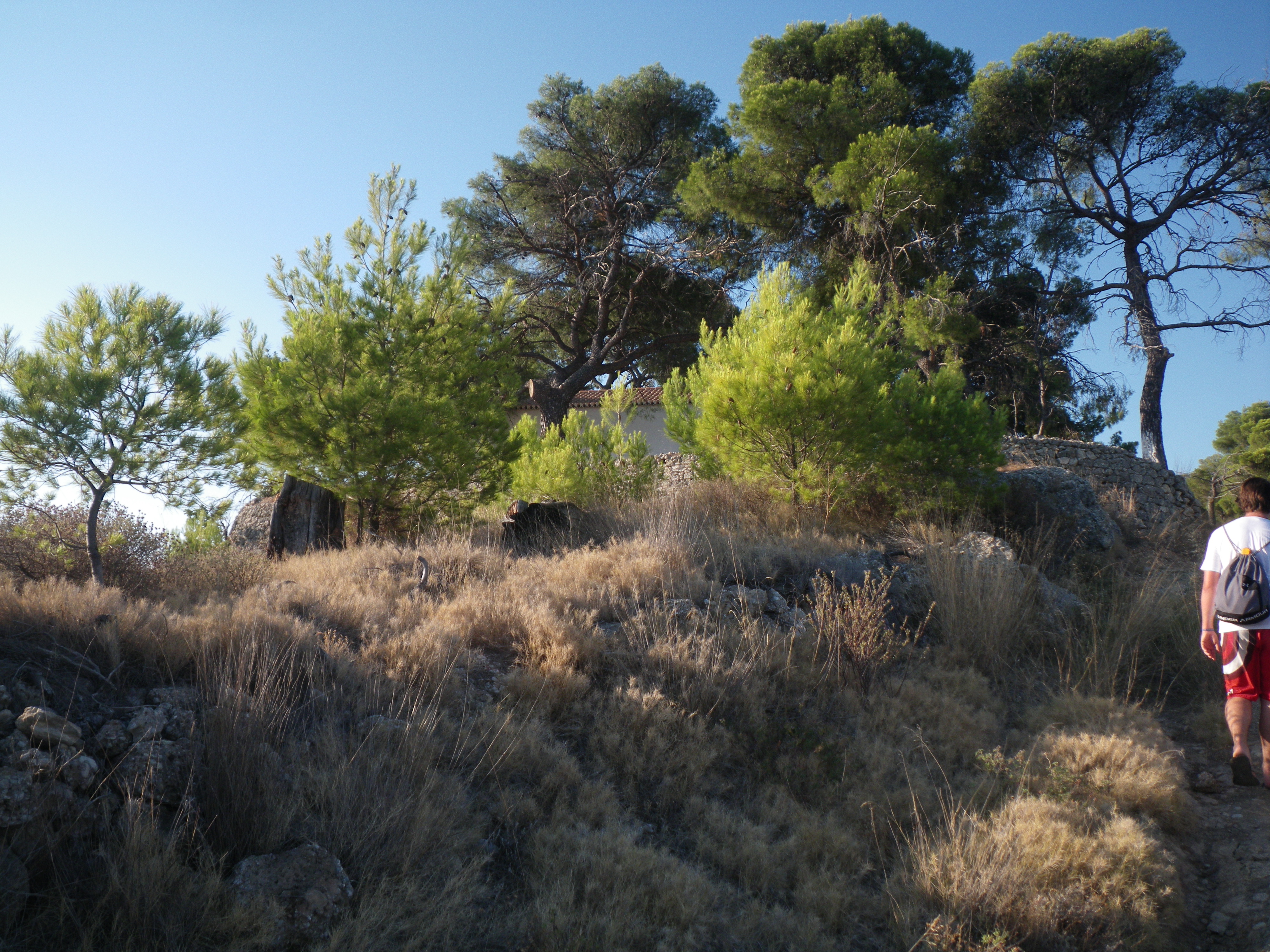
We usually get going early, around 7-7.30 am to avoid the sun on the ascent up to the ridge behind Agios Vassilis church. Its a steepish climb for about 20 minutes through the pine forest, and then a gentle climb up to Panagia Daskalaki, an abandoned monastery/church set among the trees. There are really pretty views from up there and we usually take a breakfast break as a reward for the climb.

Following the trail up to Panagia Daskalaki

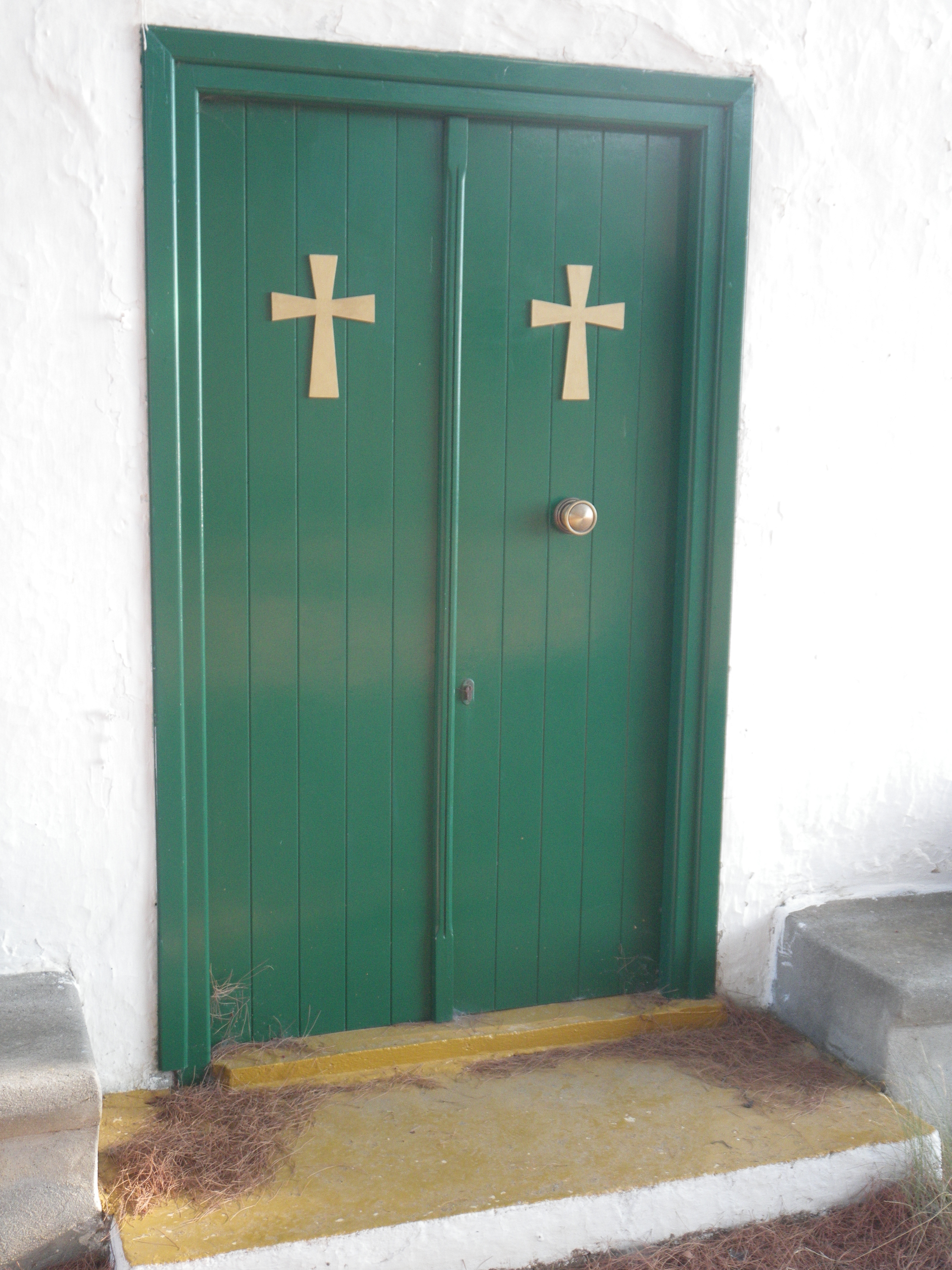
The church itself is kept in pristine condition and visited on its saint day each year and there’s even still a functioning cistern full of fresh water. However the living quarters have long fallen into ruin. When we first visited about 15 years ago, the kitchen area still had a roof, and the sleeping quarters had a dangerously caved in roof still in place. Now the sleeping quarters are just a roofless shell.

Breakfast break

Ruined walls

After Panagia Daskalaki the trail leads to the wide ridge road that runs like a spine down the centre of the island.  From there onwards its a mostly gentle, winding descent to Anagiri beach.  The trail used to be well shaded with pine trees, but about 12 years ago a major fire ravaged the back side of the island and now its just an open and dusty trail.  A shame, of course, because the trees were so pretty, but also unfortunate because it means that the hike back is only for crazy people who can handle 100 degree plus direct sun beating down on a slow, dusty ascent.  We take the bus back!

Taking the trail down to Anagiri

Destination Anagiri – reached! Now for a swim….