Volcano Hiking at Mount Pinatubo


A few weeks ago now, while Helen was visiting us in April, we went hiking at Mount Pinatubo.  It’s something I’ve wanted to do for a long while, but it takes some organization and prior planning.  I had visited the area earlier, but we only viewed some of the devasation it caused to a local church.  This time we were going to get a close up look at the volcano itself.

It’s a pretty unique opportunity.  Mount Pinatubo is a volcano which erupted in 1991, causing the second largest volcanic explosionn of the 20th century.  Its eruption coincided with the heavy rainfall of Tropical Storm Yunya, which amplified the devastation significantly. The eruption lasted 9 hours, caused two earthquakes, and the erupting lava mixed with the excessive rain resulting in 10cm of ash covered an area of 2000 square kilometers, killing more than 800 people.  Half a billion dollars in property was destroyed and entire communities were wiped out.  The top of the volcano collapsed creating a massive caldera, which today is a large lake.

20 years later the cliffs formed by the volcanic explosion are starting to grow greenery

Today the journey from the outskirts of the devastation to the lake is across a lunar-like landscape, broken up by multiple riverlets running down from the caldera lake.  The first part is covered via jeep for about an hour, as it can only move at a very slow place across the rocky boulders and river beds.

The lunar landscape that is crossed by jeep

An hour out, the journey moves to foot.  Rattled from the jeep experience, and under the burning sun we walked for almost three hours to reach the lake.
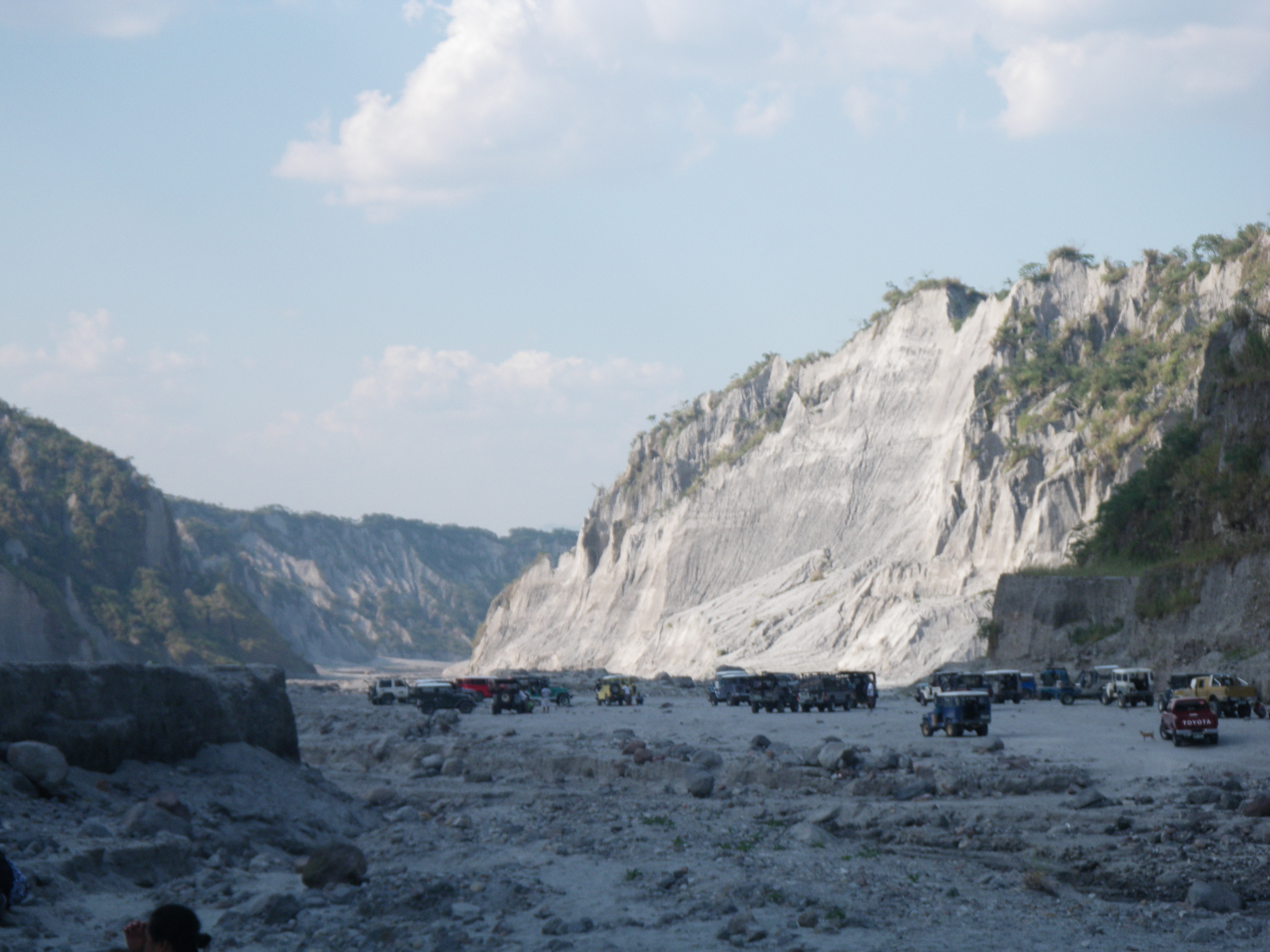
The ascent is gradual, and the path is relatively straightforward. But that doesn’t make it easy. There’s lots of scree and its easy to slide on the loose gravel, and it was particularly hot that day. The sun came out and stayed out. I wore a hat but felt like my brains were being boiled! There was very little shade. It took almost three hours to reach the last part of the journey, up some steep steps to the plateau in front of the lake.

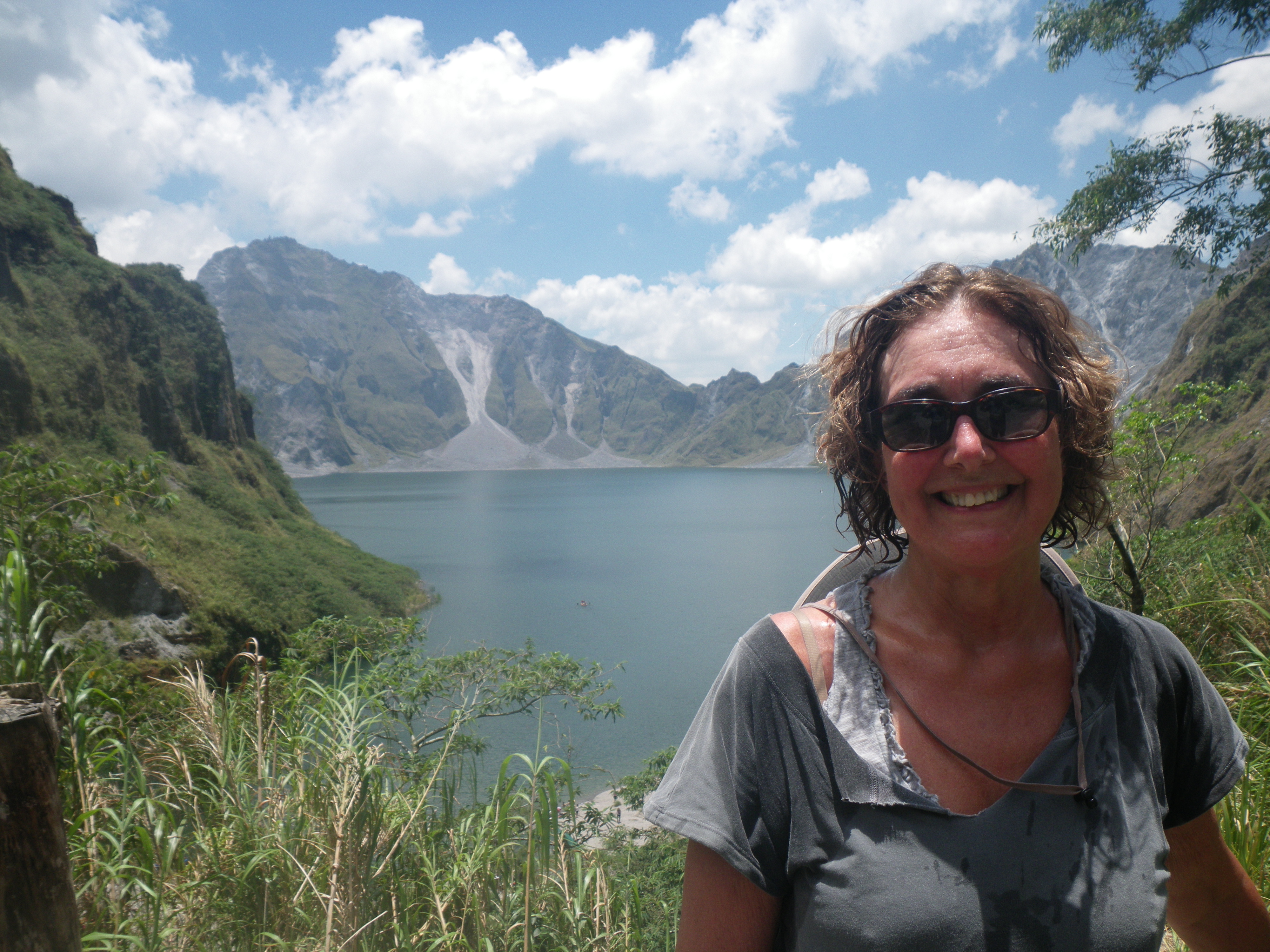
A victorious smile from Helen who was a trooper!

I was dismayed to see that there was little shade at the top, which was occupied by others, and it was another steep climb down to the actual lake shore, which meant another climb back up. We took a little rest and a food break and found the energy to go down to the shore.
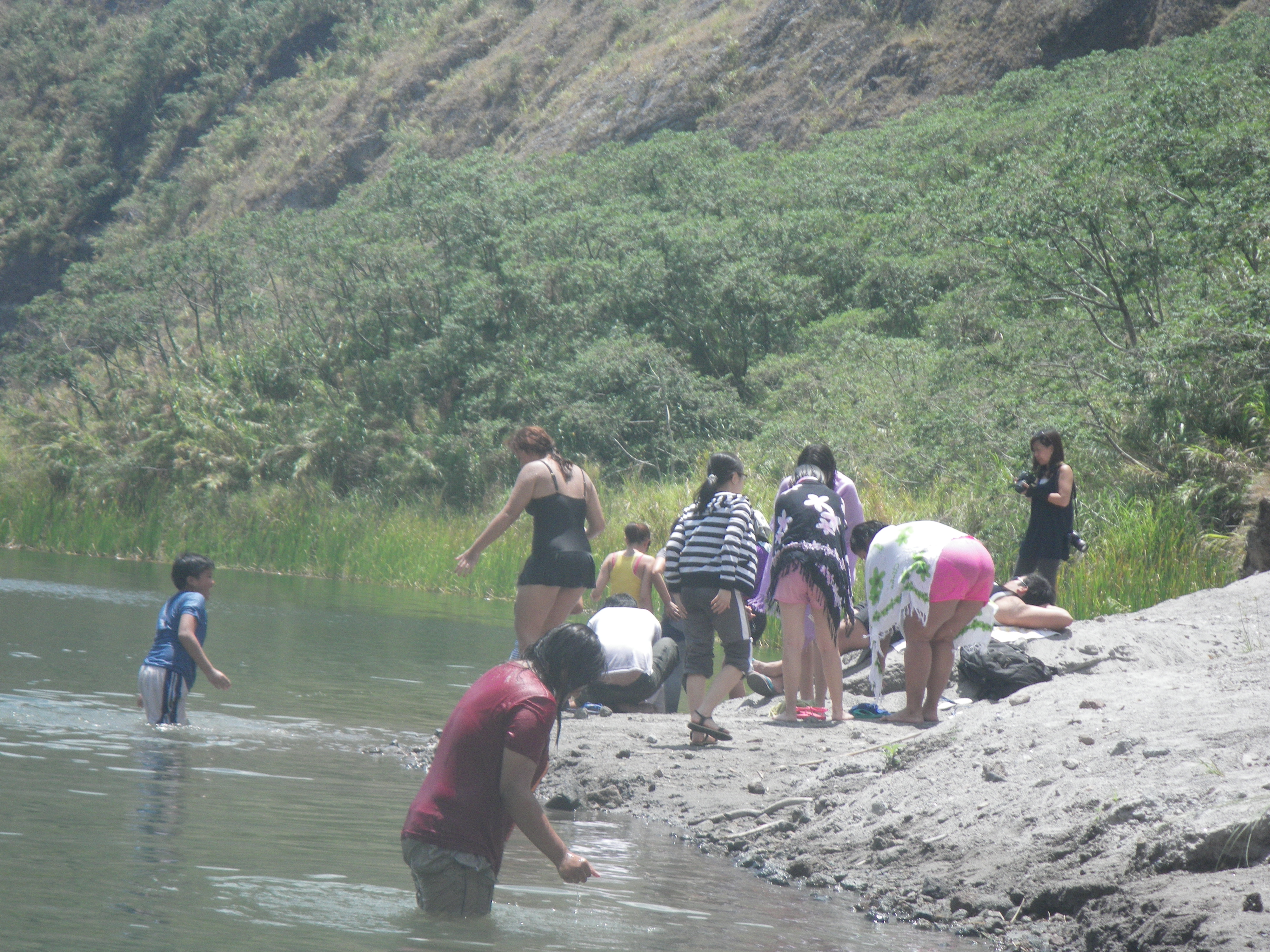
Others paddling down by the lake’s edge

Some were in the water, but changing into swim wear was not an easy option, and the banks of the lake were really steep – it was caused by a volcanic explosion after all – so we stayed on the lake’s edges and paddled. A bit disappointing really, because the thought of plunging into cold water kept me going all the way there.

Taking a boat out on the lake and a close up of a landslide, which were all around

We had started the day at 2.45am, waited in our building lobby one hour for the driver who didn’t actually show up until 4.30am. That put us at basecamp one hour late, and  there were no more jeeps available to pick us up. We were 7 people, and the jeeps only hold 6 (so we were told) so we had to split be up into two parties when the first jeep was finally found, which probably meant we couldn’t all hike together. 45 minutes later, Helen, Latham and I were finally picked up by a driver who didn’t know where he was going. The back door was broken, the side doors opened by themselves. We stopped to help another jeep with a flat tyre that turned out to be our stranded friends. We all piled into our jeep, which now was magically holding 9: the driver, the 7 of us, their guide and our guide. That’s three in the front, four in the back, one guide on the bonnet and the other holding on to the back of the vehicle. Photos don’t begin to show the whole picture!

The guide sat on the bonnet the entire time (with the other hanging off the back). How they stayed on is a mystery to me!

Being packed like sardines had its advantages when we drove in and out of river beds or bounced across dried mud and tire tracks. It stopped us flying around the vehicle as we were all jammed so close together. There were no handrails. The key fell out of the broken ignition on particularly bumpy spots, stalling the vehicle. The insides of the doors were missing, revealing the inner workings of the window and door handles. It was the crappiest, most abused vehicle I have ever traveled in.

However, our experience wasn’t even close to one reported by others. Other friends, coincidentally, had decided to visit Pinatubo that day. However, they had gone with a large group of about 30. Instead of supplying 5 jeeps to hold six-a-piece, some genius sent everyone out on a not-quite-large-enough bus, so some of the group had to sit on the roof. Of course, a long vehicle can’t handle the steep up and downs on the rugged trail, and after 20 minutes it got stuck out in the muddy, middle of nowhere. They were stranded in the lava fields for over two hours in the burning sun. They arrived at the crater lake, looking mighty pissed off, just as we were leaving.

The day was long and tiring, filed with amazing vistas and memories of a unique experience, but marred by really terrible communication and horrible transportation. It’s not the first time I’ve experienced this type of thing here. But for the uninitiated, the challenge is thus: Going in you know that the trip will probably encounter unexpected difficulties. What they will be, and how bad they will be, is unknown. Forewarned may be forearmed, but often there is nothing much you can do. Do you say no to the next one? Or do you make the best call you can and go for the experience?

At Your Bidding….


The State Department gives us about a year notice on the location of our next post and, unbelievably, our turn has come around.  I can hardly believe that we have been in the Philippines long enough to have arrived at that time, but here we are…   I’m not allowed to share the list publicly, but I can say that it is quite a mixed list with radically different places.   As this is only our second tour, we are still “directed”.  That means that we get to prioritize the list and tell them what interests us, but the powers that be have the last say.  And you may, or may not, get what you wanted.

This of course also raises the issue of “well… what is it that you really want?”  And the process of filtering through all priorities is sort of overwhelming and best dealt with in small bites.  Last time around, it was quite a bit simplier.  We had a high schooler who needed to go to a decent school that set him up well for college. Going into the second tour, he will probably be at college and we won’t be limited to posts with quality schools, or housing that is a shorter bus ride.  This opens things up, but also make it more complicated.  Robert is having a positive experience here, but it is only one type of work experience, and every post offers a unique experience in some way.  So growing and learning for him is obviously a big priority.  But there are so many others:  Do you really want to live there? What’s the housing like?  What do you do on your time off? How’s the work situation for me?  Does the new post offer some kind of respite from what ever taxes you here?  (For us that would be pollution, traffic and lack of infrastructure.)  Can you actually save money there? Nothing actually checks all the boxes.  One country’s fantastic scenery comes at the price of heavy pollution.  Another is a fabulous place that everyone will want to come and visit us, but the city is so expensive….  and so it goes on.  Its wonderful, overwhelming and frustrating at the same.  But I feel so lucky to be experiencing this, but you may need to remind me of that when they send us to the wrong place!  We’ll know mid-July.  Watch this space!

Palawan Adventures: Part 4 Underground River


When in Palawan, everyone tries to visit the Underground River.  Its one of the Philippines most famous natural attractions and has recently been voted as a contender for the Seven Natural Wonders of Asia.  It’s essentially an extensive underground cave system that goes into the cliffs for quite a few kilometers;  Eight, I think.  What makes it so unique is that the entrance is at sea, and the cave system is filled by a mixture of tidal and river waters, making the whole thing navigable by boat.

To visit from our location, we needed to either rent a boat or drive.  I think it was about a 4-5 hour drive, or a 3 hr boat trip away.  We picked the boat trip, for the shorter, unique passage, but it did mean getting up at 4.30am for a 5:00am departure.  Three hours on the banca – each way – with that noisy engine and headphones had me hesitating.  But everyone was a good sport to do it, and we set off just before dawn for the long trip.

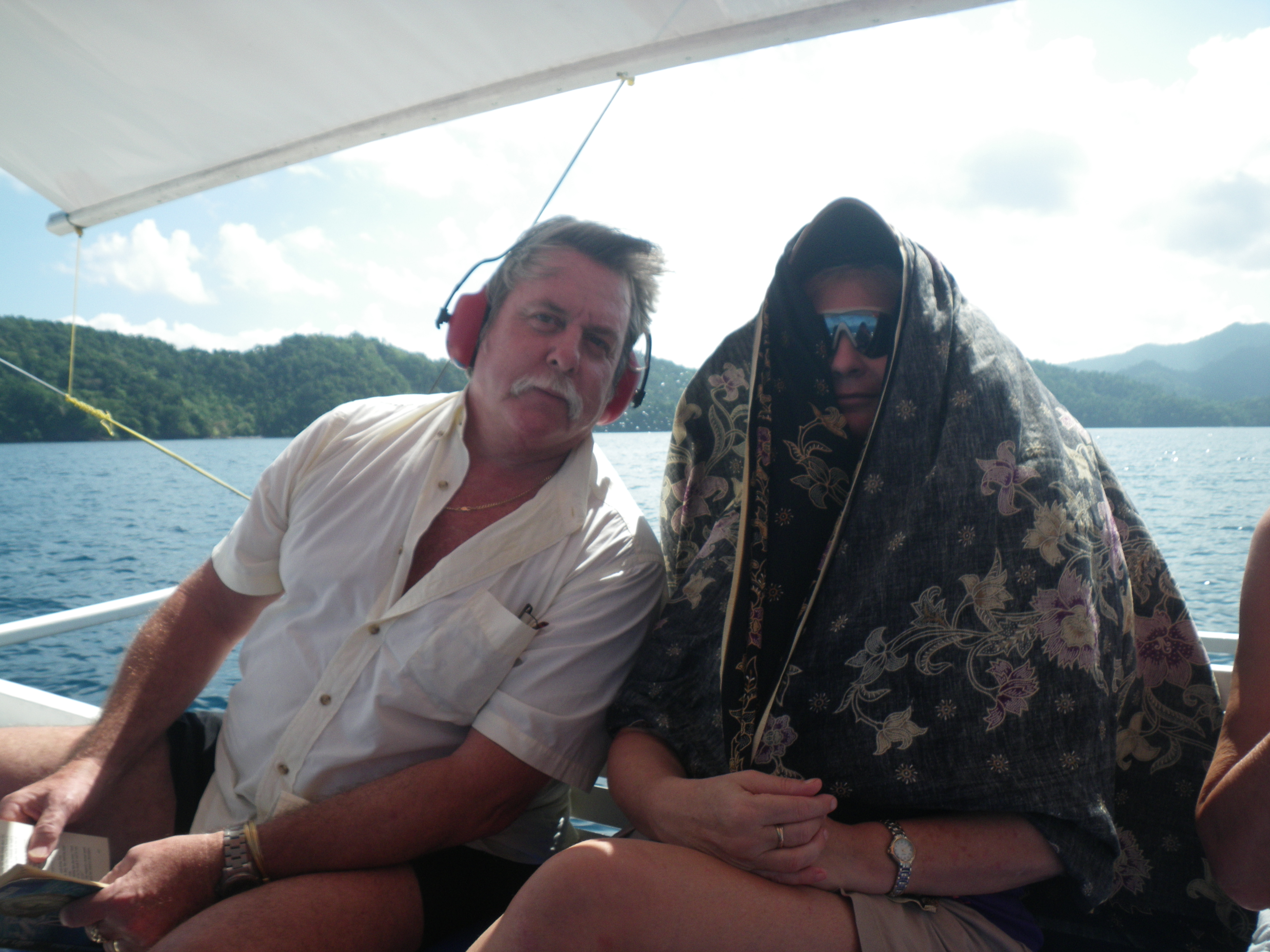
Sporting chic hat/headphone/headcover combo…

Three hours is a really long time on a vibrating, noisy banana with no cushions or real protection from the elements.  But it was such a unique experience to watch the sunrise over so much of the Palawan coastline, watch the early morning fishermen and putt past small islands off the coast.

Around 8am in the morning, we docked at a small beach and transferred to another little boat to enter the cave.  We learnt that they were expecting the heaviest traffic of the year that day, but we were the first into the cave.  4.30am paid off!  Our tour guide was awful and hilarious all at the same time.  His speech was a memorized script that was delivered in a monotone style – punctuated only occasionally in all the wrong places.  He pointed out the various stalactite and stalagmite formations to us as we sailed through, asking us to see Jesus, the Virgin Mary, mangoes and who knows what else in the formations.  I had a fit of giggles at one point.  He kept instructing Rob to point the boat’s light to the different formations, using the same language over and over again:  “Yes, yes, yes.  Move over there. Higher, higher.  More to the left.  Yes, yes, yes!” This was done so much, and for so long, that it got really creepy, like a bad porno script!

Robert asked him to shut up give us a few minutes of silence to enjoy the place.  I was reminded of our excellent kayak guide in Palau, who shared information and then paddled in silence a little, letting us enjoy the peace of the place.  (Not here I’m afraid).

Here’s a little footage of the cave entrance before it became to dark to film.  If you listen carefully you can hear our guide jabbering on in the background:

Aside from the guide, the cave was wonderful. I would like to have see more though.  More cave, less guide.  But that’s what happens with development.  Too many people.  I will say they do a very good job of preserving the mangrove swamp around the entrance, keeping tourists to wooden pathways and away from the forest floor.  The place was beautiful, but the boat trip views that really stay with me, despite the rain, hard seats and the god-awful engine noise.  A memorable day.

Palawan Adventures: Part 3 Chicken in a Box


No, we are not talking Kentucky Fried here.  The only thing fried about this chicken was her nerves.  This chicken was more than a little pissed off.  Her roosting place of choice was in a box next to the portable gas oven, where she hid and clucked like a mad thing.  No-one did effectively explain to me why she was ticked off but she crowed for a least half an hour.  Any attempts to go near her could get bloody.  We stayed away.

I’m not sure if she was named or not, but she was one of the many chickens roaming around the house.  I would go down to the beach in the morning and there would be one in the shade under my chair, or another pecking around for the early morning sand crabs.

It wasn’t hard to feel a connection between the food we ate and its source.  We were surrounding by coconuts, chickens, crabs and fish.  All our staples were ordered over the phone and brought in by boat from Port Barton.  But, with a little blood, sweat and tears, we could have mustered up a Robinson Crusoe style meal if we had to.  It was all right there.  So far, removed from KFC’s chicken in a box!

Palawan Adventures: Part 2 Ode to the Coconut


For some reason in Western culture, coconuts can be a little bit silly.  Throw a few coconuts into a skit and you have South Pacific spoof.  Two coconut shells and a grass skirt is a man in drag. Paint one up and stick one on a pole and you have a coconut deity.  You can “go coco” or throw things at them to win prizes.  This song sums it up really: 

Around the Philippines however, they are a major source of so many products and foods.  The trees are everywhere.  Leave Manila for one hour on the highway, and there they are:  Buko (young coconuts) to drink, dried coconut, fresh coconut, coconut oil, coconut matting, coconut fibre, palm fronds for roofing, woven palm frond mats, coconut shell products… the list goes on.

Walking around the house in Palawan, coconuts fell quite frequently from the trees.

I actually thought twice before cutting through the coconut plantation near us.  Every hour or two there would be a heavy thud, and a coconut would land on the ground.  Have one of those hit you and you’d know about it!  Stats say that 150 people a year die from falling coconuts.  More than sharks, I understand.  (But even that stat has an air of ridiculous about it.)

The caretaker cleaned the young coconuts for us and handed out buko drinks.  The machete handling is anything but silly: 

Occasionally the caretaker would go around and pick up the fallen coconuts and toss them onto a pile.  You see this piles all over the Philippines and they look like discarded  refuse.  But they will come back at some point and pick up the shells or the fibre casings to make something.  Nothing is wasted.

Palawan Adventures: Part 1 Getting there


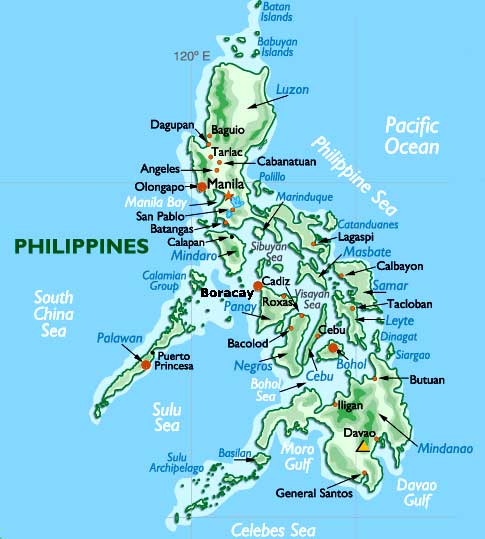
Palawan is the long skinny island in the Western Philippines and just over an hour flight from Manila.  It is considered one of the last remaining virgin jungles in the country and was one of our “must visit” locations during our stay.  It is very undeveloped, with only coastal roads, many of which are just mud tracks and impassable at times.  Jeepney’s run all over, but the going is slow.  Our northerly ride from the capital of Puerta Princesa to Port Barton was about 3.5 hrs.  To travel north further all the way to the Northern Tip of El Nido was more like 6 hrs.  Travel in the less developed South even slower.

Getting to Palawan has been a multi-stage journey, which started actually deciding what our experience would look like.  After my earlier convoluted explanation of how we came to find a rental home in Port Barton for our next great escape, we booked it for Easter, staying for a week last month, and had a fantastic time. It is considered one of the last remaining virgin jungles in the country and one of our “must visit” locations during our stay.  Latham brought his friend, Rob, and Robert’s sister, Helen, joined us too, having just arrived from North Carolina just a few days earlier.

The next stage of getting there, after the plane ride, was the long ride in the air conditioned bus.  Our journey was interesting though, and the time passed quickly.  We stopped at our supermarket to load up with food, which we packed into the coolers the housekeeper sent down with the van.  (Smart).  She had put a few cold drinks in the cooler for us, to help us manage the heat (even smarter!) and we set off out of town.

The main road as far as our turn off was tarmacked as the going pretty easy.  But once you make the turn onto the Port Barton road, it is dirt track all the way for the last hour.  It rains so frequently and heavily that any maintenance work on the road is quickly worn away.  Here’s a little taste of the rougher patches:

Port Barton was small and charming, and we had more cold drinks in the shade while we they loaded our things into the small banca that would take us to the house about 20 minutes up the coast.  The muffler on the boat was broken and the engine made a horrendous sound, so they handed out ear muffs to drown the noise.  The boat took us past fishing boats and tiny communities consisting of little bamboo shacks, and eventually landed on a beach with one small house, waiting for us:

The house was perfect.  Located right on the beach, with a sand path leading to the door.  The layout was simple, but comfortable.  Each bedroom had a small fan, but the sea air was cool enough so most nights I didn’t need it on.  We spent most of our relaxing time either sitting on deck chairs on the beach, or sitting on beanbags on the small gazebo nearby.  At night we played board games with the boys.  There was a TV, but, mercifully, no-one turned it on.  We had a wonderful housekeeper, who cooked meals, washed up, and made beds.

Helen enjoying the view

We cooked when we wanted to, and she helped with the prep.  It was so relaxing to make a marinade, or top and tail beans on the beach, and come back to the kitchen all cleaned up and ready for the next round of culinary activity, reading a chapter or two between bouts of effort.

Teenagers know how to relax

A Place in the Sun


One of the best things, and one of the most challenging things about the Philippines is the lack of development.  Before we came here, I was excited by the fact that there are so many fantastic beaches and beautiful places that haven’t been spoilt by tourism.  Any place in the US or Europe that has been recognized for something beautiful or extraordinary has been “developed” to accommodate tourists and, hopefully, protect it  from the vacationing hoards to some extent or another.  Here its another story and one that taught me a more comprehensive view of my expectations when I travel. Undeveloped sounds fantastic because it means no crowds, no tacky tourism, and no limitations on what you can or cannot see.  All of these really appeal.  I am happy to explore with no airconditioning, no ice cold drinks with umbrellas and without a tour guide to show the way.

However, the flip side of undeveloped also can mean a lot of other things, which I’ve learnt are significant negatives for me.  Inexpensive hotels on idyllic beaches can be mean toilets that don’t flush, locks that don’t lock, cockroaches and worse.  It can mean a tourist free-for-all, where locals hungry for business, compete with one another to get tourist dollars from the few that visit, and leave the visitor feeling scammed or short-changed, not to mention the damage to the environment.  Development along with regulation (if enforced) is not always a bad thing.

So this left me searching for something in the middle. Where to go that was beautiful, where we felt safe, away from the masses, that really felt like we were experiencing the Philippines?  And there are plenty of beautiful resorts offering just that.  Stunning places with individual nipa huts in the water, amazing hotel rooms, or beautiful private islands.  Luxury, comfort, and a waiter with a tray as you drink in the stunning view at your window.  But it comes at a price.  These places start at about $300/night and go up into the thousands.

But it just seems too excessive to me.  Not just financially in a world where people live on a few dollars a day, but also in terms of what we really need to be happy and relaxed.  In a beautiful place, I just want peace and quiet, a little shade, some pretty water to swim in and a comfortable chair to read my book.  Yet the options for this, are few and far between.    Most places are either very inexpensive, barely functioning local accommodation, or international, glamorous resort chains at high prices.  Middle-of-the-road places do exist, but you have to hunt them down.

So, for our filipino travel experiences, I have been on a quest here to find somewhere that is our place in the sun, where we can enjoy some time off in the right place, at the right price.  Our Boracay experience is a good example and one that was partially successful.  But the fact remains that Boracay was just too crowded and commercial for us and that we needed something simpler and quieter.

So after much internet  browsing, I stumbled upon the idea of renting a beach house in the Philippines and found just what we were looking for…a small house on a quiet beach on the island of Palawan.  We booked it in November for Easter (yes you need to book that far ahead) and last month stayed there and had a fantastic time.  Post to follow!

And for anyone reading this that thinks that all of this is ridiculous, and that we are very privileged to experience any of it – good or bad – I would have to say, you are right.  We are.  A lot of it is justified in my mind as a trade off for the difficulties of Manila life and a way to get a little fresh air back into the lungs.  But please don’t judge too harshly.  You too may find yourself screaming and shouting at bad drivers, horrible traffic and ridiculous bureaucracy after too many months. It gets to you. Its the little breaks that help keep the privilege of the Filipino experience in perspective.

Buried Churches and Bats….Spooky!


Guillermo Church. Not a recent picture, but a really good one that shows what lahar can do to the countryside and whole villages. Look how deeply the church is buried!

Recently we visited Pampagna on an all day excursion, taking in churches, traditional food and a lantern festival. About 2 hours north of Manila, its the home of the still active volcano of Mount Pinatubo.  When it erupted on 15 June 1991, lahar flowed from the slopes of the volcano onto the surrounding countryside, burying everything in its path.  The massive eruption and subsequent destruction was devastating and one of the most powerful volcanic explosions in recent years.  Towns were completely wiped out, and the landscape was changed radically.  Over 20 years later, you can still see evidence of the explosion in just the grey ash colour of the soil, not to mention the property damage and strange elevated roads.  Among the many half-buried buildings that still stand is the San Guillermo Parish Church in Bacolor, which we went to view.  I cannot find my SD drive with all the photos, so I will have to make do with descriptions, which is a real shame as the photos were great!  (I blame the cat, who probably batted it and chased it from my desk to some remote dusty corner of my office.)

The townspeople excavated the altar and the retablo after the volcanic eruption and relocated it under the dome in order for the wooden retablo to fit.  And clean up and other repairs were done, of course, but the main church still remains half-buried in the ground.  IF I had pictures you could see the main entrance to the church is now through the first story windows and the altar now sits under the eaves.  The congregation sits looking down out of half buried windows, and bats fly occassionaly around the altar.  (I saw a colony of them nesting high up in the ceiling.) It was literally, bats in the belfry….and very weird too.  You can see where the expression came from.

Other than these oddities, its business as usual inside the church.  Its decorated, clean and cared for.  There was a baptism while we were there.  Everything is just a little higher than normal.

We are planning another trip to Pampagna next month.  This time to visit the slopes of Mount Pinatubo’s crater and to swim in the crater lake.  So more on Pinatubo to follow…. (hopefully with photos next time.)

Latham’s Shiphrah Birthing Home Film


Shiphrah Birthing Home is one of the local charities supported by the US Embassy Club here in Manila.  Shiphrah do an amazing job of helping the working poor with pre- and postnatal care for pregnant women, including delivery of the baby.  They have done an amazing amount of good with very little, for a long-time, renting a property for over 15 years to use as the birthing home.  Recently, they have agreed to purchase the building and have been fundraising for the purchase price.  We haven’t been able to attend their fundraising dinners, but we were able to help out a little with publicity.  Latham made a short, informative film about the work that they do.  Hopefully it will help them get the word out about Shiphrah, Latham was able to get high school community service hours for his efforts, and I had the privilege of learning more about who they are and what they do.  Please take a minute to watch.

Ship Visit


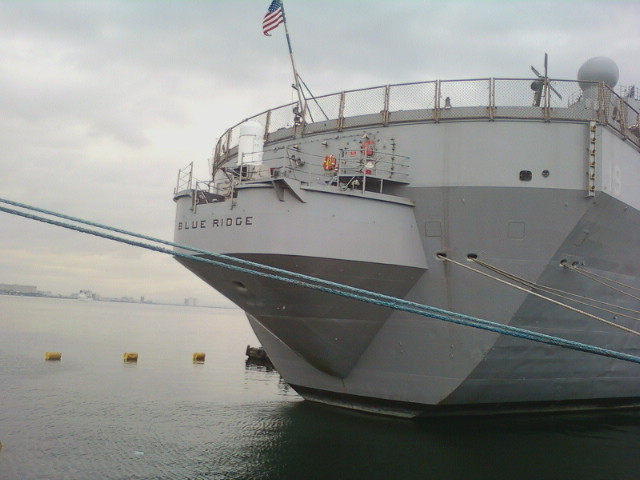
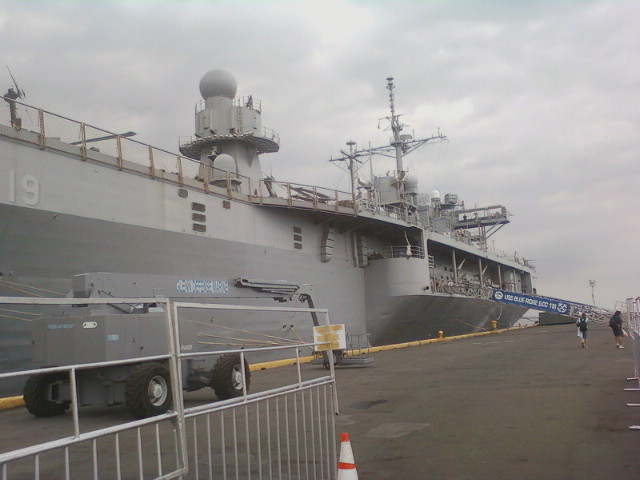
Yesterday was a very long, hot day for me, standing on the Manila docks.  The USS Blue Ridge was in, and on a busy schedule of media and community events.  Embassy personnel have the opportunity to tour the ship and I helped out with the buses and strict lists for who can board the ship.  Its been years since I hung out for hours on hot, smelly docks watching all the activities.  Fortunately they provided us with a tented area and cold water.  I took an umbrella for sun and rain protection, although both both never really made an appearance.  It was just hot, humid and a bit pungent around there.  It did bring back memories though of our cruise ship years, and sitting waiting for ships to arrive in the strangest of places.  All docks seem to have the same look and smells though…and Manila was no different.

I wasn’t able to board the ship because there was always a reason I had to be dockside, although 99% of the time I just sat there.  Sitting and watching the world go by on the docks can be sort of interesting in a relative kind of way.  (More interesting than -say – watching paint dry!)  And I did see scores of US sailors returning from shore leave, hauling all sort of different treasures that they had bought from nearby Mall of Asia.  The passenger ferry next to me had a full wash along the port side, dozens of trucks filled its belly and by the time I was ready to leave, I watched hundreds of passengers board the ferry for Dumagete, (our Christmas destination, although we will be flying).  Not a day to recommend as a good day out, but an interesting slice of life nonetheless….