More Fun in The Philippines


Latham’s preparing for his HS final film production and they want to include a green screen shot of a woman driving.  So this weekend they ran a few green screen tests.  Here’s his friend Carl goofing around to music to test the green screen and lighting.  Keep watching ….around the 1:00 mark, it all falls apart!  Makes me laugh every time…!

P.S.  I love how the green screen picks up the trees and makes them look like they’re on fire!!

Hammock Potato


Oh yes, Hammock Life!  October was really busy and the thought of three days away on a short beach trip at the end of the month really kept me going.  We booked a stay at Kookoos nest in Dumaguete on the island of Negros, a short flight away from Manila. It was a very small resort, consisting of half a dozen native huts directly on the beach. Apart from snorkeling and diving, there’s little to do except to hang around and read.  Enforced relaxation.  Exactly what we all needed.

View from said hammock…..

It was the perfect place to stay for us.  No air conditioning (but fans in the room), a private bathroom (cold water only…which I can tolerate for a couple of days) and private balcony (with spectacular sunsets), and it was surprisingly mosquito free.  There were plenty of bugs, though, if you chose to be bothered by them. I wasn’t — mostly — they didn’t bother me, and I didn’t bother them.  Except for the spider.  First night I head outside down the steps to the bathroom.  On the pathway, trying to negotiate the next step, is a very large, very hairy, black spider.  Or let’s just say it… the “t” word……tarantula.  Well, maybe not a tarantula – who’s knows, I don’t know spiders – but darn close anyway.  He looked something like this:

He moved very slowly.  I did a triple take to try and comprehend what I was looking at, then fled back upstairs.  Maybe I didn’t need to go that bad!  You can be sure I took extra precautions every evening, watching where I stepped.  Never saw him again!  Never wanted to!

After that excitement, the rest of the stay was very relaxing and uneventful.  I turned into a true hammock potato, reading 1.5 books in two days, taking four mini-naps a day.  The food was good and we ate three meals a day at their little restaurant, helping ourselves to the cooler bar whenever we wanted a drink.  I would definitely go back, despite my encounter with “Bertie” as I dubbed him.  You take the rough (and hairy) with the smooth, right?!

How to Toilet Train Your Cat


Butter wouldn’t melt….

Latham told me that as he was heading off to college next year, I should take this opportunity to buy a cat as a child replacement, or use it as an excuse anyway.  It was his way of trying to talk me into getting a cat.  I was pretty adamant that we didn’t need another pet in our mobile lives.  The cost, worries and sheer logistics just logically weigh the benefits of having a small, warm creature curled up on your lap every night.  Also, with Latham off to college, I can think of other things to do with my time than just have another entity to look after all the time.  But after a year of being worn down by cute kittens in the pet shop window and heavy hints from Robert and Latham, I finally succumbed, and last September we bought a very cute siamese.  And with her came the dreaded world of pet travel rules and regs, airline restrictions, and worst of all, what to do with her during the complexities of changing post.  Like I say….a bad idea in every way except that we all wanted a cat again.  Logic loses to emotion, yet again.

So over here in teenage land, I am dealing with potty training again.  Living in a high rise apartment meant a kitty litter tray – we’ve never had to have one for any length of time before — and its nuisance and smell.  Plus kitty litter is very expensive here.  (A ridiculous, heavy, luxury import if you think about it.)  Our helper very graciously does most of the dirty work, but our kitchen area is completely unliveable without some scooping upkeep by yours truly.
Tired of the expensive kitty litter and smelly bathroom, I looked online for alternative litter tray products and in the process discovered the wonderful world of toilet trained cats.  The prospect of toilet training her so that she did everything but flush, was very appealing and we started the process about a couple of months ago.

I’ll spare you pictures of the first part.  Essentially you just move the kitty litter tray from its original location, slowly, until it is located adjacent to the toilet.  Then, as she accepts that, you start raising it, slowly…using boxes or telephone directories ….one at a time…. until the kitty litter tray is parallel in height to the toilet seat.  Its very important that the raised tray is secure, non wobbling and able to take the force of her leap without scaring her. Depending how far away the tray’s current location is from the proposed toilet, this could take days or a few weeks.

Once you have it parallel to the seat, you move it on to the seat itself.  Leave it there for a while.  She is now jumping up on to the toilet seat to do her business.  An important goal has been reached.  Again, structural security is everything.  Use lots of duct tape!  Make sure that the toilet seat lid is taped in the open position.  You don’t want that to come crashing down accidentally and ruin your progress.

Now comes the tricky bit. The litter tray has to go.  But cats like to dig and scratch around, and the noise of the water below can be a bit scary. So again, slowly is the key.

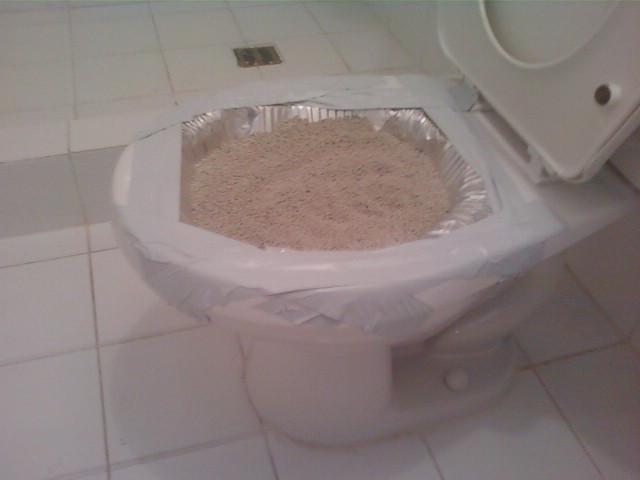
Raise the lower toilet seat and tape a disposable aluminium pan to the inside of the ceramic bowl.  It has to be tabled really securely and able to take the weight of the cat, Here’s my first insert:

Note ample duct tape securely affixed to clean dry surface. Can’t emphasis this enough!

Lower the seat so kitty has somewhere to learn to stand and balance and you have this….which is starting to look awfuly familiar:

The next step was to be cutting a small hole in the center of the aluminum tray. However, my husband unexpectedly stepped in and bought me the “Litter Kwitter” kitty training set, which does all the construction work for you. I had spotted it online, but as it cost $50 and I knew I could pull the whole thing off with cheap aluminum trays and a pair of scissors, I was too cheap to purchase it. But he did, and yes,it was easier with the pre-made trays, but doing it yourself is very feasible too. Just keep enlarging the hole — slowly over time.

As we were now Litter Kwitter owners, after 1-2 weeks of the pan in place as before, I inserted the orange LK disc, which has a medium sized hole as below:

This was the hardest stage so far. For the first week or two she missed more often than not. At first, we think she never aimed for the hole, hitting the water only accidentally as she tried to use the litter area around the edge. For us though, it was already a success as just having to flick turds from the ledge into the water and flushing was so vastly better than the litter tray. After about a month she was only missing occasionally. There was never any clumping in the litter as the “shorter” visits were hitting the water 100% of the time. Time to move on to the green ring:

More of the same, of course, except the hole is bigger. This is the stage we are at currently and I expect things to progress now so that we don’t need anything in a month or two. Even if she never progressed on from here, the smell and mess is negligible. I could happy stay here and never worry about a litter tray again.

Bottom line is that my description might make this sound like a lot of work for a long time. It isn’t. You don’t have to be diligent. There’s no timetable. I can forget about the plan for a week or two and life goes on. In fact that’s better, as slowly is the key to success. Of course, for an FS family, we do still have one more problem: How easily do toilet trained cats use other human toilets? Can I take her to a new bathroom in our Nepal home and will she adapt? Can I pop into the Ladies room with her at the airport en route? I guess we’ll have to wait and see!

Sign Language: Roadmap 2030


There aren’t many so many hilarious “Engrish” signs in the Philippines.  Filipinos usually have beautifully written English, correctly spelled with good grammar.  No struggling with “chicen” or “chikken” here.  Its always spelt “chicken”. Nor any not-so-delicious-sounding dishes such as “deep fried crap” on the menu.   But there’s plenty of other things that jump out for comment.  Here’s a large sign from Dumaguete airport from the local police force, outlining their vision and mission statement for their goals until 2030:

Its interesting how it seems both laudable (who wouldn’t want those goals), sincere, naive (given the many corruption struggles here) and a bit desperate (no-one in the west would write this, suggesting that things aren’t that way currently) – all at the same time.  And bringing the Almighty into a public service statement is just not done in the West.  Ultimately a more interesting sign than a badly spelled menu, I think.

Halloween in the Tropics


When we lived in NJ, October 31 was around the turning point for the weather.  The trees were still pretty with autumn leaves and the weather was pleasantly nippy, but not cold yet.  Halloween was mixed with the best of the fall, and kids could do things like wrap themselves in bandages as a mummy or wear black plastic sacks to be witches.  We’d bundle them up warm under the costumes and head out for candy.  You could see the kids’ breath when they yelled, “Trick or Treat!”

Not so in Manila.  Late October is the end of the rainy season and the weather is starting to get a bit drier and sunnier.  But we’ve had typhoons disrupt the Halloween festivities before, so they are no guarantees of a rain-free event.  But last Saturday our early Embassy Halloween party was dry with even the occasional breeze.  But that didn’t mean there weren’t a lot of sweaty spidermen in their black stretchy costumes, running around in the heat.  Its hard to wear a mask or man-made synthetic outfit without a river running down your neck or back.  And a kids party is not really the place to come as Tarzan, Pam from Baywatch or some other scantily clad character.  But that would have been much more practical!  I think everyone had fun though, they just headed back into the AC when things got too hot.

Halloween is surprisingly big here in Manila.  Not as big as Christmas, of course, but noticeably present.  But then Filipinos do have a propensity towards many things American, and Halloween is also a big dress up event.  Filipinos love parties, dressing up, all things sweet…so what’s not to love?  Well..costumes and humidity perhaps.  And there seems to be some that consider it anti-Christian, but despite the church and the weather it continues to grow in popularity.  Happy early Halloween everyone! 

Dangwa Flower Market


Its no secret that I love markets and this blog has had quite a run on them lately.  I’ve been back to Divisoria twice since my first visit, and each trip was a completely different shopping experience each time. Divisoria is such a warren, after three visits I can barely say that I recognize anything still.  It might take half a dozen visits and a good map before I’m brave enough to tackle it by myself.

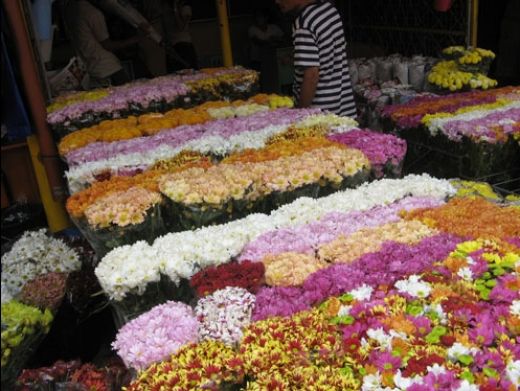
Quite different was my trip last week was to Dangwa Flower Market.  It’s somewhere I’ve wanted to visit since I first heard about it.  Not only is it a market, but wonderfully colorful, selling flowers at really reasonable prices.  There’s something about flowers that always lifts the spirits and to see masses and masses of them — a riot of colour — stretching out as far as the eye can see was a great pick me up at the end of a busy week.

For the equivalent of about ten dollars I bought 4 dozen roses, a dozen giant lillies, a selection of interesting leaves and berries, and three dozen pretty orange flowers that I’ve forgotten the name of.  Not bad.

The Dangwa experience is very different from Divisoria.  Its a 24 hour market which is busy but not heaving because buyers come at different times of the day.  The streets are paved, relatively clean and organized.  Its much smaller and more civilized.  I would totally go back by myself to look around.

Dangwa’s more civilized streets

Most of the flowers come from Bagio, a cooler area in Northern Luzon, and are brought down to Manila in unrefrigerated trucks in the early hours.  Then, depending on the day of the week and the time of year, they suffering differing extents of stress as they sit in the stalls outside waiting for buyers.  I was lucky enough to have a local flower arranger take our tour around the market on a Thursday in October.  She taught us that shopping there at the end of the week in the cooler months helped with both quality and variety of selection.  And she was right, we were there on a good day.  Everything looked fresh and good.  However, flowers in the Philippines are known not to last so long.  The heat, humidity and stress they encounter takes it toll.  We further compounded the problem by leaving the flowers for 4 hours (without water) in a hot van while we attended a flower arrangement class.  Then mine sat in my office for a further 4 hours before I went home.  The flowers were limp to say the least when I got home.  By Monday the petals were starting to drop.  If I hadn’t been so abusive, I’m sure I would have gotten a week out of everything I purchased.  I will definitely return — with a friend — as Dangwa is a great experience to be shared and takes the quality of Manila life up a notch.  Blooming lovely!

An Acquired Taste


Balut. The notorious Filipino street dish. Its a duck embryo inside of a hard boiled egg. A powerhouse of cheap protein, but maybe not to everyone’s taste.

American/European meat preferences are quite different to mainstream Filipino expectations.  Filipinos use every part of the animal to cook, and are very creative in utilizing body parts that westerners turn their nose up at: tongue, heart, lung, feet, bone marrow, cartilidge…you name it.  Most westerners squirm and make faces at just the thought of grilled lung on a stick.  I don’t eat meat at all, so I take the western luxury of choice and preference to a whole new level.  Vegetarianism is truly a luxury for those that can afford it or, for the poor or devote (not in the Philippines), the most dire and humble of diets.  An interesting contrast.

No-one I know has been hungry enough to eat anything they can find or choose to eat only lentils because of necessity.  I appreciate and admire the filipino ethic of zero waste, but as I won’t even go near Western meat recipes, I remain an interested onlooker in all of this.

The Filipino diet may originate from poverty, but middle-class and rich Filipino palates are more open to diverse meat dishes, so it a cultural thing as well.  The western palate largely confines itself to flavourful tender, lean cuts.  However tasty the flavour potential may be, westerners aren’t usually willing to dig around and work for their food, or to chew and chew to extract it.  This means no bones, no fat, no poking around with a fork to pull out the roe.

Filipino flavours also tend to be on the sweet side for Westerners.  My European palate thought Americans added sugar to everything.  Then I came here.  The bread is sweet, the mayonnaise is sweet, the meat sauces have a lot of sugar in them.  Unlike the Chinese sweet and sour concept, there less balancing of flavour.  Filipinos do add kalamansi to many dishes (its a small native lime) but its not always enough in my opinion.

So when a newly-arrived American family that has never lived overseas, is served chicken adobo by their newly-hired Filipino cook, there can be some surprises on both sides.  The cook may feel she’s done a good job of serving a tasty economical meal.  The American is wondering why there is a pile of bones and tons of rice.  Its a common point of contention, and some helpers who have worked for American families for years have learnt about American preferences.  Many others haven’t.

Which way is better is irrelevant if you’re not serving food that your employer likes.  So we decided to assist a little and run a cooking class for helpers on how to serve classic Filipino dishes to Americans.  It was well attended, and everyone had a great time.

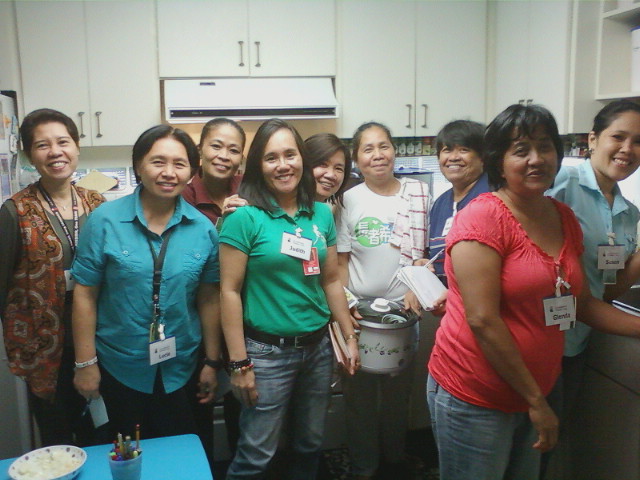
The ladies from our Filipino Cookery for Americans class

I popped in from time-to-time during the work day to see how it was going.  Of course, the class was in Tagalog, so I could only watch and couldn’t understand the instructors message.  I did wonder a little if it became an exchange of regional differences on the each dish, rather than a lesson on American preferences.  Or perhaps it was both, I can only really learn from the sponsoring families whether anything has changed at the dining table.  Time will tell on that.  However, the morning itself was great fun, and a it was a privilege to be invited to eat with everyone at the end of their efforts.  I also learnt how many food items I mispronounce!

On the food front, personally, I continue to be mostly uninspired here.  Its been fun cooking with the tropical fruit, but I’ve found the lack of fresh vegetables challenging and without easy access to markets, my food imagination has suffered. I’m not the cook my friends might remember, and this is the first country that I’ve lived in where I haven’t learnt to prepare the local dishes.  I don’t expect that to change before we leave, but hope Nepal’s temperate growing climate and more vegetarian-based cuisine will inspire me again.

P.S.  Here’s a link to an interesting BBC article on Filipino cuisine:  http://www.bbc.co.uk/news/world-asia-19541960

P.P.S.  No, I won’t be trying Balut any time soon!

Would you like fries with that?..


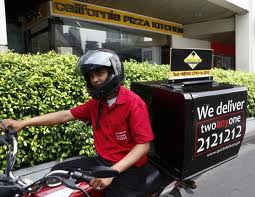
There are lots of lots of opportunities for home delivery of food here in Manila.  Just about everyone does home deliver … even McDonalds….even non-chain, independent restaurants.   You see the delivery motorbikes all the time, making dangerous moves in and out of the traffic.  We don’t really do it usually, but last night was an exception.  Latham had his final TOK rehearsal with his presentation partner, and I bought them delivered pizza to keep ’em going and keep ’em focused.

When the pizza showed up, I didn’t give it much thought.  It was just a pizza delivery. But what transpired was really adorable and sort of left me gaping.  The conversation went something like this:

Pizza Delivery Guy:  Good evening mam.  I present to you your pizza delivery.  Presenting your ham and bacon pizza, mam. <removes insulated carrier from his insulated back pack>

Me: Oh, er, thank you very much.

Pizza Guy:  Your pizza, mam, is delivered to you at 7:03pm, mam. A delivery of 24 minutes, mam.

Me: That’s great, thank you

Pizza Guy:  <removes pizza from carrier>.  Mam, this is your HOT on the DOT pizza. <he whips out a small plastic circular device and holds it over a thermal circle on the box. The disc reads “hot”> As you can see it is delivered Hot on the Dot.  <He points to the circle>

Me:  Oh, thank you, that’s great.

Delivery Guy: <opens box letting out half of the heat> Your pizza mam.  With no mushrooms as you asked.

<produces another box> Also, mam, your pigs in a blanket, mam.

Me: Thank you

Delivery Guy: <whips out a bottle from a previously unknown cooler on his other side>…and your Pepsi Max mam.  I must caution you to take care when removing the lid,  mam, to avoid accidents.

Me: Er, yes, good idea.  Let’s take care of the eyeballs. How much is that?….

Visit to the International Rice Research Institute


The International Rice Research Institute (IRRI) is about a 1.5-2hr drive from Manila.  I took a group out there this weekend to explore their facilities and meet some of the staff.  It turned out to be a great day!

IRRI was founded in the early sixties to help increase rice yields and improve rice production worldwide.  Their facility is huge with funding and staff from all over the world.  The compound includes offices, laboratories, housing and recreational facilities as well as acres and acres of experimental rice plots that monitor the growth of different rice varieties grown to combat challenges such as drought, soil salinization, pests and diseases.

Acres and acres of experimental rice crops

It also has the world oldest continuous rice cropping experiment which has been running since 1963.  For almost 50 years, the paddy has produced 3 crops a year in an experiment designed to teach scientists the effects of intensive cropping on long term sustainability and soil quality. It was developed with grat foresight in an era where sustainability was not a common area of concern, and has been a useful tool in combating some of the negative effects of the 1960s rice revolution that dramatically increased rice production by introducing new, higher yielding, non-local rice varieties.

Continuous high yield paddy

The long-term high yield experimentation fields

As these new, “super” varieties were introduced, IRRI also started a program to collect samples of ALL rice varieties from all over the world in an effort to save them from extinction.  They realized that varieties long grown in a specific location may offer have developed resistances to local conditions that the new “super” varieties had not.  Local varieties were disappearing and along with them their local “knowledge”.

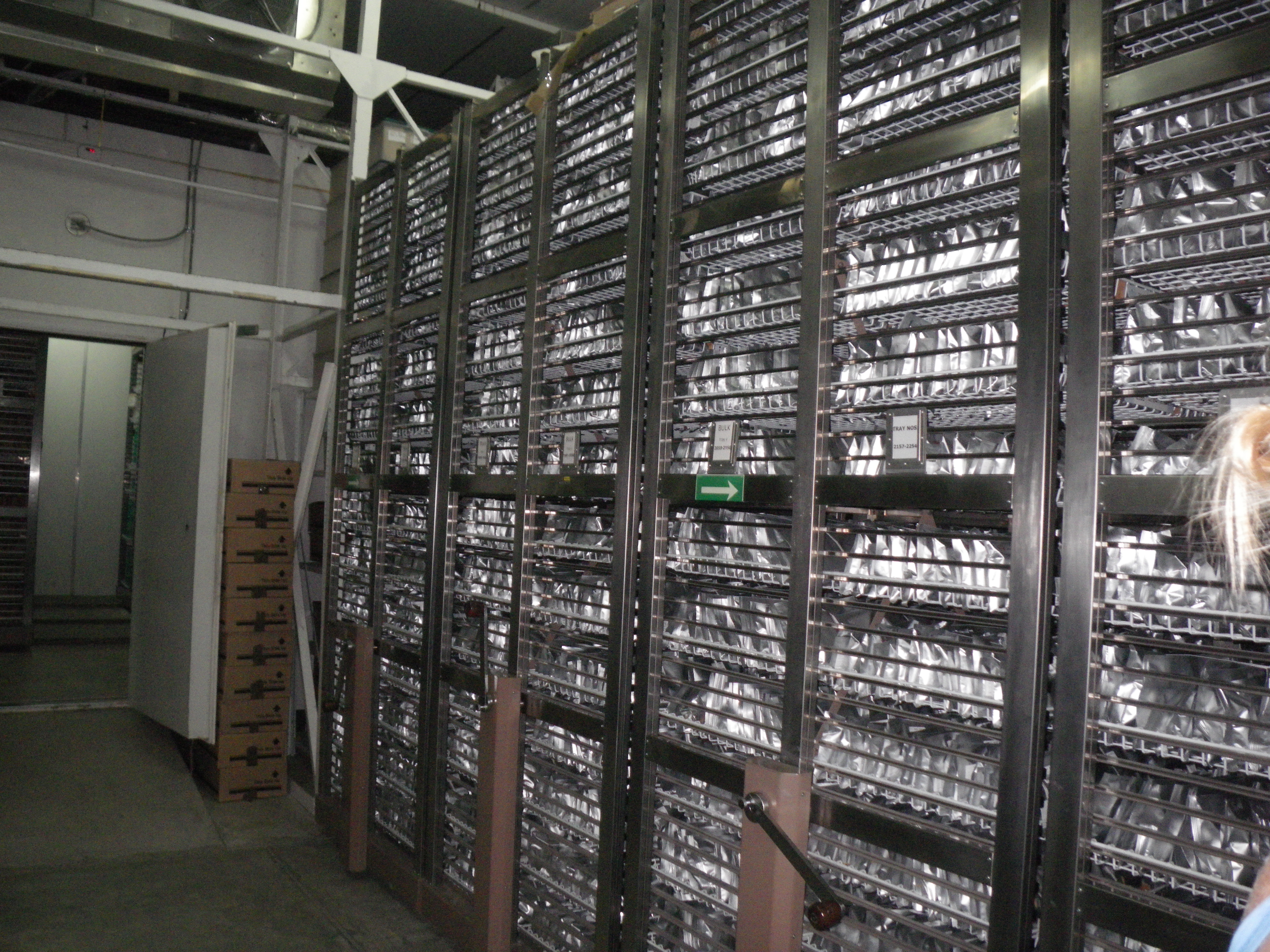
The IRRI Genebank now stores over 117,000 varieties of rice in specially designed cold storage rooms.  We visited the Genebank and stepped inside the 4 degree Celcius storage facility, which was like a library with rows and rows of silver pouches, each containing samples of a different variety of rice.  Interesting but too cold to hang out for long!

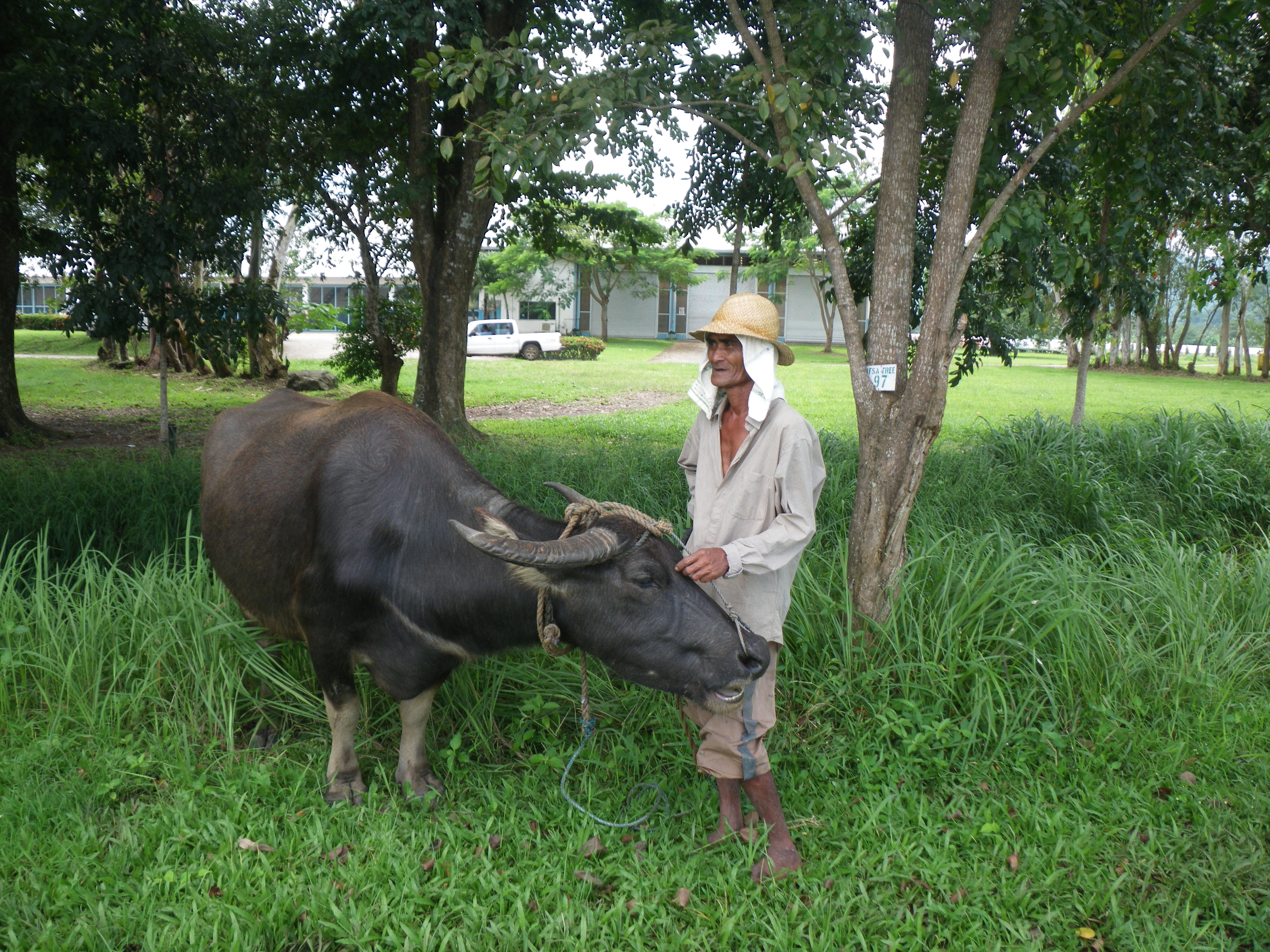
The last educational part of the day was a hands-on trip outside to learn about planting and cultivating rice.  Our group got to experience pulling a plough behind a carabao, as well as an power cultivator.  Others planted rice in the prepared mud.  Messy for sure, and a bit hazardous, as the carabao frequently stopped to “fertilize” the mud as he worked….but a lot of fun for those that didn’t mind getting muddy.

IRRI threw us a really nice lunch in their recreational area.  They were such great hosts and I know everyone really appreciated it.  The kids got to swim in the pool and cool off and around 2.30pm we sent off for the last part of the day – a short tour of the Makiling Botanical Gardens.

The tour lasted around an hour. The gardens were pretty, but more of a nature park than a botanical garden, in my view.  But certainly worth seeing and they made a pretty ending to a well-balanced day.  Great day out!

Community Welcome Party


Every year, most new families arrive in the Summer.  We were Winter rotation and sort of showed up incognito, and had to learn alot of the “how to” and “where to” information about Manila on the fly.  This was nothing new to us, as prior to the foreign service, every time we changed country we were on our own to figure that stuff out.  So, it was sort of a surprise to us that the foreign service has a sponsor system utilizing families with experience of the post to show you around, plus different events to help you acclimatize.

Vendors setting up filipino goodies to sell

One of these events is held in September to welcome new families with filipino food, vendors, and a little filipino culture.

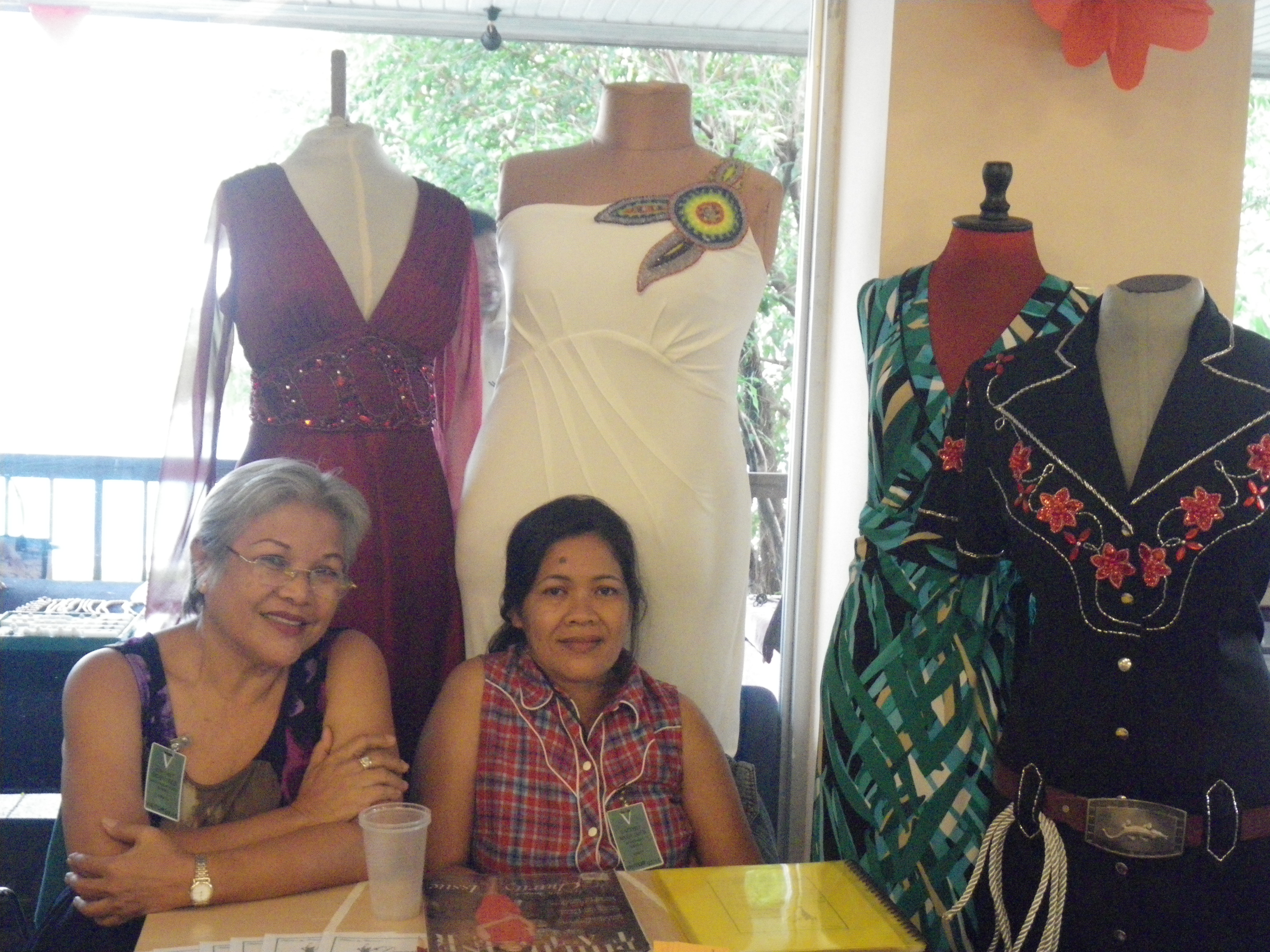
Tailors, vet, spas, local associations and others came to show newcomers their services

Organizing it was a real group activity with the ates (cleaners/helpers) doing lots of creative decorating with palm fronds, crepe paper and coconuts.  They built a simple nipa hut serving the traditional halo halo desert, a mixed concotion of shaved ice, fruits and evaporated milk.  A team of two filipino cooks prepared a filipino menu that included pork asado, chicken adobo and banana turon, all filipino favourites.  (We had been shopping for the food a few days earlier). Newcomers are sometimes immersed up to their necks in the challenges of settling into their new home and aren’t always the most appreciative of your efforts, but we had a pretty good turnout and I only heard good things from the crowd.

For me, the highlight of the day was the kids from the local elementary school who came to present a few traditional filipino dances and were just so adorable.  They were excited to come to the Embassy and did a really great job of dancing pretty intricate steps in gorgeous costumes.  They just lit up the room!  It wouldn’t have been the same party without them.