Exploring Jakarta (otherwise known as Being Traffic)


jakarta traffic

I saw one of those FB notices a while back that said “You are not in traffic, you are traffic”, which is nowhere more true than Jakarta.  Its hard to talk about a visit to Jakarta without tackling the subject of traffic.  In some ways it seems unfair to start there, but then again it colored everything we did while we visited and was the basis of many decisions made on where to go and when.  To an extent, its the same game in Manila.  By playing by certain rules, we avoid some of the Manila traffic, much of the time.  In Jakarta, it wasn’t so easy, both because of the area where we were staying and the fact that we were looking to do some touristy things.

This was our last chance to visit friends who live in Indonesia, and Manila is just a few hours flight away.  It was Easter, and another good reason to leave the Philippines where everything is booked up really early for the biggest holiday of the year.  (Last year we booked a house on Palawan which was wonderful, but I only managed to secure it by booking all the way back in November.)  What I didn’t expect in Jakarta was how much the Easter holiday would affect everything. I was surprised how many businesses were closed.  Jakarta is more than 80% Muslim, with a Christian population of approximately 12%, which is clearly significant enough to have some affect, although I’m suspicious that it was also some kind of Indonesian holiday as well.  I never quite got clear on that.  The bottom line was the city was more jammed up than usual and getting around was a greater challenge still.

Comparing the traffic to Manila was a constant temptation.  Honestly, it was pretty similar in a lot of ways.  There seems to be more major arteries running through Jakarta, with more lanes, but they are equally jammed.  More motorcyclists too, which were a real hazard.  What I didn’t see there was the large number of SUVs that you see in Manila. Instead there were many smaller, more European-sized vehicles.  There were buses, but somehow there didn’t seem to be as many as Manila, and I wondered if that explained why there were more bikes?

As hard as it is to sit in crawling, smelly traffic, you also can’t let it completely prevent you from seeing and doing things.  Leaving early, or going against the main wave of traffic, can make it bearable.  So with some strategy we set out early on Easter Saturday morning for a little trip out of the city.  The destination was a popular pancake restaurant about 1.5-2 hrs out of Jakarta.  An early morning breakfast on a hillside in the Indonesian countryside sounded like a really good idea, especially with an early start to avoid the usual weekend traffic.  Especially at its quite cool up there and you needed to wear a sweater…an almost unbelievable concept in the summer heat.  Coolness…view….delicious pancakes….let’s go, right?!   We left around 6.30am, and drove out of the city for about an hour making traffic-free progress until we hit a certain point on the expressway.  Then for about an hour we shuffled along, playing dodgems with other cars and trucks on both sides.  The hard shoulder quickly became a fourth lane, with cars trying to butt in and more forward faster.  But it made no real difference, we were at an almost standstill for the longest time.  For a while it was ok, because as a new visitor, driving at a pedestrian pace gives you time to study the other cars, passengers, suitcases and vendors selling food and snacks to stranded cars.  (It turns out deep fried tofu is a big roadside snack here.)  But after a while the curiosity fades and you just need to keep moving…and you can’t.  The hope was that traffic would open up once we cleared the toll booths.  It took us at least 30 minutes to clear the 2kms between the toll booth sign and the actual booths.  Once through, the traffic did open up a little, as some headed into the service station for gas and food.  Our gas was low, and we joined them to fill up.  Motorcyclists were parked at the service station entrance, wildly waving their arms at approaching vehicles.  In fact, it was with done with the kind of alarm that someone might flag down vehicles to take their pregnant wife to the hospital.  You were compelled to pay attention to them in the name of decency.  But, as it turns out, for a fee, they were offering a motorcycle ride up the mountain to escape the traffic.  I guess we were supposed to abandon our car at the service station and split up across several bikes…which was not even close to likely.   We turned into the gas station, where I learnt my second word in Bahasa, kosong, or empty.  Every single, damn pump.  Now we were in bad traffic and low on gas, sitting in a traffic with no apparent end…we had to turn around.  A short while further up, we took the opportunity to make a quick, illegal u-turn and, in moments, were moving normally on the other side of the highway.  Two minutes later we were back at the service station on the northbound side, and headed to the gas pumps for fuel.  An hour later we were back home, but spent most of the return drive looking at the other side of the road gawking at the stationary traffic which was now backed up all the way to the city center.  That was it.  A trip aborted.

This post was supposed to be about the charm of mountains outside of Jakarta, eating fluffy pancakes, enjoying the view and sipping some early morning Java…on Java…or at least one would hope…but instead its about the curse and reality that is traffic in mega Asian cities…  Sometimes things just turn out that way. ;o(

jakarta traffic2

Sign Language: …..and we’re back!


wang wang Came back to Manila today to discover it is a “No Wang Wang” zone. I would be very upset about this if I knew what it was! Later, Google told me it literally means “no sirens”, or more specifically here “no special treatment for self-important people who think they don’t need to line up”. As if….

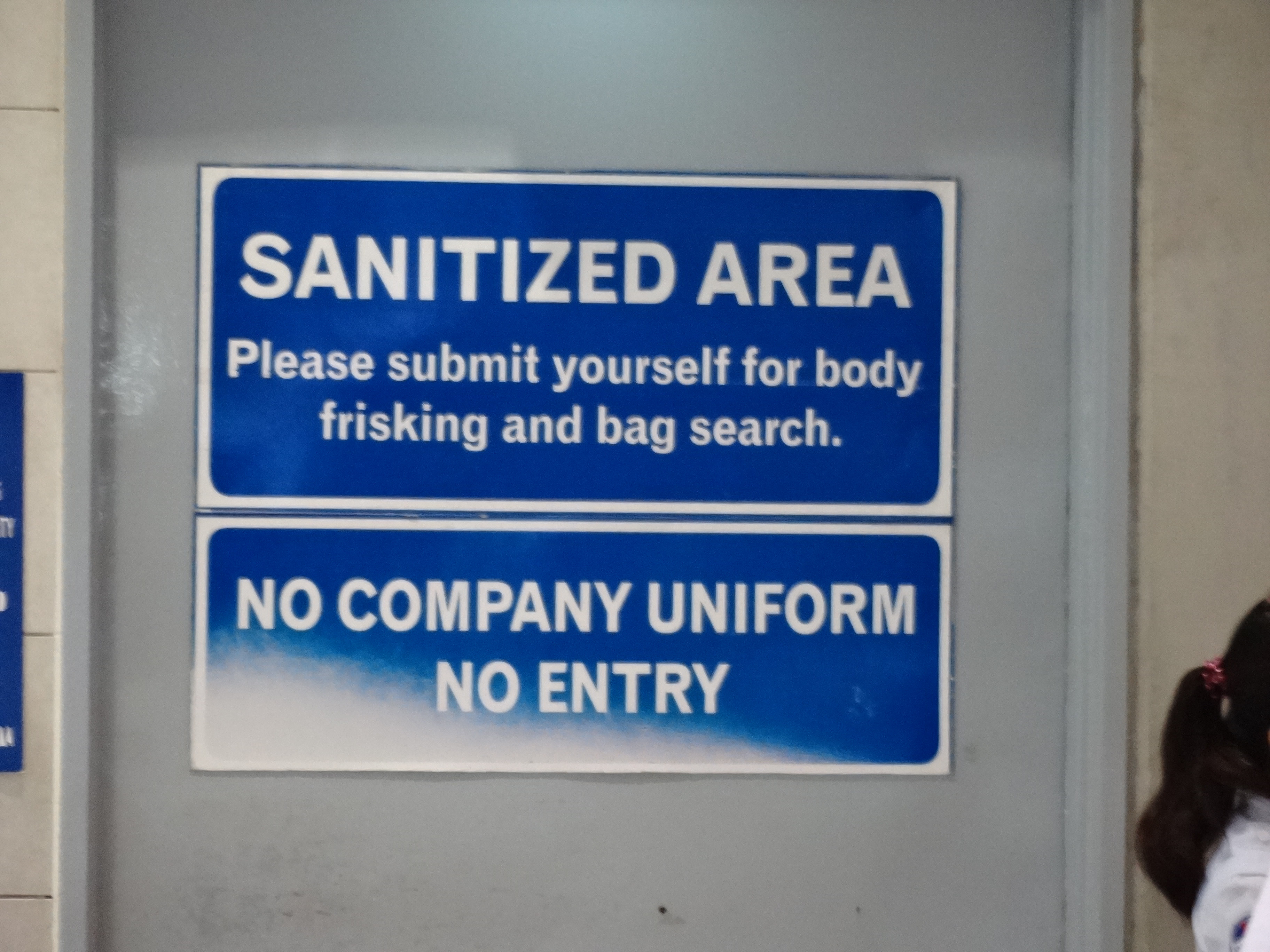
So… as I stood in line waiting… I glanced over at an interesting sign. If you got very bored standing there, you could always go over to the clean area and avail of their body frisking services which appear to be on offer.  Sounds too good to be missed:
DSC00171

Sign Language: This is not funny!


bomb jokes
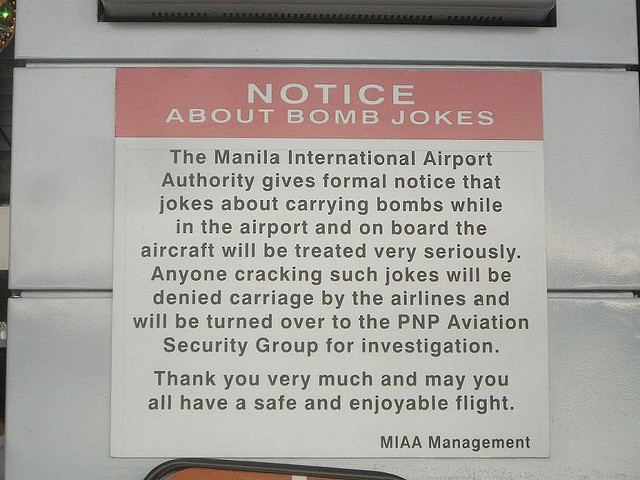
A quick post on the way out of Manila (Jakarta bound)….. I love this. What happened I wonder? Did bomb jokes at the airport become a national obsession with everyone and their granny announcing they had a bomb in their bag? Or did some clown take his gag too far one day? We’ll never know….but I won’t be “cracking such jokes” any time soon!

Sign Language: For Decorative Purposes Only?


Some people sarcastically comment that street signs here have no meaning and are only for decorative purposes.  I beg to differ.  Here’s my take on the functional interpretation of road signs here in Manila:

Sign:  Stop Sign

stop

Description:  Red hexagon

Possible Meaning: You may stop here if you feel like it, or if you would like to send a text

Sign: Pedestrian Crossing

crossing

Description:  White stripes across the road.

Possible meaning: Beware of foreign pedestrians shouting and screaming at you for some unknown reason

Sign:  Traffic Light

traffic light

Description:  Pole with coloured lights

Possible Interpretation of colours:  Green = Go.  Yellow = Go faster.  Red = Stop (unless your on a motorbike, then you can go anyway.)

Lane Markings

OLYMPUS DIGITAL CAMERA

Description:  White lines painted down the middle of the road.  Inexplicably, comes in two different designs:  solid or dashed

Possible meaning: A suggestion on how you might like to form lanes if traffic is not too heavy.

Sign: No Parking

noparking

Description:  White Circle with a crossed out P

Possible Meaning:  Other people may not park here

Am I wrong?!

pedestrians

90 Days Tick Tock…Tick Tock…


clock This weekend we have reached the 90 days until departure landmark. Its the unofficial start of the departure check list of things to schedule/do/complete before we go. And the list is long!  Its not that any of it is so difficult, there’s just a lot of it, and mixed in with family priorities going on at the same time, it pretty overwhelming if you don’t break it down into little doable bits every day.

Things would be a little easier if the people reviewing our travel orders could do so a little quicker.  They did stop by for a quick photo though:

supremecourt

How to Make Homemade Yoghurt


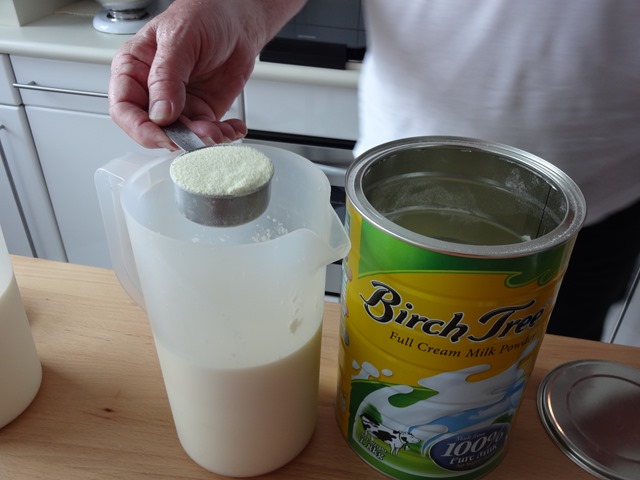
Yoghurt making equipment

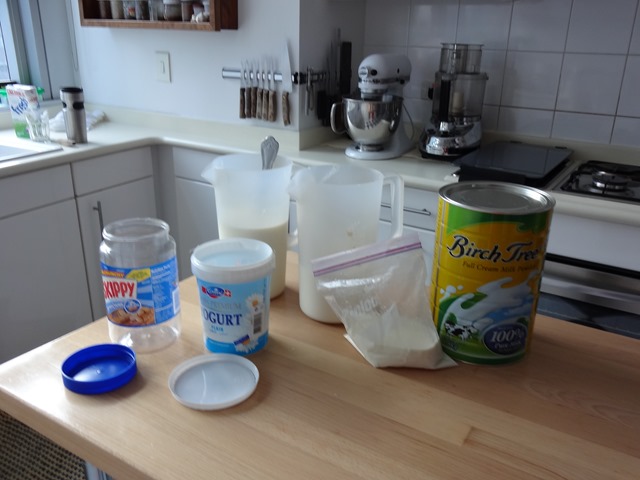
Assembled ingredients to begin the job

Ingredients to make 2 kilos of yoghurt

  • 2 litres of water or UHT milk  (you can use fresh milk also, but using that here is prohibitively expensive and UHT is just fine.  Water is fine too.  It just makes a less creamy yoghurt)
  • 2 2/3 cups of full fat milk powder
  • 1 cup of yoghurt starter or 1 cup of homemade yoghurt from the last batch
  • 1 cup of sweet whey powder (optional.  It makes the yoghurt creamy and taste like it has a higher fat content, although it actually adds no fat to the mixture.)
Sweet Dairy Whey

Sweet Dairy Whey adds creaminess and a very slight sweetness to the yoghurt without adding significant calories. You can buy it online.

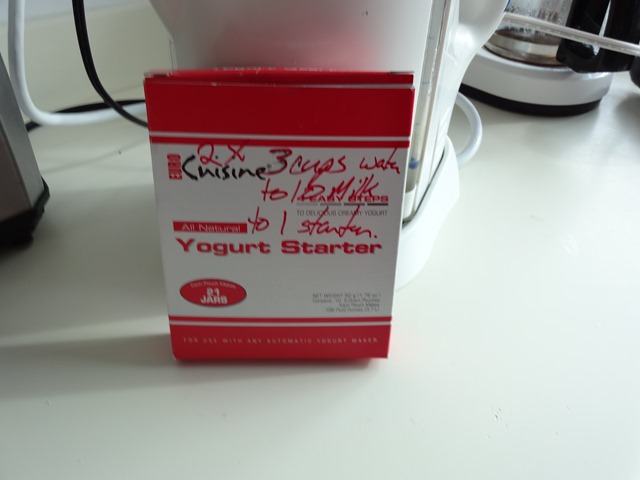
Yogurt Starter

We purchased yoghurt starter as part of our initial experiments to give us a standard to test our experiments. It turns out that you don’t really need it unless you can’t get plain fresh yoghurt easily.

Equipment

  • 2 1-kilo/liter containers (tupperware or recycled yoghurt containers are fine.  We recycled a large Skippy jar.)
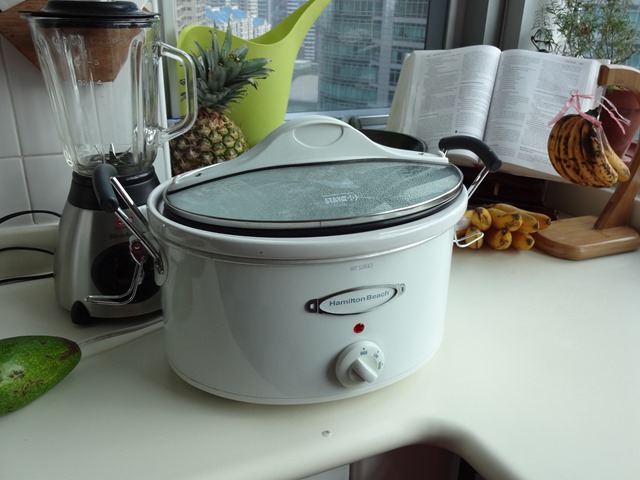
  • Large slow cooker (crockpot)
  • 2 large plastic jugs or bowls for mixing.
  • Wire whisk
  • Sieve
  • Small ziplock bag or tupperware container
  • 1/3 cup measure
  • Towel
  • Thermometer (optional, but recommended)

Method

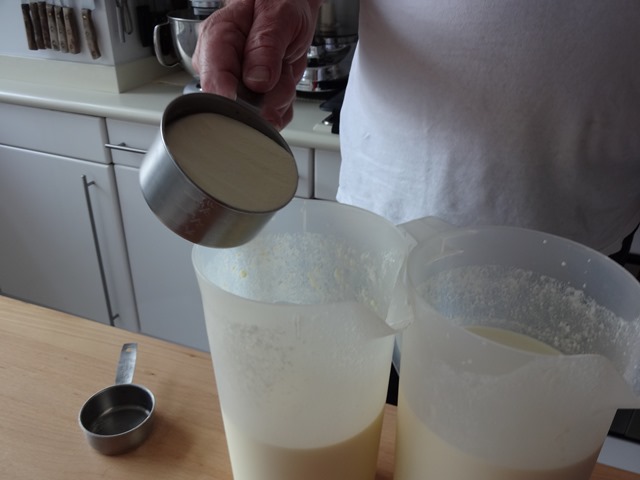
DSC00122 DSC00126 DSC00124

Pour milk(or water) into plastic jugs. Add 2/3 cup of milk powder to each jug and whisk.  Add half the yoghurt starter to each jug.  Mix well.  Finally add the sweet dairy whey to each container and whisk well.We like to use two jugs and pour the liquid back and forth to make sure both jugs have equally combined ingredients.

Pour the mixture through a sieve because at the bottom there are usually lumps of powder that did not mix in well enough.  You can pour the mixture directly into the yoghurt containers.  Because of all the powder you have added the volume will have increased to greater than 2 litres.  So pour the extra mixture into a small baggie or tupperware container.  This will be processed along with the main yoghurt containers but will become your yoghurt starter for your next batch.  Once its made, you can just leave it to cool down and put it in the freezer, ready for your next batch of yoghurt another time.

DSC00128 DSC00130

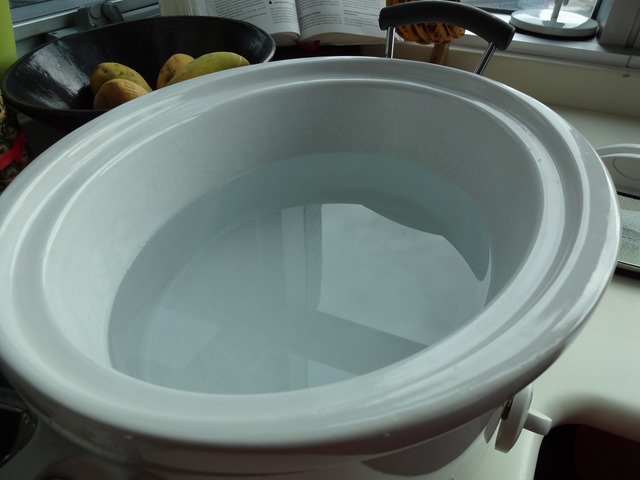
Put the yoghurt containers and baggie into the crockpot.  The crockpot should be no more than 1/3 full of warm water.

DSC00121DSC00132

Note our containers are too tall to fit into the crockpot to close the lid properly.  This is not a problem if you use a thermometer to keep track of the temperate and a towel to cover the top of the crockpot and act as a blanket.  You should try to maintain a temperature of 100 degrees Fahrenheit.  The minimum mark on our meat thermometer is 120 degrees, so once we see the temperature is getting near the 120 mark, we turn the crockpot off and let it sit for a couple of hours, keeping an eye on the thermometer and turning the crockpot back on again to bring the temperature up again.  This can be much easier if you have a hot area in the house that you know maintains a high temperature, or a crockpot that can maintain 100 degrees by itself.  Ours can’t and we are fighting erratic airconditioning in the kitchen.  With a little practice your get a feel for how long it takes and how many times you need to check the temperature.  Yoghurt making takes 4-8 hrs typically.  In the right temperature conditions, you can put it on before you go to bed and wake up to fresh yoghurt.

DSC00133 DSC00134 DSC00135

Hints and Tips

1. Always wash up the mixing equipment immediately.  The milk and whey powder traces turn to concrete on the sides of the jugs.

2. If you don’t want to purchase yoghurt starter and have yet to make your own baggie, you can use commercial yoghurt.  Most of them will say “live yoghurt” on the side of the container which indicates that it has the live culture to make your own.  The exception would be highly processed yoghurts, especially those that don’t need refrigeration.

3. If the yoghurt didn’t set, the temperature was too low.  If the yoghurt curdles the temperature was too high.  Try again with adjusted temperature controls.

4. Don’t expect to get it right the first time, but its also not that difficult.  Once you figure out how to control the temperature, the battle is won.

Cost and Quality

The flavour, texture and quality is vastly superior to commercial yoghurt.  Its worth figuring this out just for the improved product.  However the cost is also significantly cheaper.  Made with only water and skimmed milk powder, the cost is about $1.50/kilo.  Using UHT milk and dairy whey, the cost goes up to $3.00/kilo.  Compared to the prices that we are paying here for imported yoghurt, that’s a steal.  Imported yoghurt costs from $11-20/kilo here.

Donsol Whale Shark Adventure


Mount Mayon, Legaspi

Mount Mayon taken from the airport arrival in Legaspi. Hello big guy!

We set off a couple of weeks ago to Legaspi, about an hour flight away from Manila and home to the very visible, omnipresent Mount Mayon, an active volcano.  I was taking a group of 40+ people to see the gentle, giant whale sharks that pass through the Philippines at this time of year.  But I’m starting this post with Mount Mayon as its the first and last thing you see in Legaspi.  And it watched us all day as we hunted for the whales.  Its renowned for its perfect cone shape, and has erupted quite often in recent years.  This was the best picture I took as other days the clouds obscured the summit.

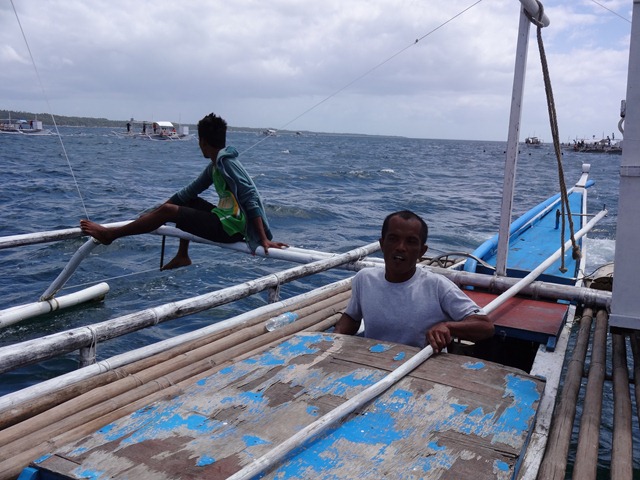
About an hour ride away from Legaspi, is the town of Donsol, where we stayed at the Vitton Resort.  There’s no much there except for a small town, and a resort built around the tourism from the Whales.  After a really early start, we arrived at the resort around 11am and headed out immediately for the first watch of the day.  Everyone was put in groups of about six on to traditional filipino bancas.  I was quite surprised how large and comfortable they were compared to other bancas I’ve been on, and there was plenty of room for six Western-sized passengers.  Plus we had a crew of four or five:  a captain, a spotter, a Butanding Interaction Officer (official tourist guide, Butanding being the filipino word for Whale Shark) and one or two lifeguards depending on the composition of the group.    The BIO guy gave everyone the swimming protocol, which involved listening to him, reacting promptly and avoiding the uncovered rudder underwater.  The spotter’s job was to spot the whales, although it was my impression they spent a lot of time watching each other too.  There was some secret signaling system where one spotter would see the shadow of a shark and all the other boats would be alert and head over, full speed, to that location.

Spotting Whale Sharks

Boatman and spotter in action

On that first day it didn’t happen very often.  We were out at sea for three hours, just puttering up and down the coast, watching another 25 boats doing the same thing.  We had a potential sighting twice, but the boats scared the shark away.  After a while, my eyelids started to get very heavy, and along with the 4.45am start, and the gentle putt-putt-putt of the engine, my eyes closed and I drifted into a nap.  So not much happened, but it was relaxing, good to be away from Manila and out at sea.

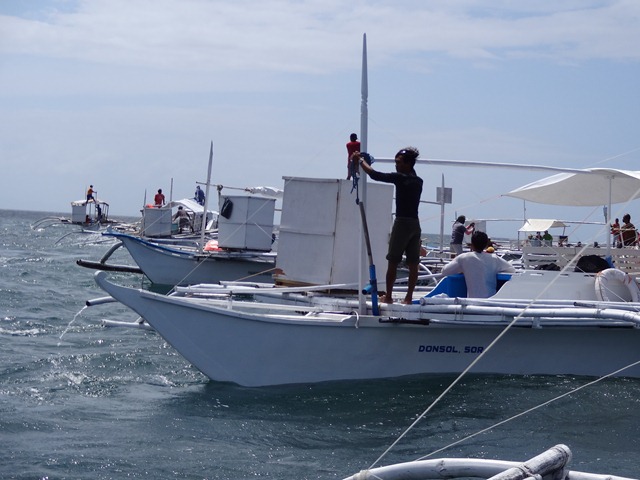
The next day I was primed for a really early start, as with nature, an early start is always best, right?  Well, not so here.  The word from the last few days had been that the later departures were seeing better sightings, and the whales were affected by other forces such as tides and the weather.  So, our departure was scheduled for 10.30am, and true to the recent pattern, the day was much more active.  After only half an hour the sightings began and ran continuously for the remainder of the three hours we were at sea.  A call would go out and all the boats would race over to the sighting:

Whale Shark Spotting

Shark alert! Everyone race over!


It got pretty congested at times.  I saw more than one game of chicken, as boats vied for maneuvering space in such close quarters.

Spotting Whale Sharks

Sometimes the boats got a little too close for comfort

Once the call had gone out for a sighting, the boatman put the engine on its highest speed and, as we raced over, our group had to get ready to jump in the sea.  On went the snorkeling gear and flippers, and at the BIO’s call, we settled on the side of the boat ready to jump in:

Whale Sharks

On standby to jump in the water

Then the BIO guy gives the signal to jump!  The boat is still moving and you hit the water running so to speak.  The water was quite choppy and the visibility was limited, because of the high concentration of plankton in the water that attracts them to the area.  I was still trying to figure out which way to go when one the lifeguards grabbed me by the arm, pointing ahead and telling me to swim hard.  Just as I got my face in the water, I saw it.  I huge,spotted mass, swimming a few feet underneath him.  I was able to keep up with him for about 30 seconds before he out swam me and disappeared into the cloudy water.  Thanks to him, I was the first person to see a whale from our boat.

It was an amazing day, very active and a little dangerous.  I could see the safety efforts were in place, but it was all too easy to get hit by a beam or someone else’s boat.  It was the very definition of organized chaos.  Here’s a little video that captures the sheer excitement/coordination/and chaos of it all:

So what’s all the fuss about?  I didn’t have an underwater camera, nor the skills to capture what I saw while I was working so hard at staying up with the whale.  But from others pictures on the internet, this most closely represents what it looks like when you’re out there:

shark1

Seeing the huge, spotted mass in the cloudy water


I’m also including this heavily photoshopped image from a tourist site somewhere, as it gives a good impression of the animals size in relation to a man.

shark2

I highly recommend the experience, but its not a passive activity.  You are beat by the end of the day!  The Butanding Tourist Office is a laudable attempt to put controls in place for both the whales welfare and the tourist’s safety.  I never felt mobbed or mistreated and we weren’t treated like cattle.  However, some of their own rules were being broken regarding the number of boats per whale because sightings have gone down in recent years, and I worry that so many boats make the experience less safe for us, less attractive for the whales, and potentially unsustainable if sightings continue to drop because of other environmental challenges.  But at least some effort is being made to balance the needs of man and nature.  An amazing weekend.

Sign Language: Think!


Filipino Public Information Sign

This informational sign was posted at the passenger ferry port in Dumaguete.  We were stuck there for over 2 hours and there was pretty little else to look at after a while.  Its not the first time I’ve seen a sign like this, especially in public places.  I think its a sneak peak into the prep talks that you see going on everywhere around the country at shift changes, and an important glimpse into the Filipino mind set on community responsibility.  It also reminded me of this sign I’ve seen around everywhere in Manila:

rotary filipino four way test

This sign gives its origin away.  Most of the ones I’ve seen don’t include the Rotary logo.  I kept seeing it over and over and wondering where it came from, until I finally figured it out thanks to the Google Oracle.  He’s a picture of Mr Rotary himself, holding the original 1943 sign.  I never noticed it around in the States at all, but its alive and well in Manila.

original rotary 4 way test

Bangkok Day 3: Exploring Chatnuchak Market and Continuing the Fabric Hunt


Chatnuchak Market

Shopping at Chatnuchak Market

Chatnuchak market is only open on weekends.  It opens early on Saturday and closes long after dark on Sunday.  I’d heard that it was THE place to shop for all thing Thai and touristy, as well as oceans of other things from kitchenware, to pets, to plants.  I had one day left in Bangkok and Robert was willing to come with me, so the market was the first stop on our agenda on Saturday morning.  I also heard it gets extremely crowded, and if you read my earlier post on crowds in Bangkok, you’ll understand my feelings on the matter. In this instance going early to the market was clearly going to help.  The question was how early?  The opening time was sort of loose, depending on who you listened to or the article you read.  I think we decided to leave for the market at 8am and see what it was like at that time of day.  We ended up taking a taxi, although the BRT is very simple and takes you right to the door.  When we arrived at 8.30am, the market was definitely open, not all stalls were up and running, but most of them were.  It wasn’t crowded though, and it was still fun to look around.  It totally recommend getting there early.

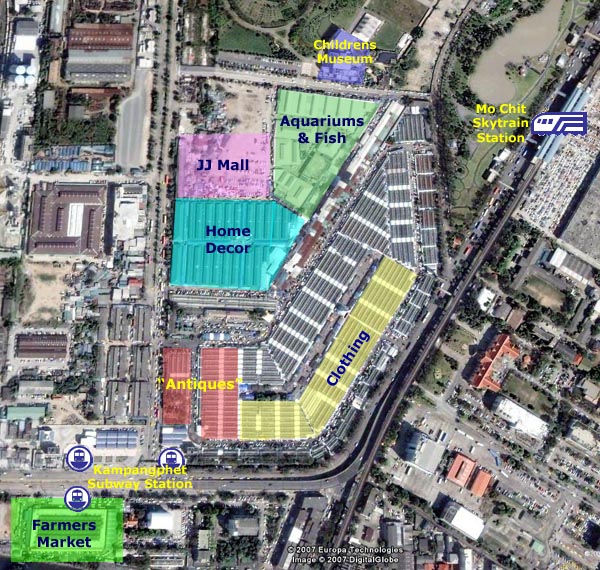
Chatnuchak is HUGE!  I think I read that it’s 30 acres somewhere, with claims of being the largest market in Asia.  I’m not sure if that’s true or not, but it very believable.  Its partially inside, under long covered aisles, and partially outside.  Thousands of small stalls line the rows, and its very overwhelming.  The experience is helped a little with the aid of a market map which is supplied from the information booths, and a numbering system which helps you navigate the different areas.  Stalls are grouped together by what they sell:  household goods, clothing, shoes, pets etc.  But it so easy to fall prey to “shiny object syndrome” and go off on a tangent and forget your original purpose.  But who cares, right?!  We wandered and shopped and wandered around some more.  There was just so much to see.

I had a bee in my bonnet about buying some cushion covers and I wanted something with the ubiquitous elephant motif on it.  Touristy I know.  But the Thai’s do it very well.  Lots of elephant-inspired everything to choose from and I got a very pretty sequined elephant design cushion cover for about $8.00 and a few other bits and pieces.  Robert was still looking for fabric.  We never found any there, but we hardly looked very hard.  There was too much stuff and too little resolve to keep going forever.  We took a break for a cold drink and Robert’s feet were killing him.  Opposite was a foot massage place.  Perfect.    He had a foot massage, and that bought me another half an hour of strolling and exploring.  I could have kept going but didn’t want to push my luck, and the place was starting to get more full, so we jumped in cab and headed back to the hotel area for lunch.

Birdseye view of Chatnuchak

Birdseye view of Chatnuchak

As we drove in a taxi on one of the major roads in the middle of the city, we noticed a stripe of orange in our peripheral vision.  Turn out to be a few monks….no, a long line of monks….no, a really, really long line of monks.  It took a while for the eyes and brain to register the enormity of it.  There were over a thousand of them (I later learnt).  Carrying only their sleeping mats, they walked barefooted on a path of flower petals, with devotees praying on the ground where they passed.  It was the most extraordinary sight.  When we got home I jumped on google and learnt that it was a devotional walk across Thailand from North to South.  We just happened to be in Bangkok at the same time they passed through.  Amazing!

Buddhist Monks

10001 buddhist monks on a devotional journey through Thailand

Our taxi was taking us down to the Chinatown and Indian areas of the city as my research for fabric suggested there was a lot to be found there.  We got out a a department store that was known for its fabric shops and looked around a little.  It was mostly everyday synthetics and cottons, nothing special, or uniquely Thai.  This memory we had from twenty years ago, just seemed to be be out of date.  We did stumble into the Old Siam Center, a shopping mall, for a look around.  We entered at the ground floor amid the food court, which looked pretty clean and fresh, and sold some interesting looking stuff.  The architecture and individual food stalls did have an old world feel to them.  I don’t think the center was as old as it wanted to appear, but it also seemed to be built much earlier than many other shopping malls I’d see, and was, perhaps, a bit outdated.

Old Siam Centre

Food hall at the Old Siam Centre

We wandered around for a bit. Looking down from the higher floors, the stall reminded me a little of Greenhills market, although more upmarket.  This place also had a fabric area.  Lots of beautiful silks and cottons.  If I had been having a fancy dress made, it might have been the perfect place to buy the fabric, but I was really just shopping for fun, and nothing really jumped out at me.  Also, at least 70% of the silks were sold by the yard in specific lengths with specific designs,  lending themselves to making a traditional Thai skirt or dress.  As pretty as all this was, this was still not we were looking for.  The fabric hunt ended there.  It wasn’t until I was at the airport and I saw some of the Jim Thompson designs did I realise that these were the fabrics that I wanted.  But the $300 price tag for a scarf was not.  Its nice to have something to look for as a way of exploring where you are, but the lesson is that things don’t always stay the same.  If there is a next time for me and Bangkok, I might just make a point of going to the Jim Thompson Outlet, which this time around I’d decided was too far out of town.

Old Siam Center

Looking down on the food area

There was probably a great place to have some Indian food around there, but with no local to show us around or even a guide book, we decided to head back to the business area near our hotel and get some lunch. It was a great decision because the business area was quiet on a Saturday and the lunch period was coming to a close.  We had a quiet Chinese lunch and headed back to the hotel.

McDonalds Thailand

I can’t imagine eating in McDonald while you are here on a short visit, but I guess people do. I liked the traditional hand greeting though. Even taxi drivers bowed this way as the opened the car door. I had thought it was just for tourists!

I enjoyed Bangkok and wish I’d had more time to explore the river or take a trip out of town.  But it was fun to stay for a few days and experience a nice hotel.  There may be other opportunities to come back as Thailand may prove to be a good R&R spot once we’ve moved to Nepal.  Especially as its a landlocked country, we may be missing the sea a little!  It was hard not to see Bangkok constantly through the filter of my experience of Manila, although I was aware that this approach wasn’t necessarily fair to either place.  Thailand is definitely ahead on making itself welcoming to tourists, and I wonder if in ten years time, Manila would have developed to this point.  I guess time will tell.