My Forever Disappearing View….


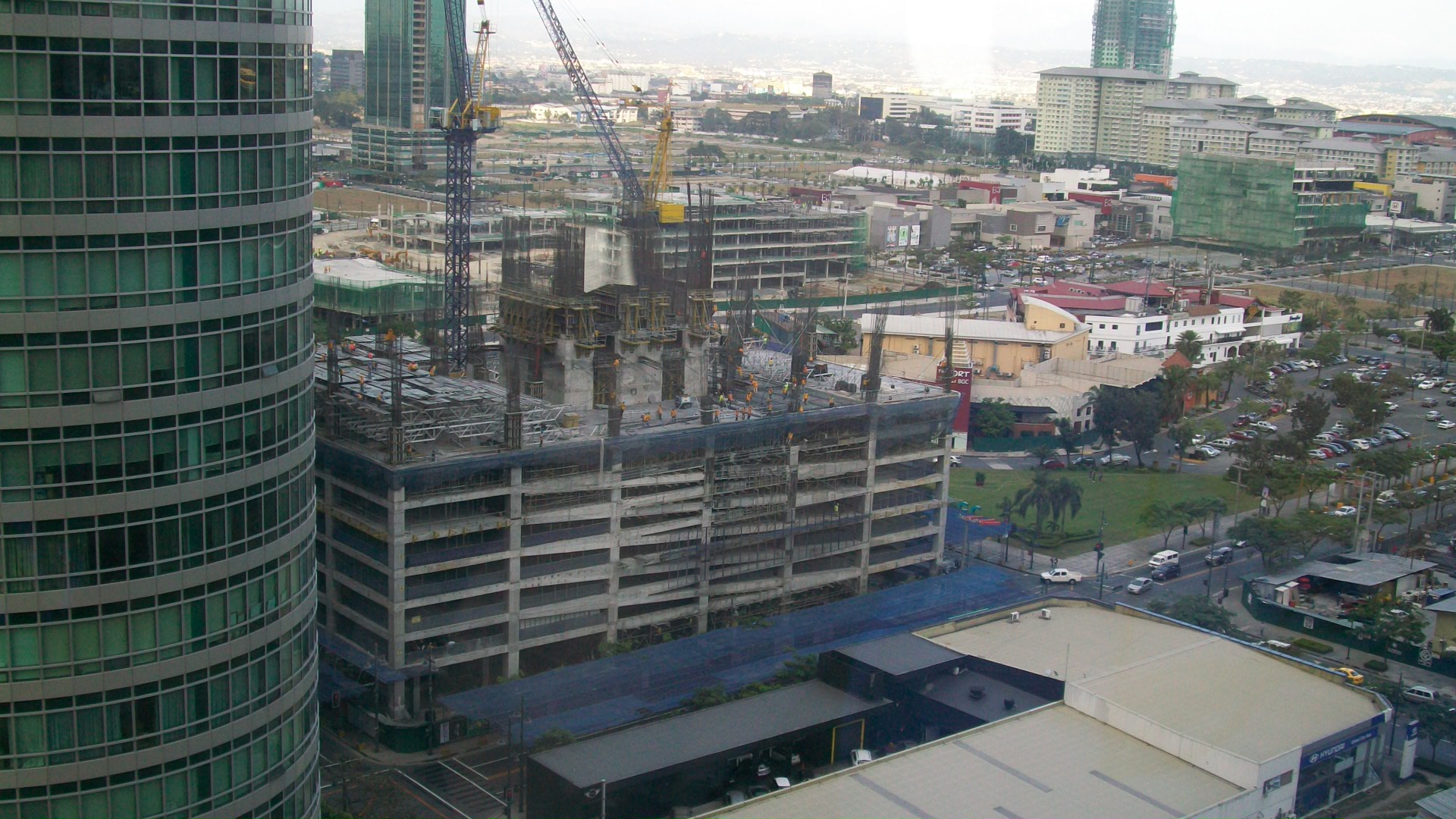
Whether I manage to blog or not.  While I sleep or while I eat.  While I watch or while I completely ignore it….the construction goes on.  Glimpse for a moment the view from window shown below at three earlier points in the last year or so:

December 2010

December 2010

Feb 2011

September 2011

September 2011


Now 16 months after our arrival, this is what’s left of my view:


March 2012

March 2012

A narrow crack between a bank and an office building.  That sneaky building on the right has edged its way up and up so it is now taller than the camouflaging building that it hid behind before.  Wonder how high it will go? Of course, if the car dealership in the foreground decides to sell out, it won’t matter.  The entire view will be gone.  Period.  However for the time being I can still see a strip of mountains and some of the Fort.  And even if they decide to level the car dealership tomorrow, surely there isn’t enough time to demolish, dig a basement, and build 20 stories to entirely block my view…is there?

Banaue Public Foot Bridge


Not sure if it warrants its own post, but it was kind of interesting and didn’t fit into any of our other tales….  so meet Banaue’s unique footbridge, which cuts off a good 20 minute walk from one side of the town to the other- by going directly from A to B — via a very large rice paddy filled ravine.

We first spotted it on the map on the day we arrived, and set out (in the wrong direction) to find it.  We, of course, failed and tried a second time that evening.  Failed a second time too…this bridge was well hidden…  However on our return visit, a third try was successful when we nipped down an alley next to the police station and caught site of it.

It was well used.  We watched locals move swiftly and deftly over the metal bridge, which swayed quite considerably with all the use.  We looked at each other to gauge whether or not crossing it would be a smart move.  After all the footing looked like this:

I remember thinking that the odds it would collapse the one time I used it were pretty slim, so we ventured out onto the rickety construction.   If Indiana Jones can do it, so can we!  With all the people coming and going, and the slippery, inconsistent bridge floor, I just couldn’t bring myself to use less than two hands and I certainly wasn’t going to take the camera out and take pictures.  So I did the best I could to capture the bridge from the safety of the other side:

Wow, did it ever buckle in the middle!  It wasn’t just the vibration from walking or the swaying of the wind.  The whole metal construction had warped, so midway you had a very distinctive sense of leaning to the left.  Scary stuff.  We arrived on the other side, just a little glad to be alive.  However, we were then faced with the reality as everyone else, now you’ve gotten there..you’ve got to go back (or walk 20 minutes around).  So back we went again – I mean, what are the odds, right?!

Caving in Sagada


Well camouflaged and hard to see, but the coffins are hanging midway down in the centre

Our trip to Sagada was part two of our travels in Northern Luzon last month, which I am unfortunately only getting around to writing about now. Sagada is about a 3 hour drive north from Banaue.  Its not really that far, perhaps about 50kms or 30 miles, but the roads are long and windy along the edge of the mountains, and a fair section of them are unpaved, or partially paved, so it takes much longer to go a short distance.  Originally we were scheduled to leave early the next morning to do the bumpy drive to Sagada, and then do the same 3 hr drive back to Banaue at the end of the day and then immediately take the 10 hour night bus back to Manila.  Sounds exhausting, right?  So with a little negotiation, we managed to turn our 3pm arrival back from the rice paddies into a 4pm exit for Sagada and started the journey out of town.  All went well until a flat tyre en route, which was fixed pretty promptly, but the 30 minute delay meant we arrived in Sagada after dark.  After quickly finding a room for the night, we managed a quick dinner before a local restaurant closed.  The hotel was reasonably clean and the room big – or “too wide” as our hotelier had warned.  We were the only guests in what had once been a fairly fancy governor’s house.  Of course, the obligatory visiting cockroach just had to make an appearance, but this time I got him with my shoe!

Early morning Sagada had plenty to see.  The Saturday market was in full swing selling everything from vegetables, to pig heads, to household items.  Fresh local yoghurt seemed to be the thing to have, judging from menus on different walls.  So we enjoyed it with fresh fruit, and very good it was too.

We were meeting our guide at 8.30am at the tourist office, but were still pretty vague about the day’s plan.  Caving and hiking in some sort of mix, we hoped.

Sagada is famous for its hanging coffins.  The local tribes didn’t believe in burying their dead, so they hung the coffins off the sides of mountains allowing the deceased spirits to be free.  Sort of a nice idea actually, unless you’re the person assigned to get the coffin up there.  Goodness knows how they managed it.  Our guide explained that it was a community effort, starting with a long procession.  The coffin was carried to the site and everybody participated in raising the body up to its precarious resting place.
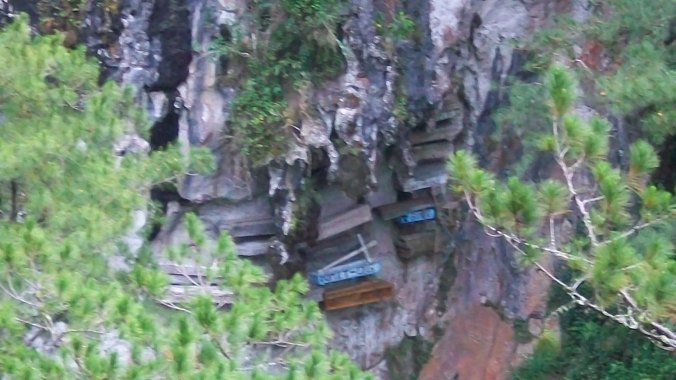
Wooden coffins camoflauging into the cliff face

The alternative to a cliff-side burial was a cave burial.  All over the countryside around Sagada are numerous burial caves, their locations kept secret.  But one or two are opened for tourists to view and our guide took us on a short hike to one of them.  This particular cave had many coffins piled on top of one another.  As our eyes adjusted to the light, more and more coffins appeared.

Most were shorter than the average human height because the dead were buried in the foetal position.  However, I noticed that some were a more standard shape, and our guide told us that coffins had also been brought in from different locations.  Coffin construction was simply a hollowed out log with a plank lid, held in place with a wooden toggle.  From the side, all piled up, they kind of looked like funny faces.

While we were discovering the coffins, at the back of the cave we watched a group of people gather with headlamps, kerosene lamps and ropes.  Our guide explained that the group were going to do the cave connection – a 3-4hr underground scramble from this cave to another one a few kilometers away.  I was curious.  I would sort of like to do that next time, as long as it wasn’t too taxing.

The stone steps at the cave entrance…about as far in as my camera would register

Our guide had a kerosene lamp too.  A big one – about three times the size of the usual kind you might use as dinner table lighting.  He explained that we were going into the cave and that after a while the steps would stop, and we would have to scramble over rocks to descend.  All the while, neither of us really knew what to expect.  I thought perhaps were being taken into a chamber to be shown a few stalactites and stalagmites and we would take pictures and come up.  We had in fact booked to go hiking, so at this point who knew..   Down and down we went in the dark, lit only by the kerosene lamp.  At the rear, Michelle was having trouble seeing the next foothold if the guide went a few feet too far ahead.  My all-terrain river sandals were quickly dubbed “no terrain” sandals, as I felt the potential of every step as a slip.   Sure enough, the stone steps stopped and the rocks began.  We descended into a chamber.  Our guide held his lamp above his head and we looked up.  You could sort of hear a high pitched noise, but the bats were so high you couldn’t make out individual animals, just masses of bats clumped together.  We descended further down and the smell of bat urine filled the air.  I tried to grab rocks without bat shit coating them, but it was slippery (because of said bat shit) and I grabbed what I could.  Better to be slimmed than fall…  We went down further and further.  You could hear voices and giggles from other cavers further down and the sound of running water.  Next our guide told us to remove our shoes.  We had now crossed the limestone and marble rocks and had arrived at the polished sandstone that was easy and safe to walk on with bare feet.  We walked through pools of cold cave water and Michelle took pictures of weird and wonderful rock formations.

Standing on a sandstone boulder in a rock pool in front of “curtains” – one of the amazing rock formations we saw.

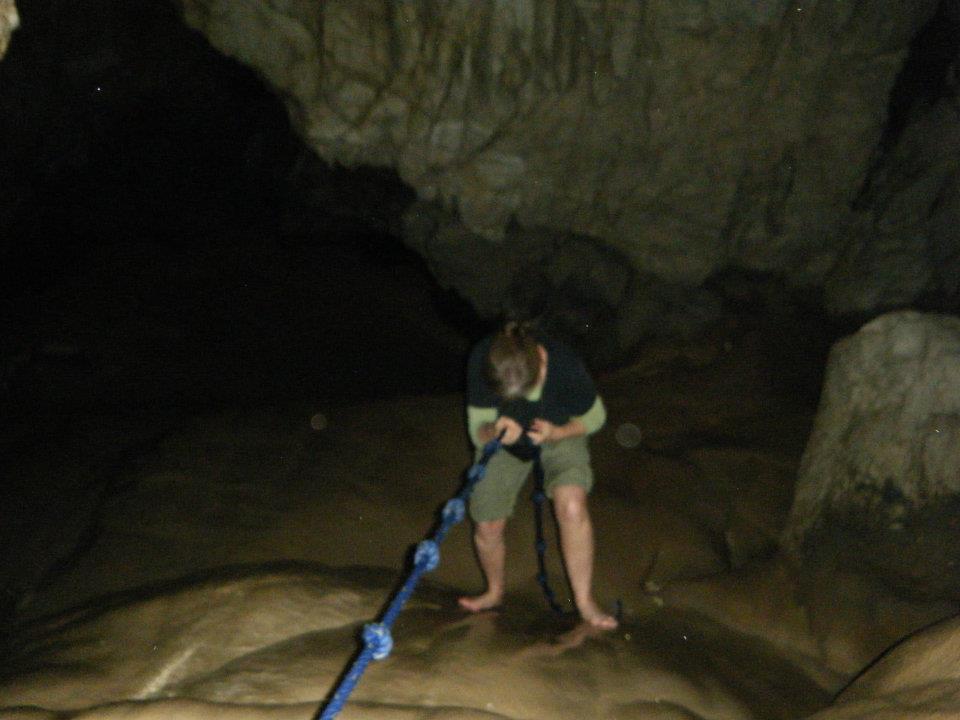
Rappelling down a boulder with a rope. The only caving “convenience” on offer during the whole caving experience.

On the other hand, as my camera flash was dead, I managed to take zero pics.   So without Michelle’s blessing I am stealing borrowing some from her FB page to bring this tale to life. Thanks Michelle!

We were in the cave approximately 2 hours and descended about 200 metres.  What made this cave experience unlike any other was that it was left completely natural inside. No gravel path ways, signs, concrete steps or taped music.  And no lighting….save the kerosene lamp.  Michelle had actually had the foresight to bring headlamps on the trip but then left them in the jeepney!  But that always seems to be the way with these adventures.  Its hard to know what to prepare for, what justifies the extra weight in your pack, and what to actually take out for the day.  But that’s part of the adventure I suppose, the unexpected!

Banaue and Batad Rice Terraces


While other people were settling down to Valentine’s Day dinners, my friend Michelle and I set out on a 4-day adventure to the romantic rice terraces of Banaue and Batad.  Taking the 8-9 hr night bus from Manila to the Northern part of Luzon was not something we were looking forward to very much, but was the only real choice if we wanted to see the spectacular terraces that the Filipinos bill as the 8th Wonder of the World.  Pretending to sleep upright on cramped seats we drove through the night until the 8am arrival in Banaue.  With a tad more energy than expected, we had the day free to explore the town, grab a quick nap, and take a short tricycle ride to the rice terraces viewpoint.

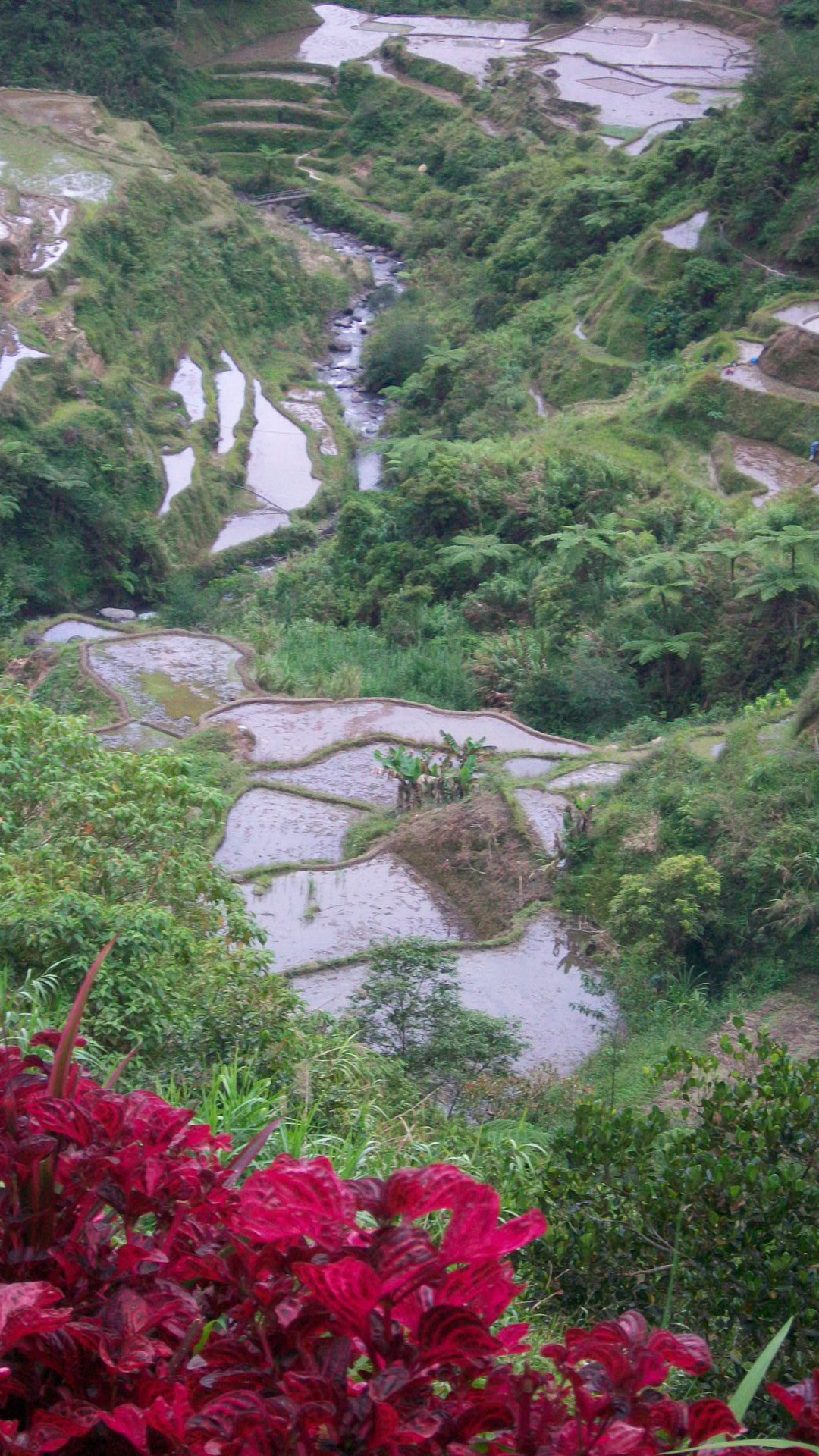
The terraces were everywhere and lived up to the many tourist posters that you see all over the Philippines.

From one of the viewpoints, they actually pointed out the view that is printed on the back of the 1000 Peso note.

That evening we ate an early dinner at the Greenview Restaurant, struggling to stay awake past 8pm.  Both lunch and dinner had been pretty good…fresh vegetables and decent choices that quite honestly I hadn’t expected in a such a remote area of the Philippines.

The next morning our guide picked us up and we transferred to Batad, via private jeepney, a journey of about 14kms.  With only partially paved and winding roads, unexpected roadworks and other obstacles, the bumpy journey took over an hour.  Our guide dropped us at the trailhead where it met the national road and we started our 45 minute descent down to the village of Batad.  An easy ramble. The biggest hiking challenge to date had been trying to get reliable or complete information on the kind of trails and hiking offered in the area.  Most of the guides and tourist offices have their preferred packages and it was hard to ascertain what was really being offered and whether or not we wanted what something different.  The fear was that hiking wouldn’t feature enough on the agenda and this easy walk made us a little suspicious that we might be right.

When we arrived in Batad we found it unspoilt, simple and charming in its own way.  It was a bit like stumbling on a secret place, a very small hamlet with about 30 buildings, a couple of hotels and restaurants and a handful of hikers.  The view from every position was of the rice terraces and we had an early lunch at our little pension and enjoyed it from their terrace.

View of Batad village

Al Fresco squat toilet (with views of terraces)

The accommodation itself was described as “basic”, a word which means different things to different people.  Here is meant a communal bathroom with no hot water; small rooms with only a bed, door and plywood partitions; ceilings that didn’t quite touch the walls, and a little wildlife (read: night time bugs and a visiting cockroach in our room.)  Not for everyone, but everyday living for millions that I could surely tolerate for one night in exchange for a rare opportunity to see such a special place.

In the afternoon we headed out for 2-3 hour hike to the Tappia waterfall.  I had been warned that it was a tough hike, and having not done any real hiking since 2010 in Arizona, I was feeling it!  We walked along the terrace walls, descending down the stone steps that helped workers travel from one terrace to the next. Up close we could see the rice paddies in their various stages of development.  Most were unplanted at this time of year, but many had nurseries with young seedlings ready to prick out in the flooded fields.

Nursery of young verdant shoots ready to be planted

Some were already planted for the season, and some were abandoned.  (Volunteer restoration is ongoing now to save some of the abandoned terraces that are starting to collapse.).  Once we reached the saddle and, after a short rest, we descended the steep slope on the other side of the mountain down to the valley floor.  Tappia falls came into view and I wobbled down the last 200 meters of steep steps as my legs started to seize up from 500 steep steps down.  We rested for about an hour to enjoy the water and cool down.

As you can imagine, the hike back was hard work, but actually a bit easier than the descent, helped by the rains that started as we began the trek back.  Beautiful views, a challenging hike and the satisfaction that we got to actually experience the terraces close up.  A wonderful experience.

Wild pink flowers grew up randomly on the terraces

On reflection….


Unless you are a devoted blogger – which it appears I am not — it seems to be that there are periods of time when you are so busy planning, doing, and figuring things out that blogging doesn’t really make it on to the to-do list.  Its not that other people don’t use their blogs to reflect, plan, and report on small (and large) fears and joys as they experience them–on the contrary–it just seems that I’m not that kind of blogger.  And, as a result, this blog starts to sit dormant and looking like it might have gone dark.

Its not that I don’t like reading other people’s experiences of bad hair days, flat tires, and unexpected joys as they unfold in their lives.  Just the opposite.  Some of the best blogs I follow share the intimate details of these events and make really good reading as a result.  Its just that I prefer to go away and plan, reflect and feel the fear of whatever it is that’s happening to me, and not post it on the wall for all the world 15 people to see.  I don’t feel the need to write it all down in private either, I guess I just work through it differently.

This is all a preamble to fact that I am kind of overwhelmed – in a good way — right now with the events of the next six months or so, and trying to make them unfold in an order that pleases me.  A recipe for disappointment, perhaps, but we have to at least have a stab at making us feel that we are masters of our own universe, right?  So the blog has been silent for a while as I am embroiled in a considerable amount of event planning that includes college tours for the summer, major surgery, new job opportunities, visits from family, trips to exciting new places, summer school placement and our annual trip to Greece.  Mixed in with all the daily responsibilities, IB demands, and work schedules, it makes me wonder how I ever worked full time.  Except that not too long ago I did.  And managed to sell our house and move our lives halfway around the world at the same time.  Its all doable, I guess, I am just less exhausted and overwhelmed by everything:  busy getting through the pile, just not on an never-ending hamster wheel of demands.   That’s as near to balance in my life as I can imagine.

So, in my attempt to not totally wimp-out on January altogether, I think I just wrote a reflective post about being a non-reflective blogger!  Who knew?!

I’m Dreaming of a White (Beach) Christmas….


Firstly, I know I got this a bit backwards – its usually Christmas before New Year I know- but it the spirit of my earlier mid-year resolution to hold consistency over perfection – here it all is and who cares about the order, right?!

We spent Christmas week in Boracay, world-famous for its 2-mile stretch of perfect white sand beach, crystal clear waters and beautiful weather.  And very beautiful it is too.  Here’s a classic promotional shot of the beach:

And it does look EXACTLY like that with two provisos:  this is the far end of the beach past all the noise and hullabaloo which we much preferred …and the sun needs to be shining to enjoy the blue skies and water.  It wasn’t when we arrived.  Christmas weather was overcast, gloomy and rainy or with the threat of rain.  This was kind of beautiful in its own way and kept the crowds away from the beaches.  It looked more like this:

We were warned it would be crowded at Christmas and it was – despite the weather.  The main restaurant and tourist section (Station 2) was heaving by 7pm and we had to shuffle single file past the shops and bars past slow-walking Japanese women wearing ridiculously high, spike-heeled evening shoes in the sand, every tenacious tourist peddlar known to man all selling exactly the same crap goods, large families with small children, loud crowds of young backpackers on an Asia odyssey, trading locals, Manila Pinoys and everyone else (and their mother)…  It was quite a scene.  We ate early, left early, and returned to our quiet cottage at the far end of the beach.  We were happy to enjoy the chaos for a short time and happy to get away.

After the rains stop around day 3, we explored around the island a little.  Boracay is very small.  A few miles long and less than a mile wide.  On the opposite side of the island is a smaller, quieter beach which is also the side of the prevailing wind, making it a great location for water sports.  When we visited the winds were still blowing strongly for the tail-end of the low pressure, and the kite boarders were out in full force.  It was amazing to see 200lb men taking off into the air like they were paper bags:

We stayed in a small, recently built private villa that was part of a native-style resort at the end of White Beach.  They were clean, new with a kitchen, bathroom, living space and bedroom:

It turns out that the thatched roofs are built in their distinctive style for reasons other than just aesthetic.  When it poured with rain and the wind blew, the umbrella of the roofs kept me dry enough to continue reading on the balcony of back porch.  Sitting outside reading, protected from the rain, watching the storm was as close as it came to experiencing the cosy, Christmasy feeling of watching the snow falling next to the fire…. a bit of a stretch I admit… but Christmas in the tropics takes a little extra imagination….

A beautiful place.  But next time I think I would prefer a smaller, beautiful beach (I hear there are many) and less people.  Working on that for Easter.

Masaganang Bagong Taon! (Happy New Year!)


The scene from the Manila New Year celebrations, as seen from the 54th floor (the roof of our building.)  Looks like the whole city is exploding….!

All the best to everyone for 2012.  Wishing you all a happy and healthy 2012!

Santa and his Workman Elves


It’s the Christmas party at the Facilities Maintenance Dept today and Latham and I decided to make a cake.

Christmas cake making used to be an annual tradition when my father was alive, as he loved fruit cake.  I would bake him one every year and spend a week decorating it with a different Christmas theme each time.  Then every night through the holidays and long beyond, he would slice off a little bit of the fruit cake after dinner and slowly enjoy it until it was all gone.  After he died, I had a small baby and no-one who truly loved it like he did…so the tradition mostly went away.  But it did leave me with quite a few sugarcraft tricks and skills, and this week Latham and I decided to put them to use and make a cake for Robert’s department Christmas party.  The theme was a natural:  facilities maintenance elves helping to construct a gingerbread house for Santa.  Latham was on it!  He designed the house and was a real partner in making layout and construction decisions.  We were a little limited on sugarcraft materials here in Manila, but were amazed what we could find in Gourdos, a gourmet cooking store across the street.  Unfortunately there were out of glucose, an essential ingredient to make modelling sugarpaste.  However, I found a stash from a wedding cake that I made a couple of years ago, and it turned out to be enough to make all the characters we needed.  (Its amazing what got packed in those kitchen boxes!)  We made power tools and screwdrivers, ladders and saws.  We even found chocolate rocks so the elves could construct a footpath.

I think we ended up with a very acceptable cake, but the most fun for me was that I got to do arts and crafts with my 16-yr old son again….it’s been a while!  And unlike arts and crafts with little ones, he was there for the whole process from conception to finishing touches.

Jolly Jeepneys


I don’t remember where I saw it, but I remember reading an insightful  commentary on the jeepney as a symbol of the Philippines.  I’m not sure I can do it justice, but I will attempt to repeat the gist of it here.  The article talked about the origins of the jeepney, jeeps inherited by Filipinos who, after the second world war, turned the beat-up abandoned military vehicles into something useful and unique.  Today the jeepney is essentially still a pile of old metal, often in bad need of repair, and held together with string and a prayer.  But with a touch of Filipino flair, some colorful embellishments and a healthy dash of optimism, the jeepney appears so much more than the sum of its parts.  Like Filipinos themselves, they make up for lack of substance with ingenuity, optimism and good humour.

And, yes, buses and metros are usually much more effective methods of transport.  Jeepneys clog the streets, carry limited numbers, and belch out polluting smoke into the already choking atmosphere. However, the metro here is woefully inadequate for such a large city.  I’ve yet to have a reason to use it.  Jeepneys, by contrast, are everywhere in Manila, in the provinces and on the islands.  Each one is unique and emblazoned with a personal message….anything from a bible quote to “Elvis is King”… expressing the owner’s faith, hopes or world view.

They are all individually owned. Routes are hand-painted on the side of the vehicle.  Passengers embark or disembark at will…there are no official stops.  Fares are cheap.  From a tourist perspective, they don’t offer much to see.  The small windows and inward-facing seats mean that it is difficult to see out.  They only hold about 20 (small) people at a maximum, but there always seems to be room for one more as the fares go straight to the owner-operator driver.  Yet they are the most colorful and attractive thing on most streets and I never tire of looking for my next favourite, really cool one.

Here’s a little humour on how to ride one around the city:

Waterfalls, Carabao Ride and Canoeing on Mindoro


Even though I liked the Coco Beach location very much, I’m never totally happy if I feel I am being coralled.  The resort is set apart from the town and has everything you really need to just stay there the whole time, but the instinct to explore is too strong and the family agreed to participate on a canoeing trip on the nearby river.  I had already been sea kayaking in Palau earlier in the year, and loved it!  Exploring the scenery at the slow pace of a boat was very inviting, so next morning we headed off on the resort-organized tour with a private jeepney and canoes strapped to the roof… off into the semi-jungle on the still tarmacked road.

The first stop was to visit the Tamaraw Waterfalls, which is touted as a major attraction near the town.  Attractive though they are, I am so glad we didn’t rent a car just to go see them.  By ourselves it would probably have pretty much been all we saw, we would have never found the subsequent stops scheduled on the tour, which turned out to be much more interesting.

Tamaraw Falls

Tamaraw Falls

Next up was lunch as at a place they called Hidden Paradise, and hidden it was indeed.  After about twenty minutes of driving on the main island road, the jeepney turned off onto a dirt road and continued for about another 30 minutes past coconut and banana groves, rice paddies, and cocoa trees to what I can only describe as a dead end.  Why had we been carried all this way to a field?  Moments later another jeepney showed, and a few small wooden carts pulled by carabao, the heavy beasts of burden that are so vital to South East Asian agriculture.  I vaguely remembered something about a carabao ride, and while I was still figuring out what we signed up for, we loaded into the cart.  Three adult males, plus me, plus the driver and the cart – we must have been close to half a ton – and the carabao set off.

Our carabao trek took us down small jungle tracks, across the shallow river bed numerous times and along the riverbank further for about half an hour.  I think I loved this part the most.  We saw unemployed carabao lazing in the river mud, more crops and farmers working in the fields, and coconut tree, after coconut tree…

Just as we saw our carabao was starting to flag, our destination came into view.  Hidden paradise lived up to its name: a pretty valley complete with waterfall, sculpted water-eroded rock pools, a pretty stream and bamboo shacks on shady banks where they were ready to serve us a barbeque lunch.  Our hardworking engine took a well-earned dip in the river, and we dropped off our stuff in the shade and headed over to the rocks.  Latham – rock boy – did his favourite thing in the world, climbing up the rocks and planning to jump from a safe spot.  Robert and I swam and floated in the surprisingly cold water.  It was a beautiful place.

Rocks eroded by rushing water

The obligatory rock jumping picture

Lunch was fantastic too.  It was probably the best meal I’ve had in the Philippines yet:  BBqed blue marlin, chicken, rice, salad, and excellent fresh fruit.  Proof that delicious does not have to be complicated.

Here’s a short video of the scene:

With full bellies we returned back another 30 minutes by carabao to the jeepney.  A short ride away was the river for our canoeing trip…1.5 hours downstream in the fast flowing water.  Ankle deep in some spots, neck deep in others, the banks were covered in reeds, silt, and the occasional grazing carabao.

The water was so fast and the river terrain so varied that I could not take my hand off the paddle for even a moment to take a sip of water. I learnt to watch the river ahead and try and spot obstacles before they were upon me, a skill I learnt the hard way.  A fallen tree, half submerged in the river took me out, and I capsized, turning the canoe over completely.  The river was just too fast, and I had been too slow to react.  But no harm done, and we all managed to arrive safely at the mouth of the river about 1.5hrs later.  I loved the river ride, but I wish our guide had been better.  He just paddle way out in front, frequently disappearing around a river bend well ahead of us and wasn’t around to help when we needed him.  Like the time a bunch of lively local kids decided it would be fun to jump into the river and hang on to the back of my canoe…talk about drag…I almost went backwards…  Fortunately, Robert was behind me and shouted them off.  The Palau kayak guide had been excellent and stopped frequently for us to regroup, letting the stragglers catch up and shared his knowledge on the flora and fauna.  This guy just wanted to get back to the jeepney asap.  The canoes were crap too.  The Palauan tour provided an excellent quality sea kayak, complete with backrest.  These were cheap, beaten up tourist canoes for renting by the hour.  Our backs hurt badly by the end.  The last downer was the water quality as the river broadened and we entered back into town.  It had been clean and drinkable upstream.  Here I didn’t even want to put my feet in it and would certainly never have entered the river if it had looked like that to start with…  Yet, despite these gripes, I really did enjoy the river ride, and the trip as a whole was well worth the investment of our time and money.  Anyone fancy another trip?